
Earlier this year, a teachers union-backed board majority overrode adopted budget cuts in favor of a proposal that was ultimately reversed after it threatened to cancel some after-school programs. In April, the same cohort ousted longtime Superintendent Kyla Johnson-Trammel. And throughout the year, the board majority has sparred with district staff about how to address a structural funding shortfall and years of declining enrollment.
That conflict escalated in October, when the board requested staff bring forward two budget proposals to cut $100 million in ongoing expenditures without closing or merging schools, or directly affecting students at school sites.
An initial proposal presented by Grant-Dawson last month identified $21 million in cuts within those bounds. To reach the $100 million figure, though, she said campuses would need to be impacted.
“We’re a school district. And a school district’s majority of its funds are in schools,” Grant-Dawson said at the time.
Since that initial proposal, Grant-Dawson said the senior leadership team had spent many long days developing two plans to realize the other $80 million in cuts necessary to stay solvent next year. She and Bellino had been the main editors of those documents, she said.
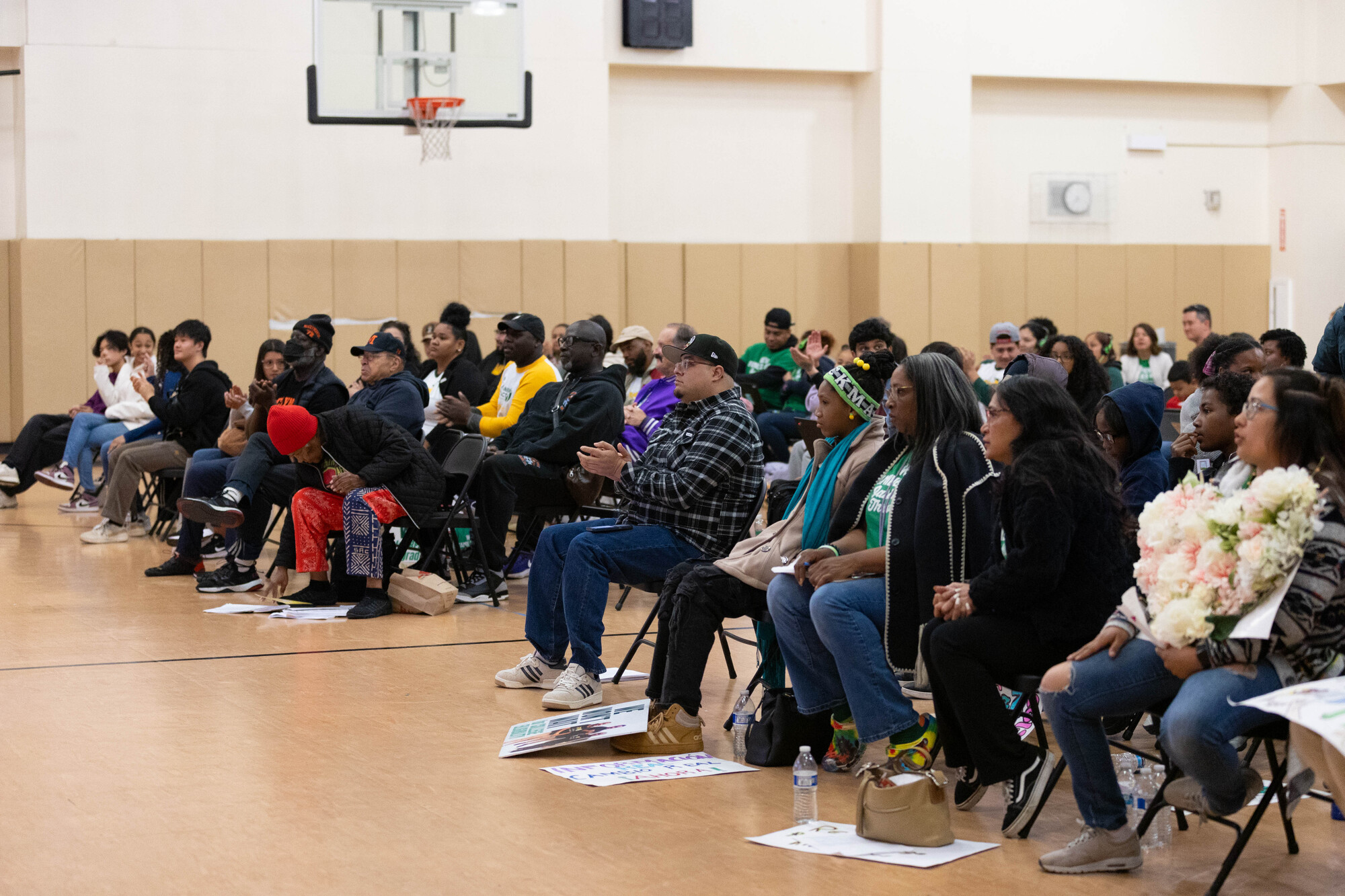 Oakland Unified School District parents, students and supporters attend a board meeting at Metwest High School in Oakland on April 23, 2025. (Gina Castro/KQED)
“We submitted the version we were working on. The whole team saw it and knew it was being submitted,” she told KQED. “I was notified that there was a change made the next day.”
The proposal that Saddler ultimately presented on Wednesday promises $102 million in cuts through major school site and administrative reductions. But Grant-Dawson said it lacks a roadmap that proves it can be implemented.
“There’s no math or evidence behind it,” she said, adding that she believes ultimately, the superintendent presented a plan that “she felt the board wanted.”
It accounts for a $20 million boost in revenue from growing attendance in each of the next two years. While the district has seen a 1.8% growth this year so far, it can’t guarantee efforts to recruit students will yield those results.
In addition to the $21 million in administrative cuts laid out last month, the proposal also recommends slashing another 15-20% of central office spending, and between 7.5-10% from each campus budget.
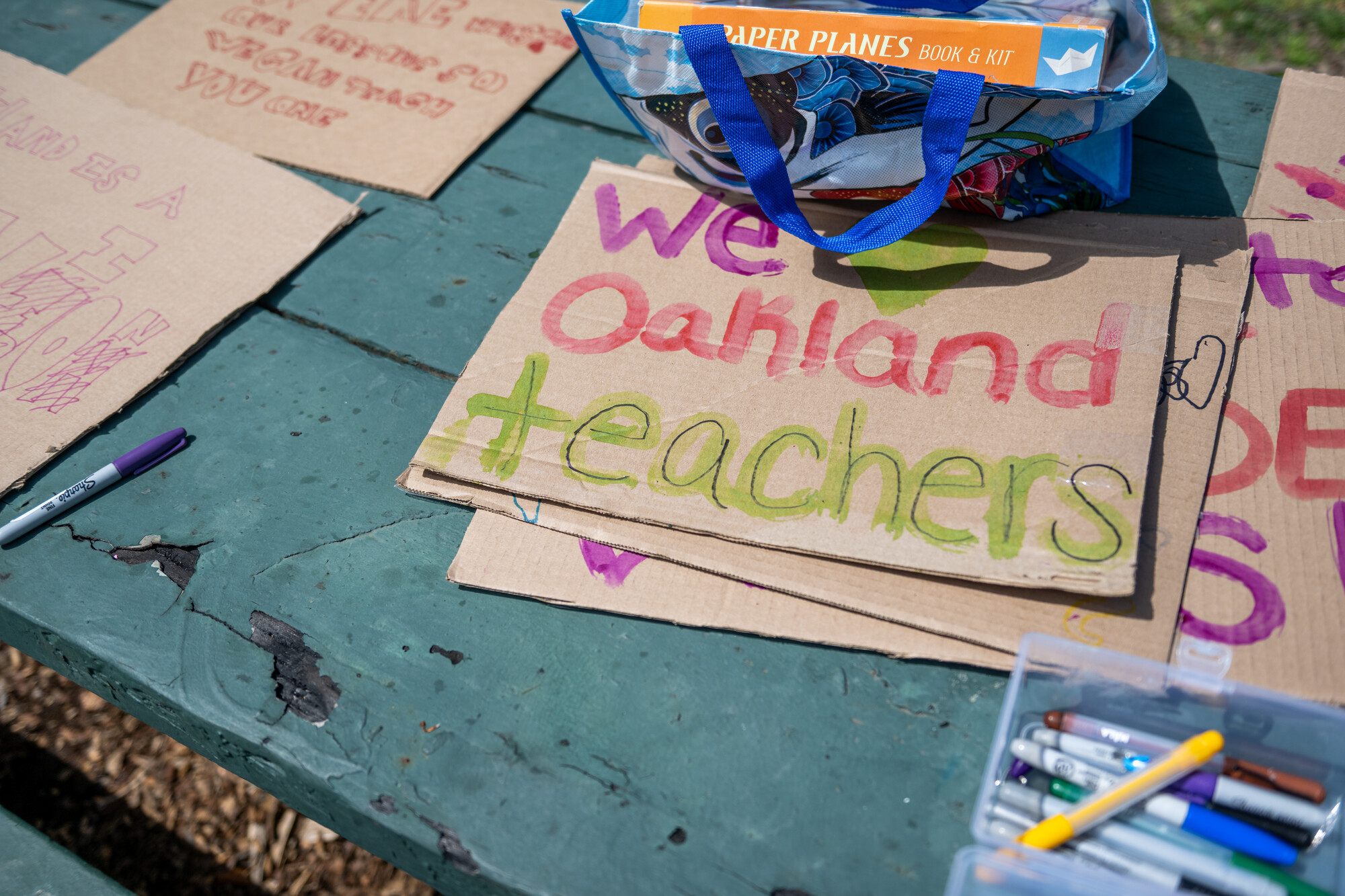 Oakland Unified students and parents make signs to support teachers at a ‘solidarity school’ in Diamond Park, Oakland, on May 11, 2023, during an Oakland Unified School District teachers’ strike. (Beth LaBerge/KQED)
To make such large reductions at school sites would likely require cutting programs or staff funded by restricted sources earmarked for specific purposes, which wouldn’t yield savings that can be reappropriated wherever the district sees fit.
Another line item reduces special education funding by “restructuring and reducing outside contracts, management, and programmatic elements,” but there is no description of what services and contracts OUSD could reduce while meeting its legal mandate.
“The reality,” Grant-Dawson said, is “you don’t have a list of $100 million that’s legit[imate].”
To make such large cuts to school site budgets, both Saddler and Grant-Dawson have said the district will have to rethink how many schools it operates.