
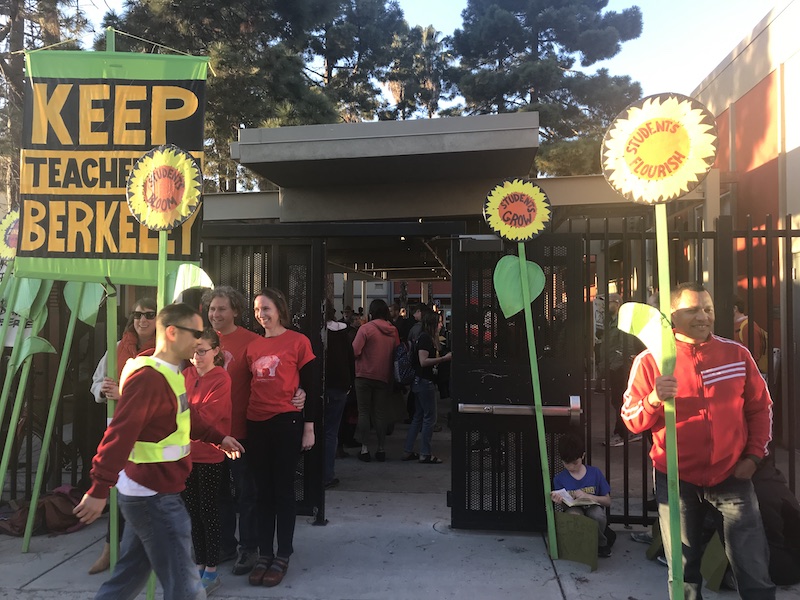
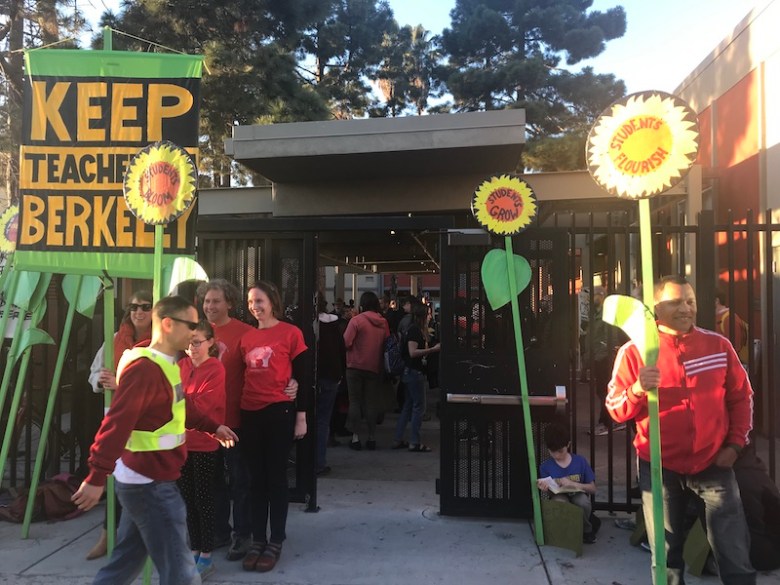
 Members of the union Berkeley Federation of Teachers meet before a school board meeting. File photo: Natalie Orenstein
This story, written by Diana Lambert, first appeared on EdSource. The version below contains additional reporting by Berkeleyside schools reporter Vanessa Arredondo.
From Los Angeles to Sacramento, teachers unions, many fueled by the “We Can’t Wait” campaign organized by the California Teachers Association and a slew of contract renewals, are rallying for higher pay, better benefits, smaller class sizes and other classroom improvements. Some are threatening to strike.
In the nearby West Contra Costa Unified School District, the call for improved pay and benefits, and classroom improvements, resulted in a six-day strike by the district’s 1,450 teachers that ended earlier this month. The teachers won an 8% pay raise over two years and will no longer have to pay health premiums.
The West Contra Costa strike is emboldening other teachers unions that are at an impasse with their districts over contract negotiations, including in Berkeley, where teachers began the year on an expired contract.
“This [WCCUSD] strike was a last but necessary resort to get their district to respond in a serious way to the very real needs of students and educators in their district,” Berkeley Federation of Teachers (BFT) President Matt Meyer said last week during the last school board meeting of the year. BFT represents more than 900 educators at the Berkeley Unified School District (BUSD).
BUSD and the teacher’s union declared an impasse in their contract negotiations in late November, adding to the number of school districts in the Bay Area and California where labor talks have broken down.
The district and BFT have met 17 times to negotiate a new contract since Nov. 20, without success, according to the union. BUSD Superintendent Enikia Ford Morthel said in a statement about the impasse on Dec. 2 that the district and union have had “many productive and thoughtful discussions,” and reached tentative agreements on 13 of 21 negotiation items.
“We are leading a historic wave of resistance to demand safe staffing, affordable health care and student-centered budgets, and local chapters are organizing to strike if needed,” said David Goldberg, president of the California Teachers Association (CTA). “Richmond showed us exactly what is possible: When we stand up for what schools educators and students deserve, we can transform public education.”
There are at least 14 school districts around the state that are at an impasse with teachers unions over contract negotiations. In addition to Berkeley, they are: Los Angeles Unified, San Francisco Unified, Oakland Unified, Madera Unified, Evergreen School District, Little Lake City, Upper Lake Unified, Duarte Unified, Newport-Mesa Unified, Oak Grove Union, Apple Valley Unified, Twin Rivers Unified and Natomas Unified.
CTA campaign ratchets up the pressure
Most of these districts’ unions are part of the CTA’s “We Can’t Wait” campaign, which has spent the last few years aligning contracts to end on the same date in order to add pressure on districts in areas where multiple unions would be negotiating and could potentially strike at once.
The campaign has also shared demands for smaller class sizes and caseloads for special education educators, and more counselors, nurses and mental health professionals in schools, as well as competitive wages and benefits to retain and recruit teachers.
School districts are largely pushing back on union demands, saying that with declining enrollment and rising costs, there isn’t enough money to pay teachers more. Teachers disagree, pointing to expensive outside contracts, high administrative salaries and ample reserves in some districts.
Now, teachers in several districts, including San Francisco Unified, Natomas Unified, Twin Rivers Unified, Madera Unified and Upper Lake Unified, have indicated — by vote or informal survey — that a majority are ready to strike.
Will Berkeley teachers strike?
Meyer said BUSD educators and district leaders will meet on Jan. 7 for state-mediated talks in hopes of reaching an agreement and averting a strike. He noted that although just one mediation day is scheduled, the process can continue beyond that.
A strike in BUSD would impact more than 9,400 students.
There is precedent for these labor efforts at BUSD, albeit decades ago. The last major strike by Berkeley Unified teachers was in 1975, when educators walked out for 33 days over program reductions and wage cuts triggered by a bookkeeping error that caused a budget deficit. The district had been integrated five years earlier, but striking teachers argued that wide racial disparities remained.
Presently, Berkeley Unified teachers and the district are negotiating a three-year contract that would have started at the beginning of this school year. Teachers want higher salaries and more robust benefits to reduce teacher turnover. Once agreed upon, the terms would be retroactive.
They also want manageable workloads and student-to-staff ratios for school psychologists, higher child-rearing leave benefits (from 25% of income to 50%), and contract language that addresses training and use of artificial intelligence for teachers.
“That is what is on our collective mind, and our district needs to come prepared next month, with solutions,” Meyer told the BUSD board. “In the words of the United Teachers of Richmond: ’Figure it out.’”
“*” indicates required fields