
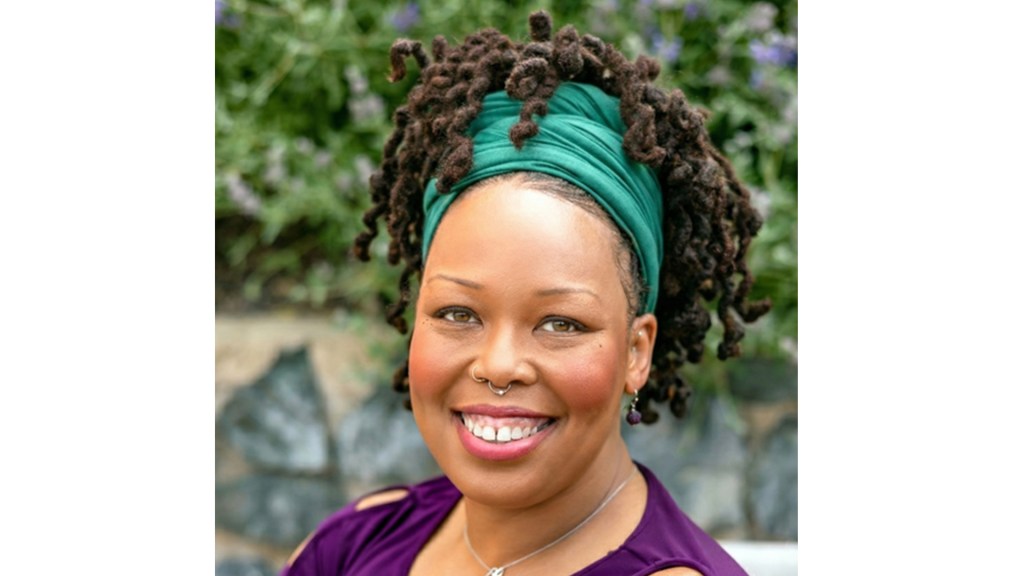
After a months-long search — and several years of leadership changes — San Diego Pride has hired KishaLynn Elliott as its new executive director.
Elliott will be the first Black lesbian to serve as the nonprofit’s permanent executive director in its more than 50-year history.
She will guide the organization through its flagship festival in July during San Diego Pride Month, as well as its year-round programming. The leadership change comes as the Trump administration and Republicans around the country have made rolling back LGBTQ+ rights a key part of their agenda.
In a statement Thursday, she said her work is rooted in “restorative justice, radical transparency and human dignity.”
“At this pivotal moment together, we have the opportunity to redefine what community leadership looks like,” she said in the statement. “To me, this work is about creating a sanctuary of belonging not only in July, but every single day, here in San Diego and worldwide.”
Elliott most recently served as the chief operating officer for the Monarch School Project, a San Diego-based nonprofit that supports education for unhoused students.
Bob Leyh, a former Pride staff member, said Elliott’s experience in San Diego will be beneficial for the role. “Hopefully she’ll be able to hit the ground running, being part of the community,” he said.
Elliott will start in the role in January.
San Diego Pride’s nationwide search began this fall for a position paid an annual salary of $190,000 to $210,000.
The new hire is one of several leadership changes at San Diego Pride in recent years. The organization has had five executive directors in the two years since longtime leader Fernando Lopez left in late 2023.
The nonprofit began this year led by Leane Marchese, who served as executive director for about eight months before stepping down in May. In the following months, two interim directors — Kristin Flickinger followed by Madonna Cacciatore — stepped in to fill the role.
Two new people, Joshua Dunn and Jordan Daniels, also joined San Diego Pride’s board of directors in September after three others left.
Dunn, who also serves as a community representative for County Supervisor Monica Montgomery Steppe’s office, said he wants San Diego Pride to be a place that’s welcoming for all, especially transgender people and people of color.
“We have to not just put marginalized voices in the conversation, but we have to center them — and we have to really dive into those experiences and figure out, as an organization, how do we uplift, champion and educate our community on those experiences,” he told The San Diego Union-Tribune in October.
Even aside from the leadership changes, it’s been a tumultuous year for San Diego Pride.
Criticism of the organization spilled into public view in late May, when a coalition of Jewish organizations called on Pride to remove Kehlani as its Pride Festival headliner. The singer, who is nonbinary, had been accused of amplifying antisemitism in their criticism of Israel’s war in Gaza.
The Jewish organizations and several elected leaders, including Mayor Todd Gloria, ultimately did not attend the festival.
The next month, a group of more than two dozen former and current Pride volunteers, staff and board members wrote an open letter detailing what they called the nonprofit’s lack of transparency and poor community engagement.
They also said the organization had moved away from year-round LGBTQ+ advocacy in favor of a focus on the annual parade and festival, which they found especially disappointing in light of the Trump administration’s targeting of the community.
“We want to make sure the community is heard, and we want the board to know that we’re watching, and we’re concerned with the direction that things appear to be going,” Leyh said at the time.
This week, Leyh said he’s eager to know how Elliott plans to reconnect with community members, especially Jewish ones, who did not participate in Pride this year.
“I hope that’s going to be one of her first tasks, to re-engage with the community and find a way forward,” he said.
To Dunn, the friction was a sign of community engagement and solidified why he wanted to join the Pride board.
“It might not have been in the tone of extreme positivity,” he said in October. “It was in the tone of awareness, and that is something that I appreciated.”
Klay Kilpatrick, a former San Diego Pride volunteer leader, said he’s glad there’s been turnover on Pride’s board and sees the hiring of an executive director as a step in the right direction.
But otherwise, he hasn’t seen much change in the nonprofit’s efforts since the group voiced their concerns this summer.
Most importantly, he said he still wants to see more of a commitment to the ethos of Pride 365 — with supported programming year-round — and a focus on activism and encouraging people to vote, especially as LGBTQ+ protections came under greater threat.
As he sees it, while the San Diego Pride board sets the vision for the organization, the executive director will play a key role in carrying it out.
“The priorities the executive director puts forth are going to tell me what the organization values,” he said. “It’s either going to be advocacy and education, or it’s going to be a festival and a parade. And at the end of the day, it should be both.”