
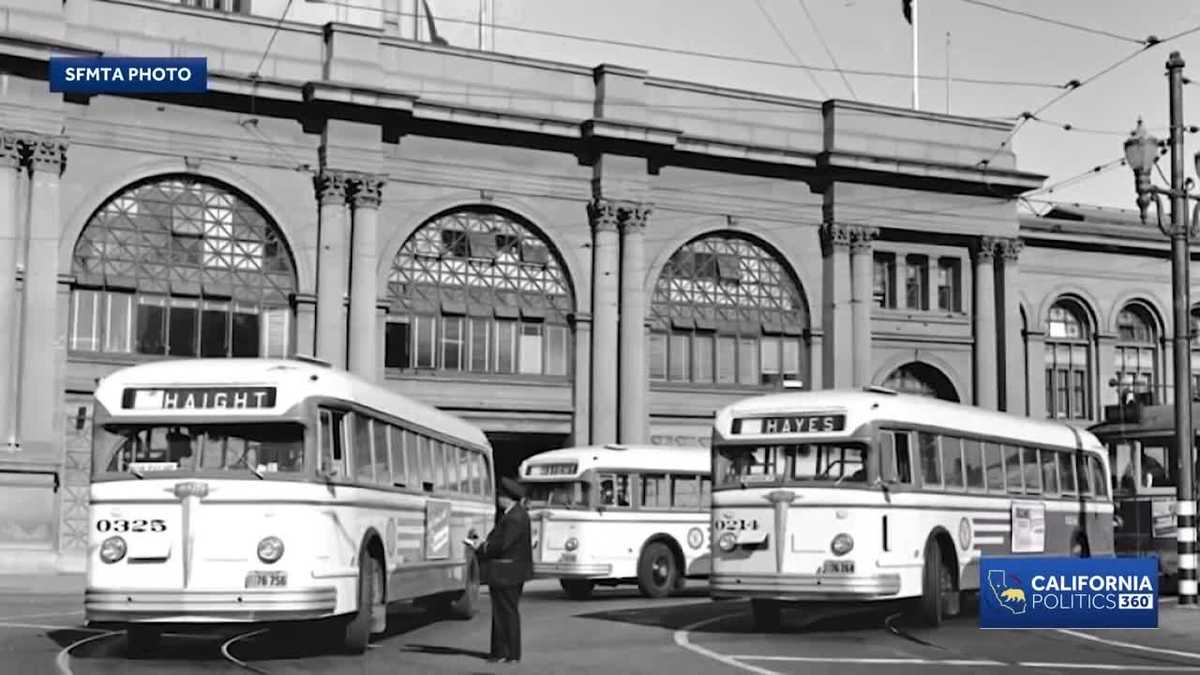
Next week marks 113 years since the San Francisco Municipal Railway began operating. December 28th, 1912, Muni ran its very first streetcar. Car number 1 up Gary Street with Mayor Rolfe at the controls and 50,000 people turned out to inaugurate this first publicly owned transit system. Well, guess what? They still own that very same streetcar. It still runs. Our nonprofit helped them get it restored, completely restored. Uh, for Muni’s 100th anniversary, and it still comes out *** few times *** year, uh, you know, for special service where the public can ride the same vehicle on the same places that their great grandparents rode.
‘Reshaped the direction of the city’: The history behind San Francisco’s MUNI | California Politics 360
December 28 marks 113 years since the San Francisco Municipal Railway (MUNI) began operating.

Updated: 8:25 AM PST Dec 21, 2025
December 28 marks 113 years since the San Francisco Municipal Railway (MUNI) began operating.”December 28, 1912, MUNI ran its very first streetcar, car #1, up Geary Street with Mayor Rolph at the controls,” said Rick Laubscher, the president of Market Street Railway. “50,000 people turned out to inaugurate this first publicly-owned transit system.”San Francisco was the first major city to create a city-owned and operated transit system. MUNI’s website says other publicly-owned transit services predate MUNI, but in smaller towns.”Every transit system in the United States was privately-owned. It was owned by people who invested in it to make a profit. San Francisco had passed a city charter in the year 1900 that advocated for ultimate ownership of public utilities,” Laubscher said.From that moment, it took 12 years for the San Francisco Municipal Railway to come to fruition. “They (MUNI) were much smaller than their privately-owned competitor, but they were aimed at expansion into parts of the city that did not have transit service yet,” Laubscher said.In 1918, MUNI connected the city with the Twin Peaks Tunnel, MUNI’s website states. Laubscher recalls the efforts MUNI undertook to reach the Sunset & Parkside district by creating a tunnel under Buena Vista Park.”They were able to open up a whole quadrant of the city, which was then just sand dunes, to become residential neighborhoods. In that way, they completely reshaped the direction of the city,” Laubscher said.MUNI’s website lists the 113-year history of the publicly-owned transit system.Families can still see the first streetcar in action on the streets of San Francisco. “It still comes out a few times a year for special service, where the public can ride the same vehicle on the same places that their great-grandparents rode,” Laubscher said. Market Street Railway helped restore Streetcar #1 for MUNI’s 100th anniversary. This story was produced for California Politics 360, which reports in-depth coverage of top California politics and policy issues. Get informed each Sunday at 8:30 a.m. on KCRA 3.See more coverage of top California stories here | Download our app | Subscribe to our morning newsletter | Find us on YouTube here and subscribe to our channel
December 28 marks 113 years since the San Francisco Municipal Railway (MUNI) began operating.
“December 28, 1912, MUNI ran its very first streetcar, car #1, up Geary Street with Mayor Rolph at the controls,” said Rick Laubscher, the president of Market Street Railway. “50,000 people turned out to inaugurate this first publicly-owned transit system.”
San Francisco was the first major city to create a city-owned and operated transit system. MUNI’s website says other publicly-owned transit services predate MUNI, but in smaller towns.
“Every transit system in the United States was privately-owned. It was owned by people who invested in it to make a profit. San Francisco had passed a city charter in the year 1900 that advocated for ultimate ownership of public utilities,” Laubscher said.
From that moment, it took 12 years for the San Francisco Municipal Railway to come to fruition.
“They (MUNI) were much smaller than their privately-owned competitor, but they were aimed at expansion into parts of the city that did not have transit service yet,” Laubscher said.
In 1918, MUNI connected the city with the Twin Peaks Tunnel, MUNI’s website states. Laubscher recalls the efforts MUNI undertook to reach the Sunset & Parkside district by creating a tunnel under Buena Vista Park.
“They were able to open up a whole quadrant of the city, which was then just sand dunes, to become residential neighborhoods. In that way, they completely reshaped the direction of the city,” Laubscher said.
MUNI’s website lists the 113-year history of the publicly-owned transit system.
Families can still see the first streetcar in action on the streets of San Francisco.
“It still comes out a few times a year for special service, where the public can ride the same vehicle on the same places that their great-grandparents rode,” Laubscher said.
Market Street Railway helped restore Streetcar #1 for MUNI’s 100th anniversary.
This story was produced for California Politics 360, which reports in-depth coverage of top California politics and policy issues. Get informed each Sunday at 8:30 a.m. on KCRA 3.
See more coverage of top California stories here | Download our app | Subscribe to our morning newsletter | Find us on YouTube here and subscribe to our channel