
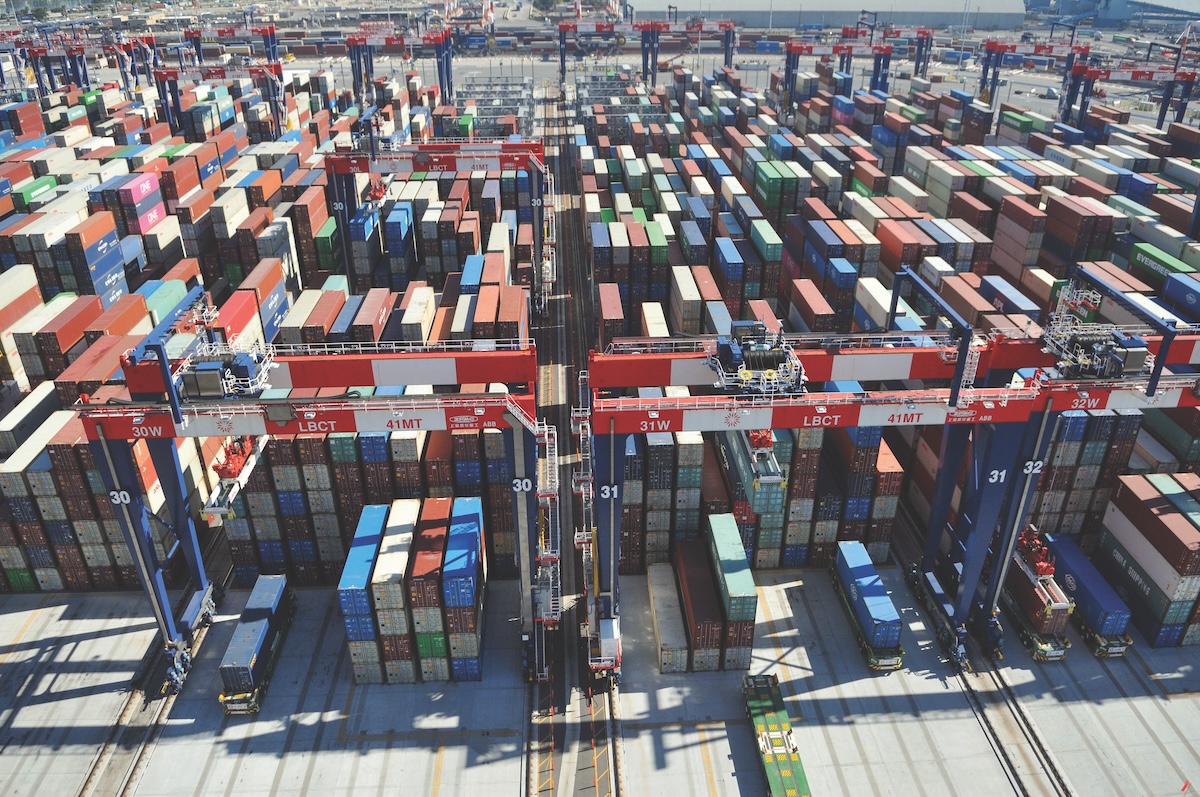
The cargo slide continues in the San Pedro Bay, but it probably won’t be enough to offset an otherwise prolific first half of the year.
The Port of Los Angeles in November processed 782,249 cargo containers at its terminals, while the Port of Long Beach handled 817,561 containers. The combined total of just below 1.6 million containers is slightly below an average month for the year to this point.
It also represents a four-month slide of year-over-year totals, as manufacturers and shippers settle into the new trade economics guided by the signature tariffs of President Donald Trump’s second administration. The early result of the new trade policies, of course, was that shippers raced the clock to get as much cargo here while it remained cheaper to import them – or before import taxes rose even higher.
“Even with all the trade uncertainty, we’ll finish 2025 north of 10 million TEUs, putting this year firmly in our top three of all time,” Port of L.A. Executive Director Gene Seroka said at his monthly media briefing. “All that cargo moved without congestion and not a single ship backed up.”
Dockworkers at the Port of L.A. handled 406,421 loaded import containers in November, a decrease of about 11% from the previous November. The Port of Long Beach also saw a drop, with its 400,505 loaded imports representing a 7.5% decrease.
Loaded exports similarly fell – 113,706 containers for L.A. declined by down 8% and 110,122 for Long Beach dropped 7.5%. The remaining containers consists of empties moving in either direction.
Even with the four-month slide, 2025 will broadly be a successful year for both ports. L.A. is projected to have its third best year in its history, while Long Beach is projected to set its all-time record – a figure recorded last year.
“Cargo moved at a steady rate with no congestion or disruptions at the Port of Long Beach as consumers, businesses and supply chain partners endured an extraordinary amount of uncertainty caused by shifting trade policies throughout 2025,” said Mario Cordero, who is retiring as the Port of Long Beach’s chief executive this month. “We will continue to move trade smoothly through the end of the year and look forward to a moderate increase in cargo for 2026.”
Through November, the Port of L.A. is up 1% and the Port of Long Beach is up 2.9%.
Once offloaded, cargo continued to leave the ports at a rapid clip in November.
Dwell times – the period between cargo being taken off ships and being taken out of the ports – were recorded by the Pacific Merchant Shipping Association as being 2.62 days for truck-bound cargo and 3.73 days for rail-bound cargo. Those are improvements from 3.1 days for truck-bound cargo and a whopping 7.67 days for rail-bound cargo the prior November.
Both times also are near lows for 2025.
“The November results demonstrate the continued reliability and resilience of our gateway,” said Natasha Villa, external affairs manager of the PMSA. “These dwell times reflect the commitment of marine terminals and supply chain partners to maintaining fluid cargo movement.”