
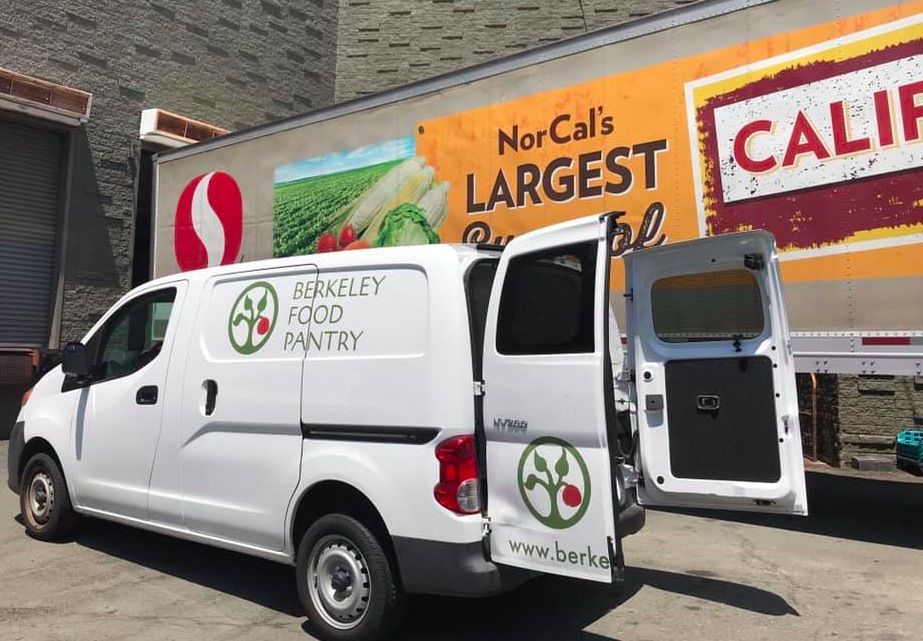
For 56 years, the Berkeley Food Pantry has been a lifeline for Berkeley and Albany residents facing food insecurity. Now, the service is set to end after failed merger negotiations.
On Dec. 3, Berkeley Food Pantry officials announced that the organization will cease operations after Jan. 31, 2026, with its last day of grocery distribution set for Jan. 30. The announcement comes after Nosh reported in July about a plan for the pantry to merge with the Berkeley Food Network (BFN).
In a joint statement released by BFN and the pantry’s oversight committee, officials stated that the two organizations mutually agreed to end merger negotiations and close the pantry. In the statement they say it became evident that the “structural requirements for a successful transition and continued operation of the pantry exceeded the current capacity of both parties.” The statement cited the recent government shutdown, surging need for food assistance, and lack of bandwidth among the church’s aging congregation as key factors for the decision.
The pantry, located at 1600 Sacramento St., has been operating out of the Berkeley Friends Church since 1969. In July, the California Association of Food Banks, estimated that over 175,000 people in Alameda County receive CalFresh (SNAP), but in a presentation shared with the Alameda County Board of Supervisors on Oct. 25, staff said that the number was closer to 179,000.
Delays in federal SNAP benefits during the recent 43-day government shutdown (the longest in U.S history) fueled record demand at food banks across the country. This year alone, Berkeley Food Pantry officials told Nosh that pantry visits reached 47,589, up from 34,778, — a sharp, 36% increase.
“Our objective in this process is to make sure that hopefully not a single person who has been relying on Berkeley food pantry for food will be surprised,” said Micah Bales, pastor of Berkeley Friends Church. “Hopefully every single person will have a good idea of what their next step is in terms of receiving food.”
For years, the pantry has housed volunteers from all walks of life — from teachers, to astrophysicists and everyone in between — creating a community rooted in care and service. While the closure has left food assistance seekers and pantry supporters alike reeling, the sudden decision has left others confused. Numerous people who volunteered, worked or interacted with the pantry, are calling into question the committee’s reasoning for the closure and the legitimacy of the merger plan itself.
Berkeley resident and longtime pantry volunteer, Jeanette MacMillian, voiced her frustration at the timing of the closure. She sympathizes with the church congregation’s exhaustion, but believes that closing now, as the U.S braces for a potential government shutdown in January 2026, would only deepen the food assistance crisis in Berkeley.
“My impression is that they’re an elderly and small congregation, and I think the pantry just really got away from them,” she said. “I just wish what could have happened was that the Quakers had gone to the community or the city and said: ‘Hey, we’re overwhelmed and we need help. We need organizational support, or a new site.’”
Bales understands the frustration, he said, noting that the decision was a difficult choice for all parties involved, shaped by years of discussion and the realities of rising demand.
“I think it’s a fair thing to wonder, because the truth is the demand has been steadily rising ever since the pandemic, and there have been conversations inside the church about this for at least five years,” Bales said. “But we’ve been running this food pantry for 56 years. We care about it a lot, and it was not an easy decision for us to lay down this ministry after so much time and so much spiritual investment.”
Several people familiar with the pantry’s internal operations said the merger negotiations appeared insincere, expressing confusion over why closure was presented as the only viable outcome. These individuals, who were not authorized to share internal deliberations, and requested anonymity over concerns about future job prospects, stressed that funding was not an issue, and questioned whether negotiations were pursued in good faith, suggesting the process foreclosed alternatives that might have allowed the pantry to remain open. Others likened the closure outcome to “getting every single answer wrong on a test”.
But the question on most minds was how a 16-month-long negotiation process unraveled in its final weeks. Despite the joint statement, many of the people Nosh spoke to doubted the explanation, noting that the Berkeley Friends Church and pantry oversight committee’s day-to-day role in pantry operations is minimal, and that the pantry’s three-person managerial staff were the real heavy lifters.
Some volunteers did propose that the pantry be transferred over to its current staff. Bales said the committee did initially explore that route, inviting staff to present a plan to run the pantry independently, but eventually found their proposal impractical, instead deciding that merging with BFN would be the more sustainable option.
“We also wanted to make sure we weren’t leaving any options unexplored,” Bales said. “And there was a proposal, and we sort of weighed it together with the exploration we were doing about the partnership with BFN, and the oversight committee decided that the better path forward was with the network.”
Regarding the pantry’s assets, Bales explained that the Berkeley Food Pantry is legally tied to the church’s nonprofit status, with donations restricted for food assistance rather than church operations. Those funds are maintained separately from the church’s general budget, designed for what the church defines as “food insecurity ministry” — a designation that will shape how the remaining funds are handled once the pantry closes.
“We do not have a plan yet as a church for what is going to happen with the residual money once the wind down has completed,” Bales said. “But whatever happens to that money, it is going to be for food ministry and making sure that we can reduce food insecurity. Whether that’s through a new program, donating all the money to one organization, donating money to different organizations, all that money is going to be treated according to the original wishes of the donors.”
But while Bale and Stowers characterize the negotiation conclusion as a mutual decision, Andrew Crispin, head of Berkeley Food Network, said the call largely came from the pantry oversight committee, not his organization. According to Crispin, once the government shutdown commenced and SNAP benefits were delayed, BFN saw a surge of community members visiting its pantries, a steep 40% increase that Crispin and his team couldn’t ignore.
“It made it very clear that as an organization and the community, we really needed to focus on the present moment and ensure our community was fed,” Crispin said. “I communicated to the church, who wanted to transfer ownership, that we needed to pause the negotiations and pick things back up in January so that we could get through the holidays.”
However, according to Crispin, shortly thereafter, pantry officials contacted him to terminate merger negotiations.
When asked about this, both Stowers and Bales remained adamant about the mutuality of the situation, stating that with both organizations stretched thin, it wasn’t feasible for either party to continue negotiations regardless of timing. With the plan for some staff to take over the pantry already deemed infeasible, the pantry oversight committee recommended to the Berkeley Friends Church congregation to end merger talks and close the pantry.
“For over a year, the oversight committee, which has consisted of [four] volunteers, plus me, the pastor. The committee was effectively acting in lieu of a director, and doing all of that work. Eventually, that just couldn’t hold,” Bales said. “[BFN] realized that logistically they were not in a position to continue negotiations, they were too busy feeding people. For us, knowing that, we also realized that we were beyond our capacity to continue negotiations, so we discontinued that process.”
Since the closure announcement, the pantry has been distributing fliers to pantry visitors informing them of the closure, but its central concern is sustaining its home delivery service — a bi-weekly grocery box delivery program launched in 2020 for residents unable to attend regularly scheduled distributions. Currently, the pantry is in talks with Alameda County Community Food Bank and BFN to see if they can assist to prevent service gaps after the closure.
“We’re hoping to work with the church leading up to its closure to understand how many community members they’re serving, and how they’re serving them, so that we have a better understanding of what the gaps are,” Crispin said. “And we’ll be working on a plan internally over the next eight weeks to make sure that we’re able to continue to serve community members at our Ninth Street pantry and other programs.”
For some, hope for the pantry endures. Retired teacher and volunteer Robin Franklin has been fighting to keep the pantry open since whispers of the impending closure made its way through the organization. Together with two other volunteers, she’s been hunting for another church that would be interested in taking over the pantry — identifying three potential leads so far. If all else fails, Franklin said she’s willing to buy a space herself to house a pantry, an expensive undertaking, but one that captures how far volunteers are willing to go to keep a decades-old Berkeley staple from fading away.
“Every volunteer that works there loves it. We all want to save the pantry.” Franklin said.
For more information on Franklin’s efforts, email her at: lobzii@gmail.com
“*” indicates required fields