
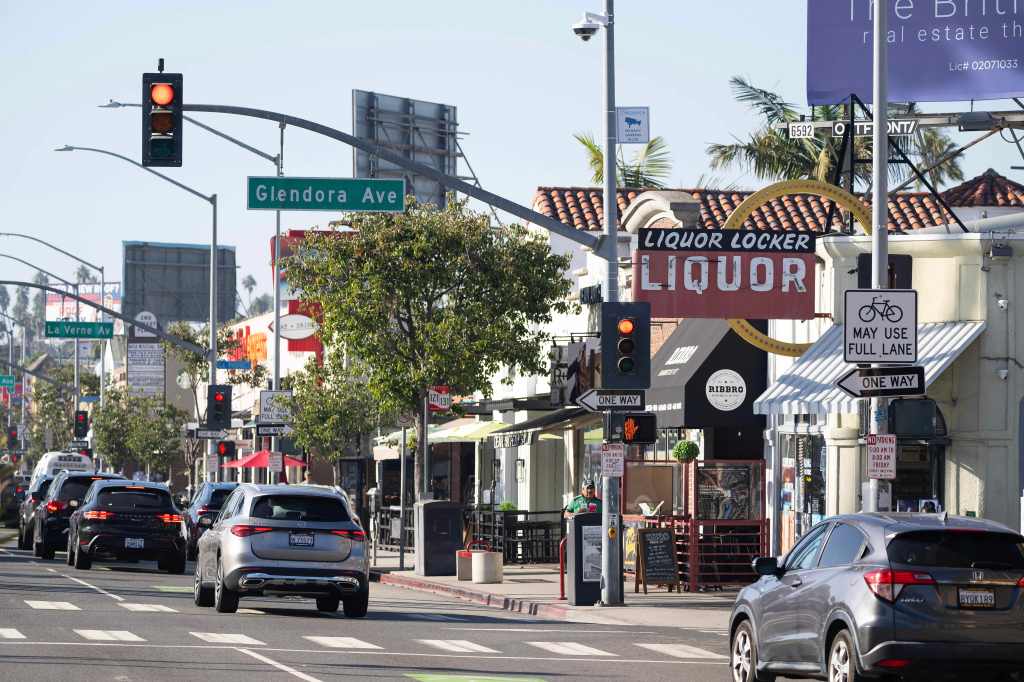
Long Beach will launch its pilot program for automated speed enforcement next year, city staff shared last week.
City Council unanimously approved the implementation of the pilot program along several city streets where city data identified as necessary during its Tuesday, Dec. 16, meeting. City leaders said that they hope this program will help reduce speeding and traffic fatalities.
The cameras for the automated speed enforcement are anticipated to be installed and operational by fall 2026, according to city staff.
Long Beach’s decision to install these cameras was because of Assembly Bill 645, which was signed into law in 2023 to address the persistent problem of excessive speeding and the associated rise in serious and fatal collisions throughout California, according to the staff report. The legislation authorized a limited pilot program for the use of automated speed safety cameras in six California cities, including Long Beach, for a maximum of five years up to Jan. 1, 2032.
Other cities selected for the pilot program are Los Angeles, San Jose, Oakland, Glendale, and San Francisco – each authorized to deploy a designated number of device locations proportionate to the city’s population.
The legislation permits deployment of up to 18 speed safety cameras throughout Long Beach to address excessive speeding along high-injury corridors, while expressly prohibiting the deployment of enforcement devices on state highways, according to the staff report.
City Council approval was required to adopt the Speed Safety System Use Policy and Speed Safety System Impact Report in accordance with state law. The Use Policy defines the amount and type of data to be collected, data retention policies, and security protocols. It also details staff training practices, rules prohibiting the exchange of an individual’s information with law enforcement, and opportunities for reduced fines and diversion programs, according to the staff report. The Impact Report contains maps of the device locations, an explanation of how the locations were selected, the citation process and fees, and discussion of the estimated program cost.
The draft policy and report were made available on the city’s website for public review on Oct. 3, and an overview of the program and both documents were publicly presented to the Mobility, Ports, and Infrastructure Committee on Oct. 7, said Josh Hickman, director of the Public Works Department. In addition to the public feedback received at the committee meeting, as of Nov. 7, 98 public comments were received through the program website.
The automated speed enforcement cameras will capture the date, time, location, speed and photo of the rear license plate of speeding cars, Hickman said, and the cameras will not capture any facial information. All locations will also include advanced speed limit signs, speed feedback signs, and notices of approaching enforcement zones, providing sufficient time and roadway length to reduce speeds safely.
“That information is saved only as necessary to process any citations or appeals, and not shared with any other outside (law enforcement) agencies,” Hickman said during the council meeting. “The system is designed to complement, not replace, our other traffic safety strategies that we have out there or our traffic calming initiatives. We’re really intending to promote this as a transparent program that helps address and lower speeding for all community members, consistent and impartial speed enforcement with a 10-mile-per-hour buffer.”
Long Beach used a data-driven, needs-based approach to prioritize speed safety system locations. Nine sites were selected on the high-injury network based on weighted factors, such as racing frequency, school zone presence, crash severity, and excessive speeding.
Nine additional sites, evaluated based on similar weighted factors, were chosen to ensure geographic equity citywide and to minimize overlap, ensure a balance, systemwide deployment, according to the staff report. Segments with high-quality transit, truck routes, or other geometric design constraints that limit conventional traffic calming treatments were given extra consideration.
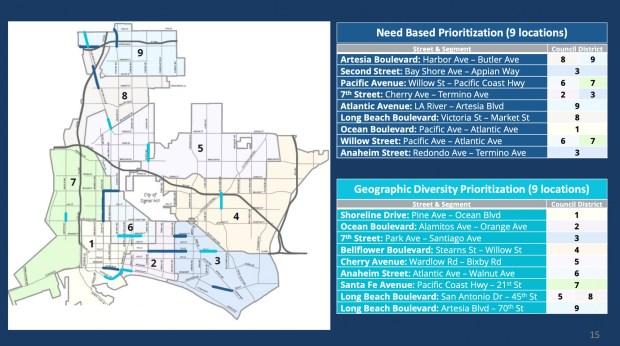 Long Beach will launch its automated speed enforcement pilot program at 18 locations across the city in the fall of 2026. (Photo courtesy of the City of Long Beach)
The nine need-based prioritization locations include Artesia Blvd. from Harbor Ave. to Butler Ave.; Second St. from Bay Shore Ave. to Appian Way; Pacific Ave. from Willow St. to Pacific Coast Highway; Seventh St. from Cherry Ave. to Termino Ave.; Atlantic Ave. from LA River to Artesia Blvd.; Long Beach Blvd. from Victoria St. to Market St.; Ocean Blvd. from Pacific Ave. to Atlantic Ave.; Willow St. from Pacific Avenue to Atlantic Ave.; and Anaheim St. from Redondo Ave. to Termino Ave.
The nine geographic diversity prioritization locations include Shoreline Drive from Pine Ave. to Ocean Blvd.; Ocean Blvd. from Alamitos Ave. to Orange Ave.; Seventh St. from Park Ave. to Santiago Ave.; Bellflower Blvd. from Stearns St. to Willow St.; Cherry Ave. from Wardlow Road to Bixby Road; Anaheim St. from Atlantic Ave. to Walnut Ave.; Santa Fe Ave. from Pacific Coast Highway to 21st St.; Long Beach Blvd. from San Antonio Drive to 45th St.; and Long Beach Blvd. from Artesia Blvd 70th St.
City Council also needed to approve for Long Beach to enter into a contract with Verra Mobility for the furnishing and installation of the enforcement cameras at the 18 locations, maintaining those systems and equipment, providing an event processing system and printing/mailing services to support the enforcement activities for the five-year pilot period, according to the staff report. The total cost of the contract with Verra Mobility will not exceed $5.6 million.
City staffers reviewed cooperative agreement options and determined that the contract between Oakland and Verra Mobility provided the best value to Long Beach, Hickman said, which will help roll out the program much faster.
The fines from the automated speed enforcement cameras will start at $50 for driving 11 to 15 mph over the speed limit, with the first violation being a warning; $100 for driving 16 to 25 mph over the limit; $200 for driving 26 mph or more over the limit; and $500 for driving at a speed of 100 mph or more.
The city may provide low-income individuals with a payment plan, according to the staff presentation. It may also reduce fines by 80% for people receiving assistance such as Medi-Cal and SNAP, or by 50% for people at or below 250% of the poverty line. The city may also offer a diversion program allowing community service in lieu of payment.
“The revenue itself will be used specifically to pay back the cost to roll out this program,” Hickman said, “and then any additional revenue that is above and beyond that will be utilized for traffic calming throughout the city.”
The annual operation costs for the program are approximately $1.6 million, and an overall program cost of $8.9 million over the five-year pilot period, Hickman said.
The pilot program for the automated speed enforcement cameras aligns with Long Beach’s Safe Streets and Vision Zero plan. Safe Streets Long Beach is an initiative to reduce traffic-related fatalities and serious injuries to zero by 2026 and is guided by Vision Zero, a road safety philosophy that states that no loss of life due to traffic collisions is acceptable, according to the city’s website.
By reducing vehicle speeds along these high-risk corridors, the automated speed enforcement significantly lowers the likelihood of fatal and life-altering injuries, particularly for pedestrians and bicyclists, who are most vulnerable; thereby, maximizing the program’s effectiveness and advancing the city’s Vision Zero goals, city staff said.
Speed is the leading factor in the severity of crashes, city officials said. At 20 pmh, there is a 13% likelihood of a pedestrian fatality or severe injury, according to city data. At 30 pmh, that likelihood increases to 40%, and at 40 mph, it increases to 73%.
City officials said that there has been a slight increase in traffic fatalities this year. There have been 50 traffic fatalities year to date, according to the Long Beach Police Department, compared to 40 deaths in 2024 and 36 deaths in 2023.
“I know there’s enthusiasm here on the public side and city council side; I think the timing couldn’t be better,” Mayor Rex Richardson said during the meeting. “This pilot project we’ve talked about for quite some time, this is something that’s incredibly important. I’m glad the entire city will benefit, and that we’re finally in a place to see this program roll out in the new year.”
Councilmembers shared similar sentiments on the need and urgency for this pilot program to begin, and asked the city to be thorough in their communications about the program with residents and continue to report back to the council with data on how it’s working.
“I think that there’s just a lot of interest because we’ve all experienced it when we’re walking in our neighborhoods, crossing the street, people are driving faster,” Councilmember Suely Saro said. “We’ve taken various approaches and what makes this so appealing is that it’s taking a preventative approach and opportunity for awareness.
“Our residents want to feel safer, that they can walk the streets, because many of the most tragic stories are people who are sitting at bus stops or they’re on sidewalks – you would think that you would be safe if you weren’t on the reload and that is where people are terrified,” Saro added. “That really shouldn’t be the case and this pilot really is an effort on our end to show that we’re taking action to make sure that we address it and reach our Vision Zero plan.”
Long Beach City Council unanimously approved adopting the Speed Safety System Use Police and Impact Report, the contract with Verra Mobility, and increased funds to move the automated enforcement system pilot program forward.
The next steps for the pilot program, according to the staff report, will be to install speed feedback signs and conduct speed counts in early 2026; begin device and additional signage deployment, and a minimum 30-day public information campaign in spring; activate the system and a 60-day warning period during the summer; and finally citation period beginning in the fall.