
When rates of hunger climb, every dollar matters. That reality drives two Sacramento-based organizations to pool resources in an effort to meet a growing regional food insecurity crisis.
Sierra Health Foundation and United Way California Capital Region have begun a Match for Meals campaign promising to match donations to five regional food banks. The organizations will match every donation up to $300,000, with Sierra Health Foundation matching up to $200,000 and the United Way up to $100,000. The campaign runs until Jan. 31.
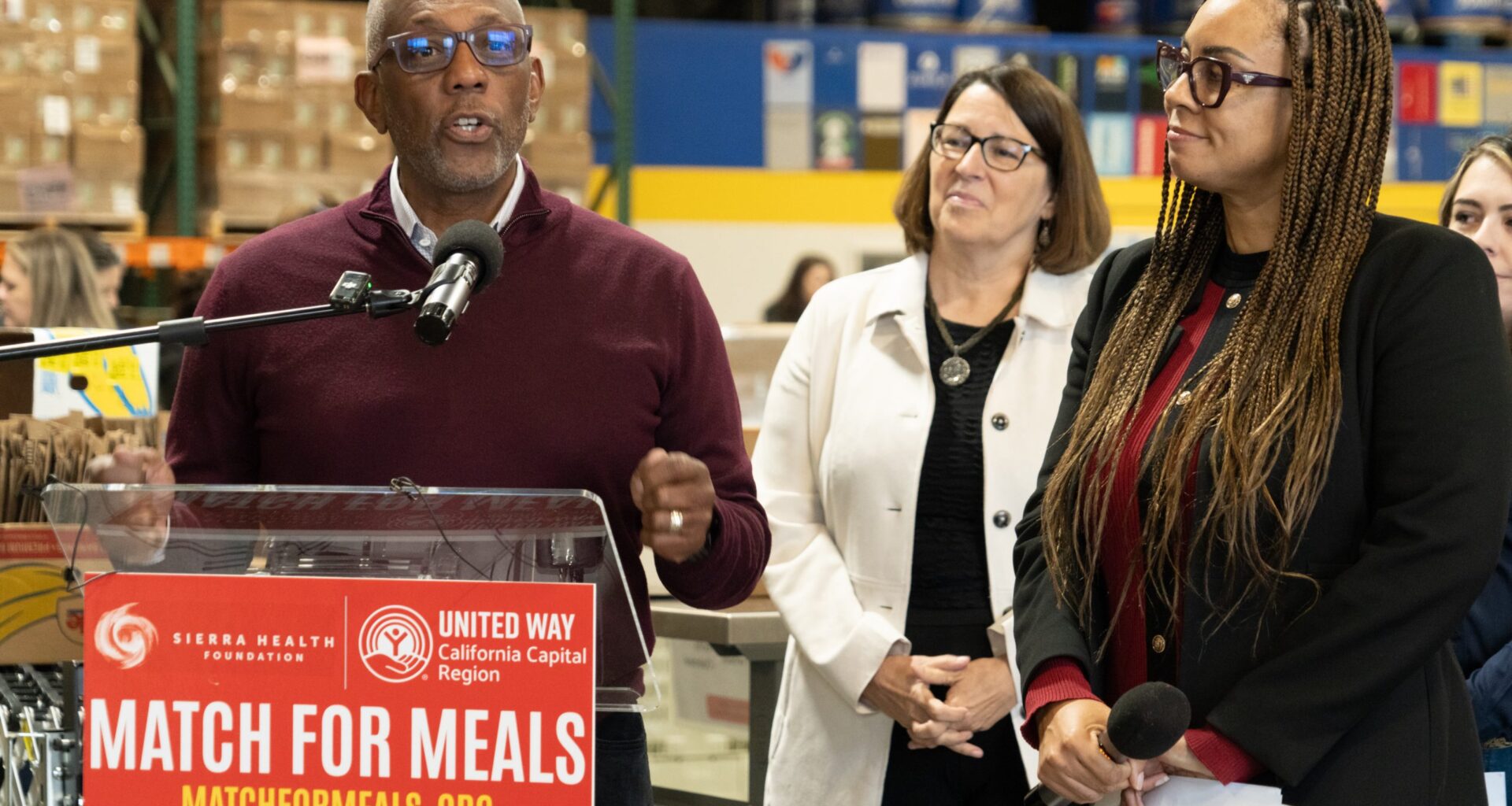
“When families are hungry, that’s our disaster and just like United Ways respond to fires, hurricanes, and other disasters, we must respond now to our own food insecurity crisis,” Dawnté Early, president and CEO of United Way California Capital Region, said Dec. 11 at one of the benefitting food banks, Sacramento Food Bank & Family Services.
Match for Meals also supports Interfaith Food Bank of Amador County, Food Bank of El Dorado County, Feeding the Foothills in Placer County, and Yolo Food Bank. All donations made through MatchForMeals.org or by texting Match4Meals to 41444 will be matched until that $300,000 cap is reached. Donors can decide if they want donations to go to one of the food banks or to be dispersed amongst all five.
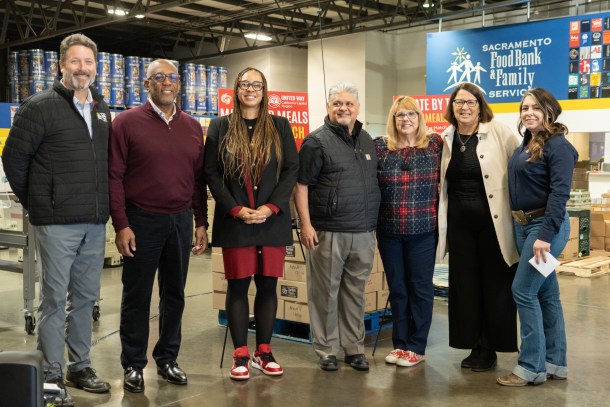 From left to right: Blake Young, executive director of Sacramento Food Bank and Family Services; Chet Hewitt, president and CEO of Sierra Health Foundation; Dr. Dawnté Early, president and CEO of United Way California Capital Region; Dave Martinez, executive director of Feeding the Foothills in Placer County; Beth Stanton, executive director of Interfaith Food Bank of Amador County; Karen Baker, executive director of Yolo Food Bank; and Makenzie Gold, administrative assistant of El Dorado County Food Bank. Sacramento Food Bank and Family Services on December 11, 2025. Roberta Alvarado, The OBSERVER
Food insecurity in California is front and center in many communities. The campaign comes at a time when food banks across the region are serving record numbers of people. According to data from the California Association of Food Banks, more than 1 in 5 Californians, or roughly 8.8 million people, struggle with food insecurity despite the fact that nearly half the nation’s fruits and vegetables are produced in the state.
Since the COVID-19 pandemic, local food demand has surged to record levels. Sacramento Food Bank & Family Services supports more than 110 partner agencies and roughly 200 distribution sites. On average, nearly 320,000 people rely on such services each month.
The recent government shutdown has exacerbated those numbers. In October, the food bank served more than 372,000 people, hitting a 49-year record, about a 140% increase from the organization’s pre-pandemic numbers. Food bank leaders believe resources still are needed and make clear the importance of food banks being well equipped and prepared to service the needs of communities at any point.
“The government shutdown put people temporarily out,” said Black Young, executive director of Sacramento Food Bank & Family Services. “Many people that were out of work live paycheck to paycheck, so what we’re finding is that it’s been very hard for people to catch up.”
Young highlighted that the shutdown brought in people who had not previously used the services.
Match giving is a form of fundraising that has been seen as highly effective because it often stimulates donor behavior. By promising to double contributions, matching programs give donors a clearer sense of impact. A $25 donation becomes $50. A $100 gift becomes $200. In this case, if the community gives a collective total of $300,000, that turns into $600,000.
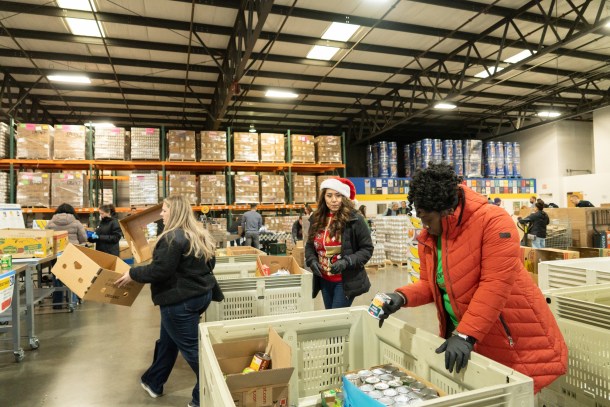 Volunteers fill boxes with an assortment of food to distribute at Sacramento Food Bank and Family Services on December 11, 2025. Roberta Alvarado, The OBSERVER
Research on philanthropic giving has shown that matching incentives often increase both the number of donors and the size of individual donations, particularly among people who might not otherwise give.
Chet Hewitt, president and CEO of Sierra Health Foundation, acknowledges Match for Meals is extremely critical at a time when food banks are being asked to fill gaps left by cuts to public assistance programs.
“There are many problems that we face that are really challenging to resolve. Feeding people is one that we actually know we can actually do,” Hewitt said. “This is a problem that can be resolved.”
Food banks are uniquely positioned to make donated dollars go further than most individuals or institutions could on their own. They are able to stretch donations significantly by purchasing food in bulk, leveraging wholesale pricing, and partnering with farms, retailers, and distributors. Locally, Sacramento Food Bank & Family Services estimates that $1 helps to provide at least three meals. Nationally, that number is even greater.
Feeding America, the country’s largest hunger-relief network, calculates that $1 can translate into as many as 10 meals because of donated food, wholesale purchasing, and logistical efficiencies.
Related