
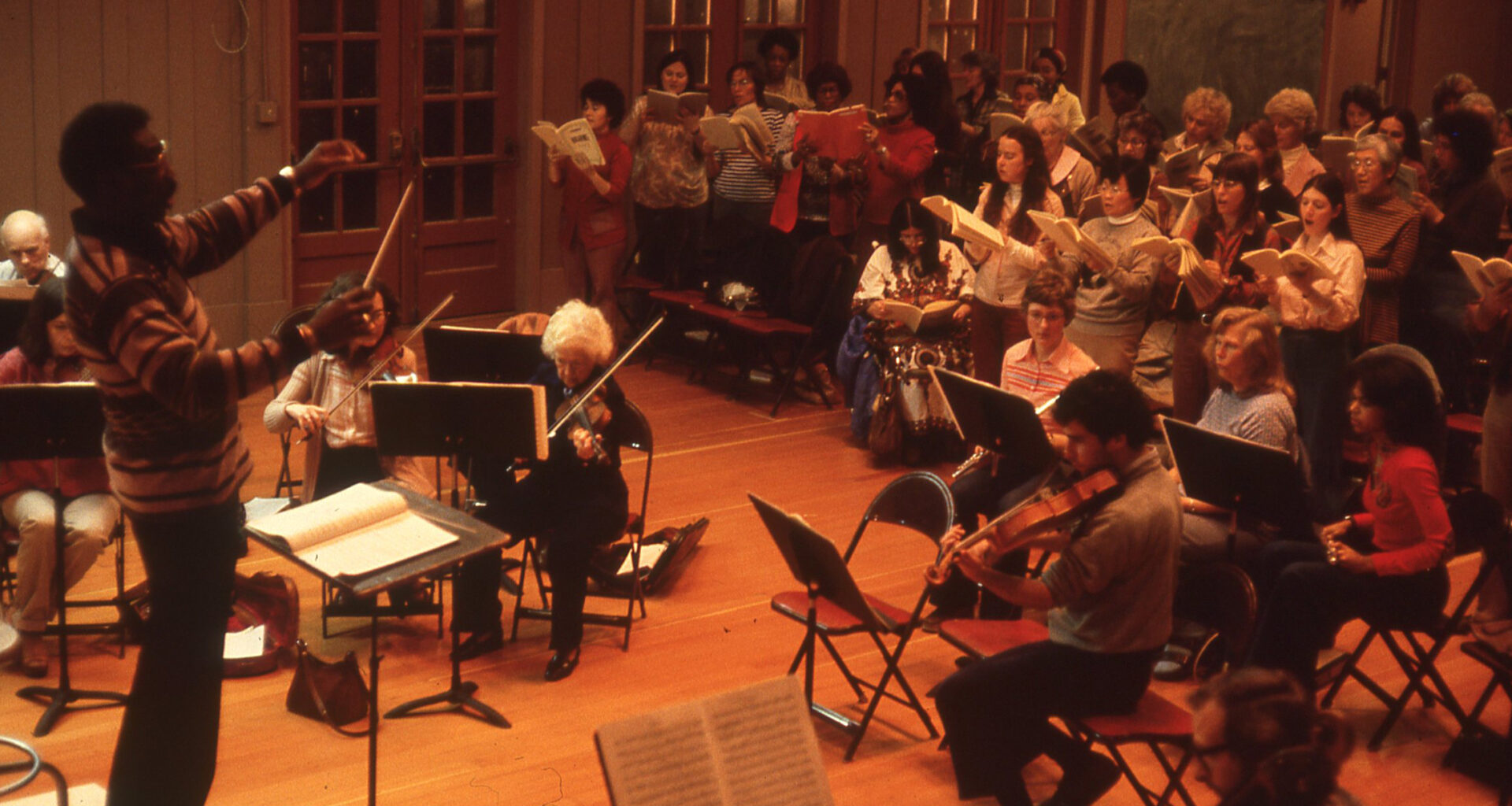
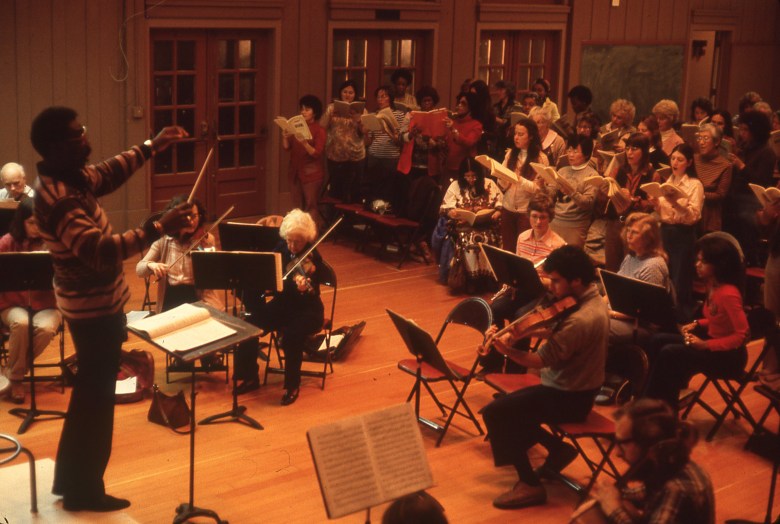
 Eugene Jones conducts a performance of the Berkeley Community Choir and Orchestra in 1979. Credit: Dewey Livingston
Precious few of the utopian schemes and ventures that coalesced in 1960s Berkeley have survived to present day, and the list of endeavors that continue to shine with their original sense of purpose is shorter still.
Amidst that select company, the Berkeley Community Choir and Orchestra stands out as an organization that has thrived by hewing tightly to the radically egalitarian vision of its founder, the color-line-breaking Oakland firefighter Eugene Jones. Launched in 1966, the BCCO has maintained Jones’s open-door policy, inducting new members without audition and always performing for free.
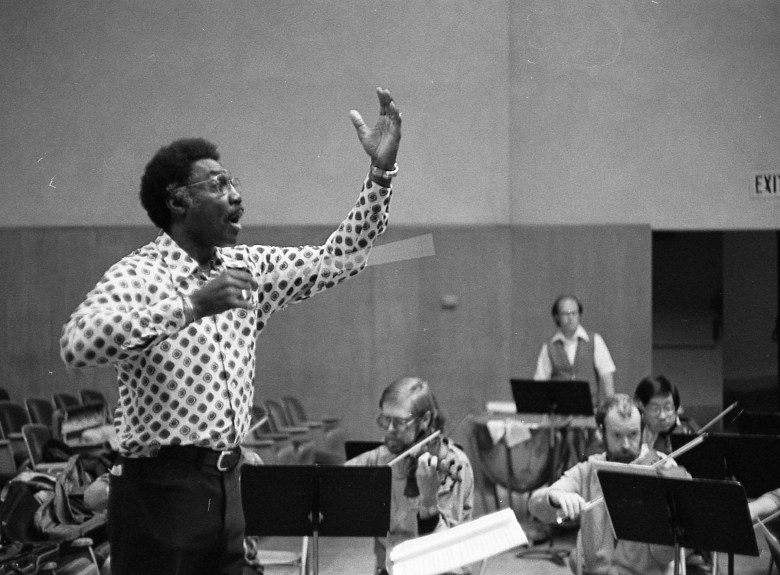 Eugene Jones, founder of BCCO, in 1980. Credit: Dewey Livingston
Conducted since 2011 by Ming Luke, the BCCO’s third music director, the 240-member choir kicks off its 60th season with three performances of Verdi’s Requiem at UC Berkeley’s Hertz Hall Jan. 2-4. It’s an impressively ambitious undertaking for an all-volunteer organization, and it’s not the first time the BCCO has grappled with the daunting evening-length work.
In a recent Zoom conversation with three long-time members a portrait of the BCCO emerged revealing an organizational culture devoted to the unfussy creation of beauty through a participatory process. All three got involved with the choir in mid-life when family responsibilities eased and they were looking for a creative outlet.
Berkeley resident Nancy Wolfe, a serious violinist in her youth, joined the BCCO in 1993 after years away from playing music. A friend told her about a chorus that didn’t require auditions.
“You just came and sang, which sounded good because I knew nothing about singing,” she recalled. The first piece she tackled with the BCCO was Stravinsky’s “Symphony of Psalms,” an assignment that “sounded very daunting,” she said. “But I loved it and haven’t stopped singing since.”
She’s done more than sing. Wolfe, who started as an alto and eventually moved to the soprano section, spent 13 years on the BCCO board, including several as president. She also chaired the team that selected Luke as the replacement for Arlene Sagan (who had picked up the baton from Jones in 1988).
Choir was launched out of Berkeley Adult School in 1966
The choir was created by Jones in a moment of civil rights-era defiance and optimism as a program in the Berkeley Adult School. A gifted and avid bass who sang with several local opera companies (he also subbed at Berkeley High, teaching music and Black history), Jones integrated the Oakland Fire Department in the late 1940s. He launched the BCCO with four singers, but quickly attracted a multi-racial cast of some five dozen.
By the time he retired and Sagan stepped in, the organization was a nonprofit with a strong board of directors. She continued to expand the chorus, while hewing to Jones’s vision of a open-door ensemble accessible to anyone willing to throw themselves into the music. Many have been eager to take the leap.
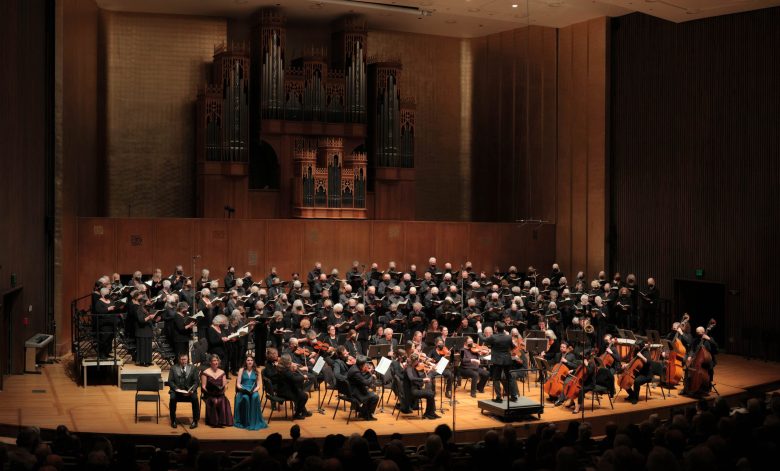 Ming Luke and BCCO at Hertz Hall. Credit: Bill Hocker
One way the chorus manages its size is by rotating out a third of the membership for each performance, so that concerts feature 160 singers (and each member performs in two of three Requiems).
Choir members are empowered in decision-making process
Unlike most choirs, where repertoire choices are the music director’s domain, the BCCO selects pieces via an ongoing dialogue. “It’s a joint effort to pick the music,” said tenor Pam Miller, a San Francisco resident who joined the BCCO about two decades ago, around the time her son was finishing high school, “and I decided to get back to tennis and singing.”
While Luke makes the final decision, “there are meetings and people suggest things and bring recordings of pieces they’re interested in,” she continued. “It gets whittled down. Ming has a lot to say, but is extremely open to suggestions. I don’t think many choruses operate that way.”
The last time the BCCO performed Verdi’s Requiem was as part of a 2016 European tour, an extremely ambitious undertaking in itself. This milestone season continues in late spring with the premiere of a newly commissioned work by composer Michael Schachter (whose ancestor, the Czech-Jewish composer and conductor Rafael Schächter, organized numerous performances of Verdi’s Requiem while imprisoned in the Theresienstadt Ghetto).
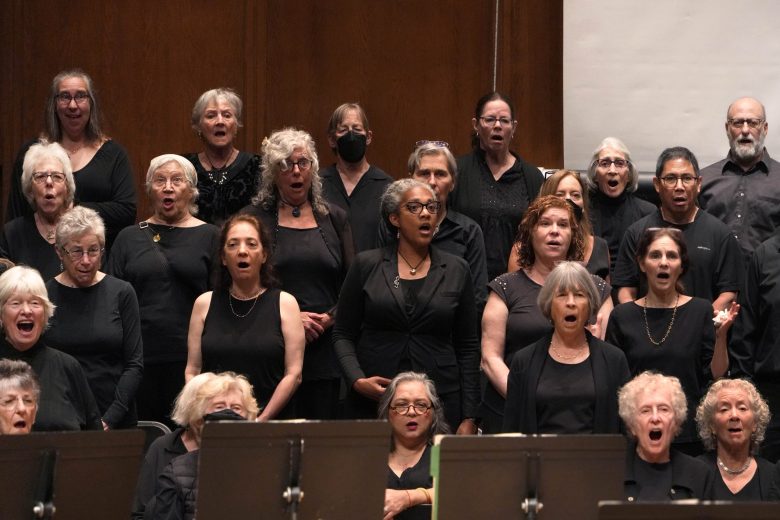 BCCO at Hertz Hall. Credit: Bill Hocker
While the values animating the BCCO have remained constant, the budget has changed considerably and is now around $300,000. The chorus used to hold bake sales to help cover the cost of travel and performances. “Our budget was so slim we had to consider the cost of music we played and how many soloists we could afford,” Wolfe said.
As the chorus has grown — there’s still a multi-year wait list for people looking to join – resources have increased, too. Vocalists pay tuition, but a scholarship program ensures that no one is excluded. The budget has expanded enough to cover a commissioning program, which focuses on emerging composers, and soloists, like the Requiem cast with soprano Erin Ridge, mezzo soprano Mariya Kaganskaya, tenor Kevin Gino, and bass Andrew Pardini (a tenured member of the San Francisco Opera Chorus).
The BCCO’s changing fortunes are driven by the actuarial table and the devotion of members. “We’ve had a lot of very generous bequests,” said bass Christian Fritze, a 22-year CBBO member and former executive director who lives in Alameda.
“It reflects people’s feelings about the chorus,” Wolfe added. “It’s been so important in their lives.”
“The group is unusual in that it’s so ambitious but so amateur, in the best sense,” Fritze continued. “The budget is bigger. We strive to pay orchestra musicians a fair wage. We pay an assist conductor as part of our Conductor Mentoring program,” an initiative launched by Luke. “These are big commitments for an amateur group.”
High demand for a spot in the choir
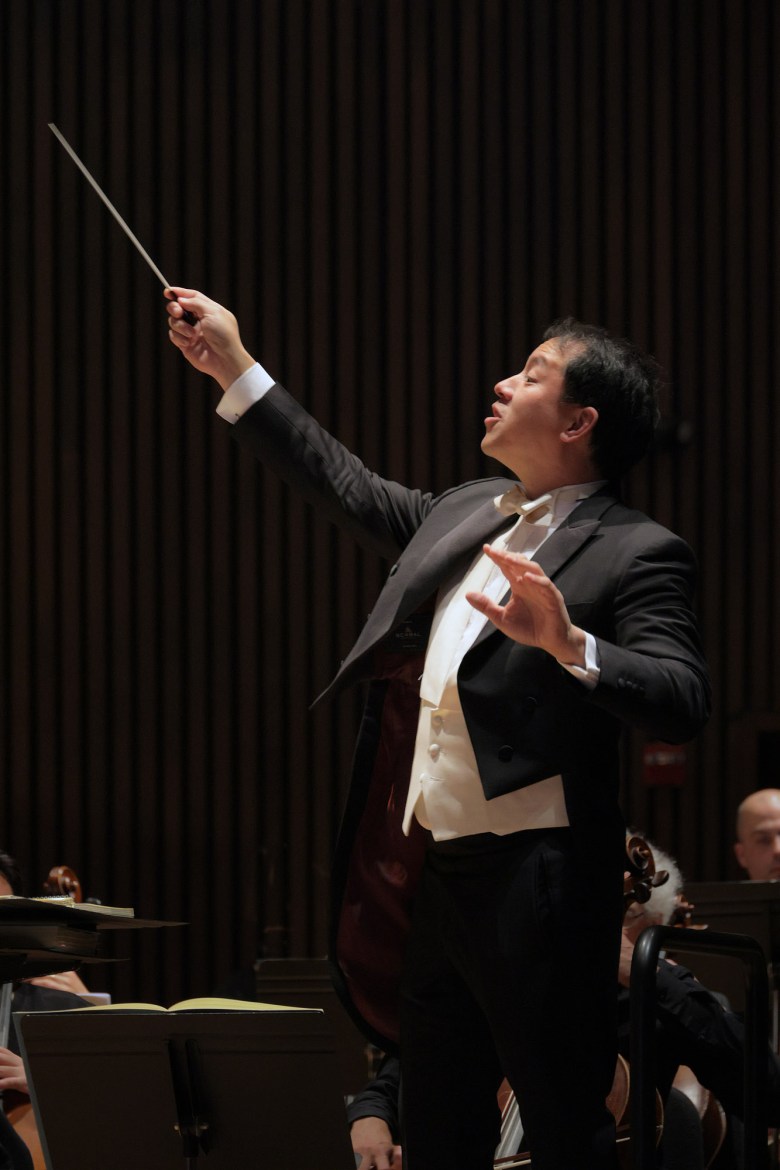 Ming Luke conducts BCCO at Hertz Hall. Credit: Bill Hocker
Success comes with a cost, however. The low bar to entry means that, given the fairly stable rate of membership turn over, the wait list for a spot became untenable. In the fall of 2013, to help meet the growing demand, Luke created the BCCO Women’s Chorus under the direction of Deb Golata. The ensemble is now run by Julia Morris, a thriving graduate of the BCCO Conductor Mentoring program.
The waitlist is shorter these days, but don’t expect to show up and start singing the same season. “At the moment no one has been on the wait list longer than 2023,” Miller said. “That’s a big improvement. Coming out of Covid some people had been on for eight years.”
What’s most remarkable about the BCCO is the evident pride in its democracy of talent. When Miller noted that there are probably several members who are tone-deaf, her fellow singers concurred. Bringing together a diversity of talent and skill level is part of the BCCO’s mission.
“There are people who don’t read music,” Miller said. “Our section leader, one of our best singers, doesn’t. They use recordings, listening at home and memorizing the score. And some of the music is really hard!”
“There are people who could be soloists and people who can barely sing,” Fritze added. “Ming’s theory is that good singers can raise the bar of singers who aren’t as good.”
Putting that theory into practice, BCCO performances lift all listeners.
“*” indicates required fields