
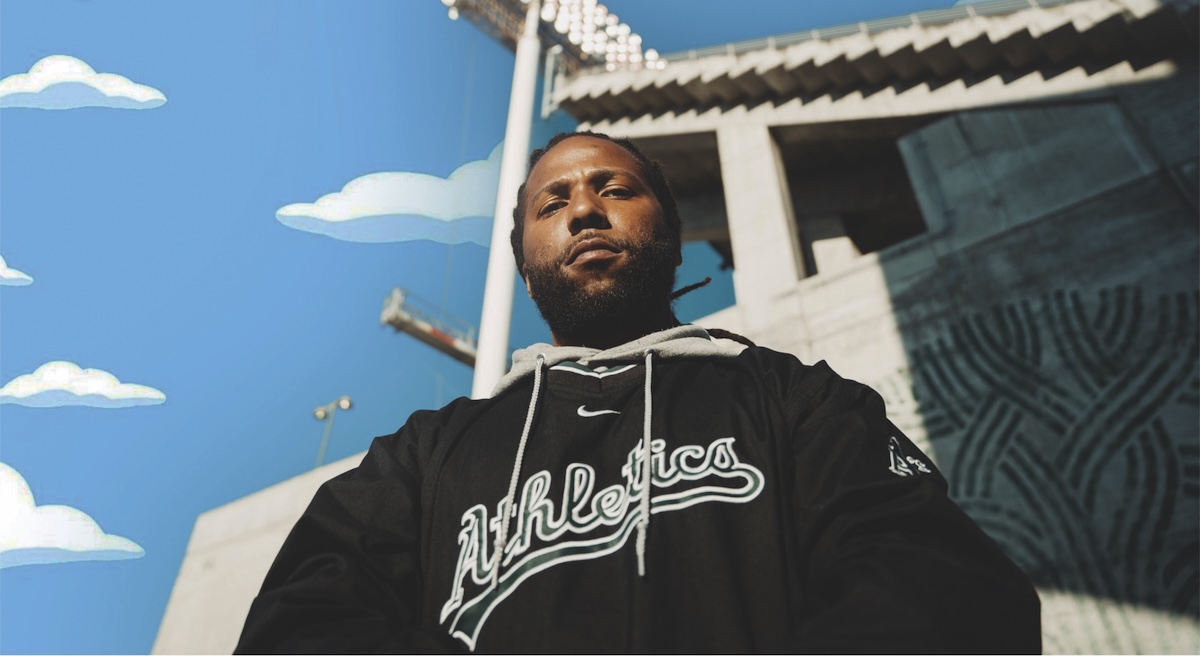
As a middle-schooler, when most kids woke up to cartoons or played video games, a young Philip Bank$ did something far less expected: He read the newspaper. He didn’t flip straight to the comics or check the Warriors box scores. He studied the city, absorbing homicide reports, city council dust-ups and the complicated rhythm of Oakland long before he had the language to name what drew him in. That impulse, to document the world around him with curiosity, empathy and precision, animates East Bay Times, the Oakland rapper’s debut solo album and the most complete statement of his voice yet.
“With the title East Bay Times, I’m reporting on myself, my inner thoughts, as well as what’s going on in the city,” Bank$ said. “That’s how the title came.”
Across nine Hiright-produced tracks Bank$, now 35, a Morehouse-trained sociologist and a third-generation Oakland native, delivers the kind of grounded, community-rooted storytelling often missing from today’s rap landscape. His voice is steady but emotionally agile, never preaching and never posturing. He simply reports live from the city that raised him.
“I’m trying to encapsulate what’s going on in Oakland,” he said. The clarity of purpose is woven into every detail.
Many first met Bank$ as one-third of Trey Coastal, the Oakland group that went mildly viral with its “Polynesian Sand” video. The group performed on a couch floating across Lake Merritt while threading humor into critiques of gentrification and shifting city culture. Their work carried the DNA of classic Bay Area mischief, equal parts social commentary and comedic chaos.
After the trio’s 2023 EP, Bank$ slowed his musical output. Behind the scenes, he wrestled with the idea of striking out solo. East Bay Times is actually his third attempt at a solo project. “It wasn’t a linear process,” he admitted. “I would get overwhelmed. Life was happening, and the responsibility of wanting to get it right weighed on me.”
He recorded some songs in late 2023, while others trace back to the years immediately after the pandemic, a period he describes as creatively rich but emotionally heavy.
“It was a consistent effort, especially over the last year and a half,” he says. “The songs cover the last two or three years of my life. I’m recapping and processing. The project definitely expands life post-pandemic.”
Bank$ began writing raps at 12, pulling inspiration from Oakland legends like Yukmouth and Too $hort, as well as New York icons like Nas. After high school, he moved to Atlanta for college and paused his rap ambitions to focus on academics. That sociology training informs his writing now. His observations are sharp, people-centered and grounded in the belief that the personal is always connected to the political, especially in a city like Oakland.
On “Land of the Oak,” an early standout, Bank$ trades verses with Ian Kelly as they map out the emotional and economic terrain of modern Oakland. The song touches on grief, the criminal justice system and the grind of staying independent as an artist.
The Bay Area remains Bank$’s creative foundation. Outside of music, he is a founding member of the Black Rock Collective, a group dedicated to creating safe and affirming spaces for Black climbers and outdoor newcomers. It was during one of those climbing sessions that he wrote “Ventilate,” the album’s breeziest lyrical exhibition. The song is almost meditative and exudes the skill and calm confidence that come from someone who has done real internal work.
“Oakland Unified” follows and marks the album’s emotional shift toward its heaviest material. On “Jason’s Lyric,” Bank$ grieves his late cousin and processes what it means to carry someone’s legacy. The writing is tender and intimate. He captures the quiet moments grief disrupts: birthdays, school milestones and family gatherings that feel incomplete.
The album closes with “Hyphy Kids Got Trauma,” a title taken from graffiti that stopped him in his tracks. It serves as a thesis statement for the project. It reflects what it means to come of age in a city that has endured some of its highest crime rates while still producing so much brilliance. He remembers the tension it created for his mother, who watched her son venture into a world she could not fully protect him from.
In the end, East Bay Times delivers exactly what its name promises. It’s a front-page dispatch from an Oakland son who grew up reading the news and now understands how to write it with rhythm, introspection and a reporter’s devotion to truth.