

These are some of the key local stories to watch in San Diego County in 2026 as selected by Union-Tribune news reporters.
A fight for Congress, and much more
Major contests will dominate the ballot in the 2026 midterm elections — not least a wide-open race for California governor and a high-stakes battle for control of Congress. That battle is widely seen as a referendum on Donald Trump’s presidency and on the acquiescence by Republican allies to his agenda and expansion of executive power.
San Diego County will host one of the nation’s most closely watched congressional races, as a scrum of Democrats challenge longtime Republican Rep. Darrell Issa for a seat that redistricting has made newly competitive.
 Rep. Darrell Issa, left, and EPA Administrator Lee Zeldin speak during a press conference about the ongoing Tijuana River sewage crisis on April 22 in San Diego. Issa faces a tougher 2026 re-election race now that his district has been redrawn. (Ana Ramirez / The San Diego Union-Tribune)
But further down the ballot, some of the most impactful questions voters face will be on how to fund firefighting, schools, sewage solutions and other government services.
Huge new costs local governments face from the loss of federal funding and services mean it’s increasingly likely voters will be asked to back new local revenue measures. Those could include a countywide half-cent sales tax hike some citizen groups are now pursuing, plus a contentious proposed tax on vacation homes in the city of San Diego.
Other local elections could also have a big impact on local government priorities.
A three-way race in North County to replace termed-out county Supervisor Jim Desmond could decide the board’s partisan split, and how much power its Democratic majority wields; two Republicans are vying to establish themselves as heir to the conservative incumbent, in a district that leans slightly Democratic. Four seats on San Diego’s all-Democratic City Council are also up for grabs; the races to succeed two termed-out incumbents are wide open, and increasingly crowded.
— Lucas Robinson & David Garrick
Prosecuting La Mesa officer’s death
The case involving a 38-year-old military police officer accused of killing La Mesa police Officer Lauren Craven in a suspected DUI crash is expected to unfold in court in 2026.
 La Mesa police Officer Lauren Craven. (La Mesa Police Department)
Antonio Alcantar, a U.S. Navy master-at-arms with 11 years of service, has pleaded not guilty in San Diego Superior Court to one count of murder and one count of gross vehicular manslaughter in connection with Craven’s Oct. 20 death.
Investigators are still looking into whether charges will be brought against him in connection with the death of another motorist at the scene, 19-year-old De’Veonte Morris. Alcantar’s defense attorneys said the factors leading up to Morris’ death have not yet been fully determined.
Prosecutors said that Alcantar had been out drinking with a friend in the hours leading up to the crash before he decided to drive home. On Interstate 8 near Waring Road, the Toyota Camry that Alcantar was allegedly driving slammed into Craven on the freeway while the officer was responding to a previous crash involving Morris.
— Caleb Lunetta
U.S. Supreme Court to hear San Diego case
What does it mean to “arrive” in the United States? The U.S. Supreme Court will decide that issue in 2026 when it hears a San Diego case that deals with “metering” migrants at the U.S.-Mexico border.
The practice of metering involves U.S. border officials turning away would-be asylum seekers at the border and forcing them to wait in Mexico if the officials determine a border crossing to be at capacity. Metering began during the Obama administration and was later formalized by President Donald Trump during his first term.
 Obed Benjamin Ramos, 8, grabs a soda from his mother’s store on April 15 in Tijuana. The Salvadoran family planned to seek asylum in the United States but have now have started a new life in Tijuana. (Ana Ramirez / The San Diego Union-Tribune)
The Biden administration ended the government’s metering policy, and Trump hasn’t needed it during his second term as border encounters have plummeted and remained low. But the Trump administration has argued that metering is a “critical tool for addressing border surges” and that such a tool might be necessary in the future.
The Supreme Court’s task in the San Diego case will be to clarify federal law that states that any immigrant “who is physically present in the United States or who arrives in the United States … at a designated port of arrival … may apply for asylum.”
The Trump administration wants “arrives in” the U.S. to be defined literally as someone who takes at least one step onto U.S. soil at a port of entry; this would allow border officials to turn away migrants a few steps from the border, thus denying them the ability to seek asylum.
But a San Diego federal judge, and later the 9th U.S. Circuit Court of Appeals in a 2-1 opinion, have ruled the government’s interpretation was too literal. Those rulings held that a migrant who makes it close to the border and presents themselves to a U.S. border official has met the definition of arriving in the U.S. and can make an asylum claim, even if that migrant doesn’t technically touch U.S. soil.
It’s not yet clear when the Supreme Court will hear the case, though it will likely be in February, March or April.
— Alex Riggins
Shifting immigration enforcement
The Trump administration’s plans for mass deportations are expected to remain a focal point in the coming year.
Recently, arrest tactics have expanded, from targeting people at their immigration court hearings and check-in appointments to detaining them at their green card interviews.
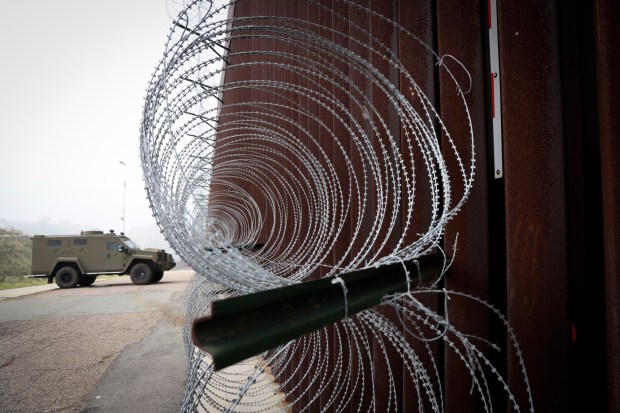 A Border Patrol truck along the U.S.-Mexico border wall in San Ysidro. (Sandy Huffaker / For The San Diego Union-Tribune)
The local offices of the Border Patrol and U.S. Immigration and Customs Enforcement have recently gotten new chiefs. The new Border Patrol chief said San Diegans can expect Border Patrol agents to be conducting more operations in interior communities rather than just sticking close to the border fence, where few migrants are crossing these days.
Yet more border security projects are underway. Construction of additional fencing along the California border began in 2025, and more projects to close additional gaps have been approved for next year.
The Trump administration also recently expanded the militarized zone to include California, where the U.S. Navy took over areas of borderland in San Diego and Imperial counties. The designation gives military personnel the authority to detain individuals for trespassing and turn them over to border agencies when necessary. It remains unclear how the military will be used in the zone, or if criminal prosecutions of trespassing charges will ratchet up in court.
— Alexandra Mendoza
Elephant Valley habitat set to open
After years of construction, a new elephant habitat at the San Diego Zoo Safari Park is slated to open to visitors in March.
While the price tag for the project has not been released, San Diego Zoo Wildlife Alliance officials have said the Denny Sanford Elephant Valley will be the largest and “most transformative” addition in San Diego Zoo history. Work on the project began in late 2022.
 Eight elephants are already living in a new elephant habitat at San Diego Zoo Safari Park slated to open to the public in March. (San Diego Zoo Wildlife Alliance)
The habitat will house the park’s eight African savannah elephants. Funding was provided by Sanford, a philanthropist who has supported other zoo projects, as well as contributions from more than 4,100 donors.
The exhibit will feature Mkutano House, a two-story restaurant offering three dining destinations and panoramic views of the elephant habitat. The structure’s design was inspired by lodges that cater to travelers on African safaris.
African savanna elephants are classified as endangered due to pressure from climate change, habitat loss and poaching. Wildlife Alliance officials say the new habitat will underscore its conservation priorities.
— Karen Kucher
Sand replenishment projects in the works
Wider, sandier beaches top coastal San Diego County’s wish list for 2026, and cities are watching several ambitious projects in the works to make that happen.
An important key to any local sand project could be the completion of the U.S. Army Corps of Engineers Oceanside Special Shoreline Study, which began in 2016 but was suspended after federal funding dried up. The shoreline study received a $2.27 million federal grant in 2025 to update and complete the work, which will provide important data for local and regional sand replenishment efforts.
One of the most interesting is Oceanside’s Re:Beach program, a pilot project to place as much as 1 million cubic yards of sand along a six-block segment of beach between the ends of Tyson Street and Wisconsin Avenue.
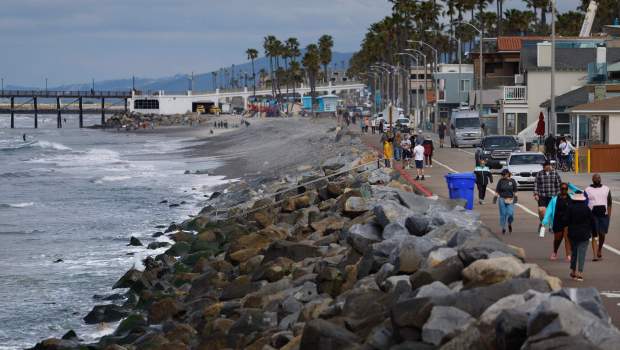 Sand has diminished along the Oceanside coast, shown here along The Strand on April 4, 2024. (K.C. Alfred / The San Diego Union-Tribune)
Along with the sand replenishment, the Re:Beach concept includes the creation of “living speedbumps” and an artificial reef to keep the sand in place. The so-called speed bumps would be short, rounded, landscaped headlands, like small jetties, built on the beach to slow the erosion of sand in the surf and ocean currents.
Final designs, engineering and studies are underway for the project. Construction could begin in 2028 if funding becomes available.
Also in the early stages is a possible third regional sand replenishment project led by the San Diego Association of Governments. This one would be the largest yet, including all San Diego County coastal cities, and San Clemente and Dana Point in Orange County.
— Phil Diehl
The changing face of San Diego County neighborhoods
A combination of new legislation and local regulatory changes could combine in 2026 to jump-start the reshaping of neighborhoods across San Diego County.
New housing development, including some mid-rise and high-rise buildings, will be more likely in many parts of the county because of new state laws limiting environmental reviews and encouraging ambitious projects near public transit.
Housing development in urban areas — along with child care facilities, health centers, parks and more — will be exempted from California’s landmark environmental law. And SB 79 overrides local zoning rules to allow high-density housing near transit statewide, including at every stop on the San Diego Trolley and the Sprinter.
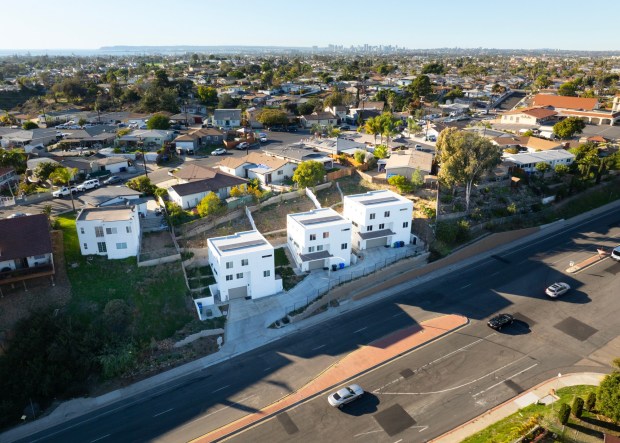 Homes on Reo Drive in Paradise Hills on Dec. 9. San Diego is launching a new effort to rezone properties in single-family areas for duplexes, cottages, row homes, townhomes and bungalow courts so that young families have more choices than new high-rise buildings or unaffordable single-family homes. (Nelvin C. Cepeda / The San Diego Union-Tribune)
This coming year in the city of San Diego, officials plan to encourage housing development by softening historic preservation rules and by adding density to single-family neighborhoods by allowing more duplexes and townhomes.
San Diego County is set to begin a multi-year rewrite of its zoning ordinance, with an eye to undoing requirements that have long held back the aims of a 2011 general plan that calls for higher-density housing. And supervisors will consider other measures to build more homes, including ADUs and income-restricted affordable housing.
— David Garrick & Lucas Robinson
Tijuana River sewage solutions advance
The decades-long Tijuana River sewage crisis will test binational cooperation and South Bay residents’ endurance in 2026 as implementation of December’s Minute 333 agreement begins.
The accord commits Mexico to constructing a sediment basin before the 2026-27 rainy season and building the Tecolote-La Gloria Wastewater Treatment Plant.
Meanwhile, approximately 7,700 air purifiers have been distributed to residents — temporary relief as many await permanent solutions. Recent state hearings revealed the crisis’ severity: hydrogen sulfide levels at the Saturn Boulevard hotspot have reached as high as 20,000 parts per billion, exposing 11 schools within 1.5 miles to toxic pollutants.
With 200 billion gallons of sewage having crossed the border since 2018 and Imperial Beach’s shoreline closed 296 days in 2024, the coming year will determine whether expanded wastewater treatment capacity and infrastructure improvements materialize — or if South Bay communities face another year of contaminated beaches and health impacts.
— Walker Armstrong
 The Tijuana River flows on Dec. 11 in San Diego. (Ana Ramirez / The San Diego Union-Tribune)
Major medical center partnerships
The most dynamic situation in San Diego County health care should continue to play out in the north as two public hospital districts facing financial pressures move forward with their plans to join larger partners.
On the coast, voters will be asked to approve a 30-year lease of Tri-City Medical Center’s assets to Sharp HealthCare. Inland, the joint powers agreement between Palomar Health and UC San Diego Health does not need voter approval to begin after the first of the year. However, a public vote is anticipated, likely in the fall, to transfer more than 49% of Palomar’s assets into the partnership.
In both cases, leaders are betting that plugging stand-alone operators into larger networks of care can provide more stability, folding facilities that have recently been underused by patients into health insurance contracts and referral relationships that can drive up occupancy rates, making it easier to sustain viable services 30 or 40 miles outside San Diego’s urban core.
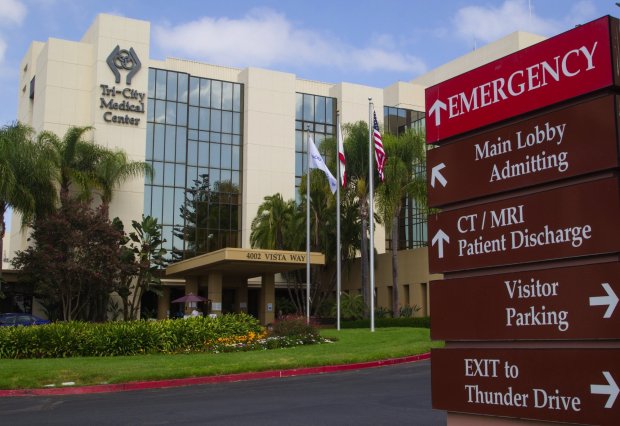 Tri-City Medical Center in Oceanside. (Eduardo Contreras / U-T File)
For patients, the true test will be the resumption of services. Both Tri-City and Palomar Medical Center Poway have closed their labor and delivery units, generating community outcry for resumption. Likewise, mental health care services have eroded on the coast and inland, putting pressure on facilities much farther south, forcing those who need care, especially those covered by Medi-Cal, to travel farther for services that require hospital admission.
The coming year, then, poses the question: Can these new partnerships bolster health care in San Diego’s North County enough to effectively restore long-term sustainability of community assets that are vital to the overall public health, especially for those with emergencies that require immediate attention, without a 30-mile commute?
— Paul Sisson