
Time is running out! Your donation to Berkeleyside can be matched—but only until midnight on Dec. 31. Give now and double your support of our nonprofit journalism.
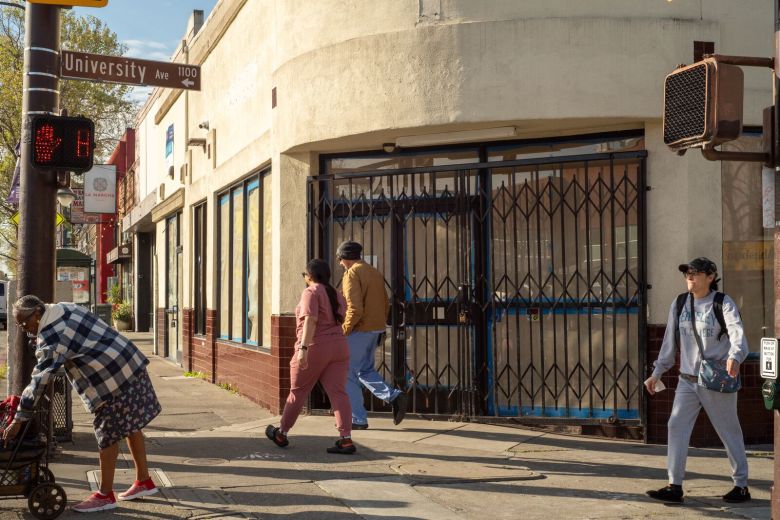 The shuttered 7-Eleven is one of three currently vacant storefronts at the intersection of San Pablo and University avenues. Credit: Ximena Natera, Berkeleyside/CatchLight Local Local
Editors’ note: This week we’re republishing some of our favorite stories of 2025. This story was first published on May 14.
The intersection of University and San Pablo avenues, which tattered banners proclaim is named International Marketplace to recognize the area’s many multicultural businesses, was once the gateway to Berkeley and its university for those arriving by ferry.
More than 100 years later it continues to play that role for drivers coming off the nearby I-80 off-ramp. The intersection is also at the heart of Berkeley’s original neighborhood, Ocean View, which has gradually morphed from a landscape dominated by wharfs, factories and lumber mills to a mixed-use area of commerce, light manufacturing and housing. At its heyday, two movie theaters served the area, and it was home to a melting pot of immigrant communities. It’s still in Berkeley’s most diverse district, a result in large part of redlining, but as housing costs rise, the area is becoming increasingly wealthy, white and Asian.
Today, the block of San Pablo south of the intersection is among the most vibrant in West Berkeley, a trendy corridor catering both to new arrivals and what remains of the neighborhood’s working class — with a Michelin-recognized tapas bar doors down from a light-filled laundromat; popular bars where Berkeley politicos grab drinks after council meetings; a low-cost donut shop sharing a wall with a cafe boasting weekly concerts in its redwood-shaded back patio; and well-stocked Latin American and Middle Eastern grocery stores selling lengua tacos, menudo by the liter, and hummus, dolmas and baklava alongside fresh produce and aisles of specialty goods. Nearby, to the east and north, are several Indian and Pakistani stores and restaurants, and two Halal groceries.
But the intersection of San Pablo and University, at the heart of it all, is desolate. Since the 7-Eleven closed on the southwest corner late last year, three of the intersection’s four corners have been standing vacant. Wells Fargo, which held down the northwest corner, closed in 2022, part of a wave of branch closures driven in part by a rise in online banking. Alpha Design Custom Furniture, on the southeast corner, is the lone survivor.
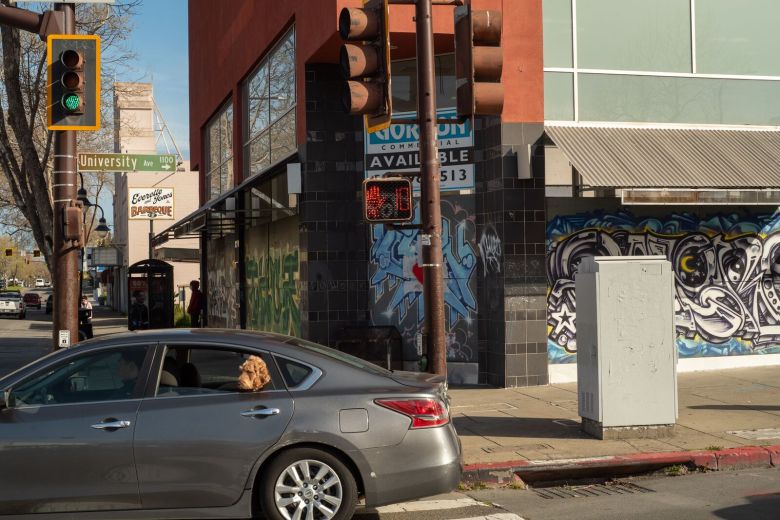 A new tenant recently signed a lease for the building on the northeast corner of San Pablo and University avenues which housed a Pet Food Express store until it closed in 2018. The space has been vacant since then. Credit: Ximena Natera, Berkeleyside/CatchLight Local
That may soon change, however, as a tenant has recently signed a lease for the building on the northeast corner, according to realtor Kevin Gordon. The space has been empty since 2018 when Pet Food Express moved out. Berkeley Patients Group briefly considered moving its dispensary there, along with a marijuana vape lounge, but abandoned its plans during the pandemic. The 5,516-square-foot space is listed on Gordon Commercial’s website for $2.50 per square foot, which would bring the monthly rent to $13,790.
Gordon, who said he could not yet share details of the building’s new renter, said he had his work cut out for him finding a tenant. The size of buildings like this one alone make them hard to fill, he said. Fewer businesses require large spaces because of the rise of online shopping and online banking. “ Banks don’t need big spaces or big parking lots,” he said. “Pet food doesn’t need a huge space anymore.”
University Avenue brings people from one of the biggest freeways in all the Bay Area into Berkeley. When you get to that intersection, and there’s three out of four storefronts vacant, that’s a bad, bad sign. — Anand Patel, operations manager, Holiday Inn Express
The 2022 closure of the 99 Cent Store — a refuge for low-income shoppers inside a grand century-old former movie theater — has also dealt a blow. Events celebrating the neighborhood’s multicultural heritage were once held in the 99 Cents Store’s parking lot, where local business owners now say abandoned cars and safety concerns scare off customers. And it’s unclear if a seven-story mixed-use development planned for the site will move forward.
Much like the city’s other commercial districts, businesses come and go, retail being a challenging sector. Heads and Tail Barbecue opened last year, while Highwire Coffee closed last month.
But at this key intersection, one of Berkeley’s central crossroads, neighbors and merchants wonder what story the empty storefronts tell.
“ San Pablo Avenue brings people from Emeryville into Berkeley, it brings people in from Albany into Berkeley,” said Anand Patel, operations manager of Holiday Inn Express on University Avenue, and current president of the University Avenue Association. “University Avenue brings people from one of the biggest freeways in all the Bay Area into Berkeley. When you get to that intersection, and there’s three out of four storefronts that are vacant, that’s a bad, bad sign.”
Commercial vacancy rates are down
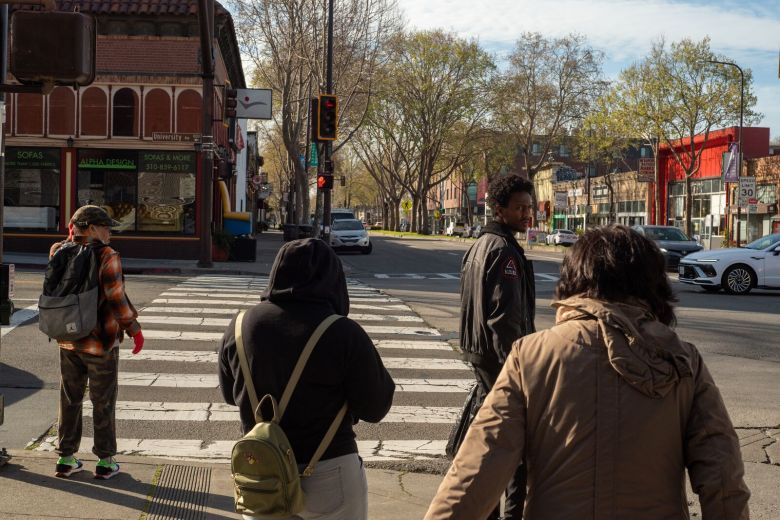 People cross the San Pablo and University avenues intersection on a Friday morning. The area is a high-traffic area for cars and pedestrians. Credit: Ximena Natera, Berkeleyside/CatchLight Local
Perhaps surprisingly, commercial vacancy rates have actually fallen on San Pablo Avenue after rising for three straight years, according to a recent city report.
The ground-floor commercial vacancy rate for the avenue as a whole for 2024 was 7.1%, down from 15.6% the previous year. The vacancy rate on University Avenue also went down, from 17.7% in 2023 to 7.6% in 2024, the lowest rate in five years. These decreases were in line with most of the city’s other commercial districts. Only West Berkeley as a whole saw a significant increase, from a vacancy rate of 2.1% in 2023 to 6.5% last year.
But if the vacancies are falling in the area, why does one of the busiest intersections in the city still have so many empty storefronts?
Alexander Quinn, Senior Director of Economic Research for JLL, a commercial real estate brokerage firm, said he doesn’t believe the answer is a lack of people. “It’s a very high-traffic area, so it’s not an issue of traffic counts,” he said.
But Quinn does think the location has its challenges for people on foot. “The street environment, of course, is difficult just in terms of a pedestrian who’s accessing these retail spaces. So that creates its own issue.”
Many successful commercial districts create what are known as “loops,” said Quinn, walkable areas connected to multiple retail assets. He cited Berkeley’s Fourth Street shopping district as an example.
“You’ve got that retail loop, and that creates a comfortable environment,” he said of Fourth Street. But at San Pablo and University, it’s another story. ”It’s not as comfortable in that intersection,” he said.
Bank building with historic ties is up for grabs
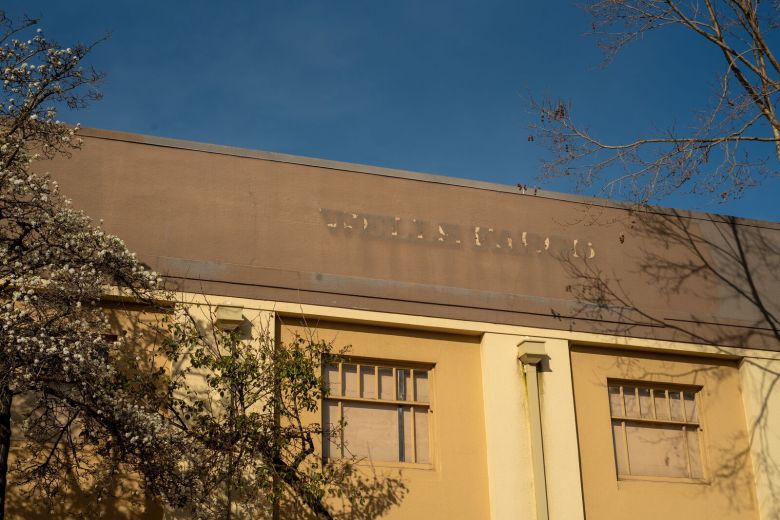 The Wells Fargo branch on the northwest corner of the San Pablo-University intersection closed in 2022. The building was bought in 2024 but still stands vacant. Credit: Ximena Natera, Berkeleyside/CatchLight Local
Wells Fargo sold the building on the northwest corner last year to an entity registered as 1095 University LLC.
The new owners are “exploring conversations with both buyers and tenants” for the building, according to Catherine Macken, an associate broker with John Cumbelich & Associates, who added that the current owner will retain the adjacent parking lot parcel “for a future residential development project.” The asking price for the building is $2 million.
The building was originally the home of West Berkeley Bank. It was built in 1905 and designed by architect Charles Dickey, who also designed the Claremont Hotel, according to Daniella Thompson, an architectural historian based in Berkeley. Just a year after it was built, the 1906 San Francisco earthquake struck, severely damaging the building.
As Richard Schwartz wrote in his book, Earthquake Exodus, 1906: Berkeley Responds to the San Francisco Refugees:
Police officer W. H. McCoy, working his beat in the Oceanview, was standing at San Pablo and University avenues when the earthquake struck. The stone walls of the elegant West Berkeley Bank on the northwest corner shattered, the building shifted off its foundation, and the masonry cornices fell to the ground. One section weighing thousands of pounds flew past McCoy’s face and crashed at his feet. Dust blanketed his cup of coffee as he stood frozen and stunned.
Walter Gordon, Berkeley’s first African American police officer and the first African American to graduate from Berkeley Law, opened a law office in the building in 1923 according to an article written by his grandson.
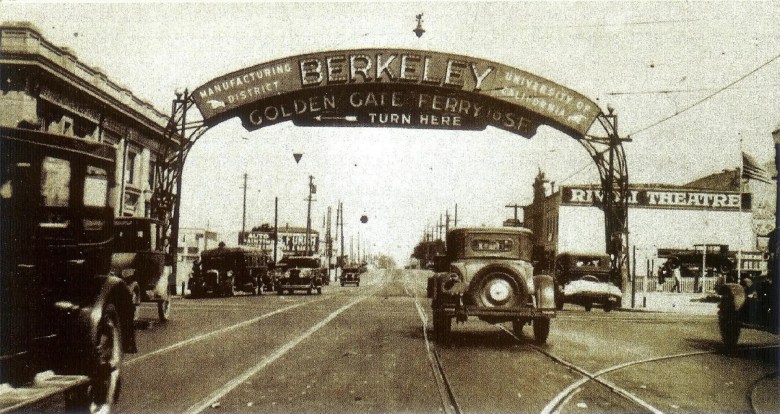 An arch built in 1924 that spanned San Pablo Avenue on the north side of University welcomed Key System train passengers and car drivers to Berkeley. Credit: Berkeley Historical Society and Museum
Around the time that he was setting up his law practice, an arch was constructed on the north side of University spanning San Pablo with a lighted sign reading “Berkeley,” welcoming passengers aboard Key System trains that passed through the intersection. Painted hands pointed the way to the Manufacturing District to the west and the University of California to the east. A sign was later attached to the arch alerting the growing fleet of car owners to “turn here” to catch the Golden Gate Ferry to San Francisco. The arch was removed in 1942.
Pictures of the arch show the West Berkeley Bank building, with many of its original architectural flourishes that are absent today.
“Unfortunately that building has been modified significantly,” said Thompson. “So you really cannot tell that it is 120 years old.”
Life-size Snoopy made trips down the street
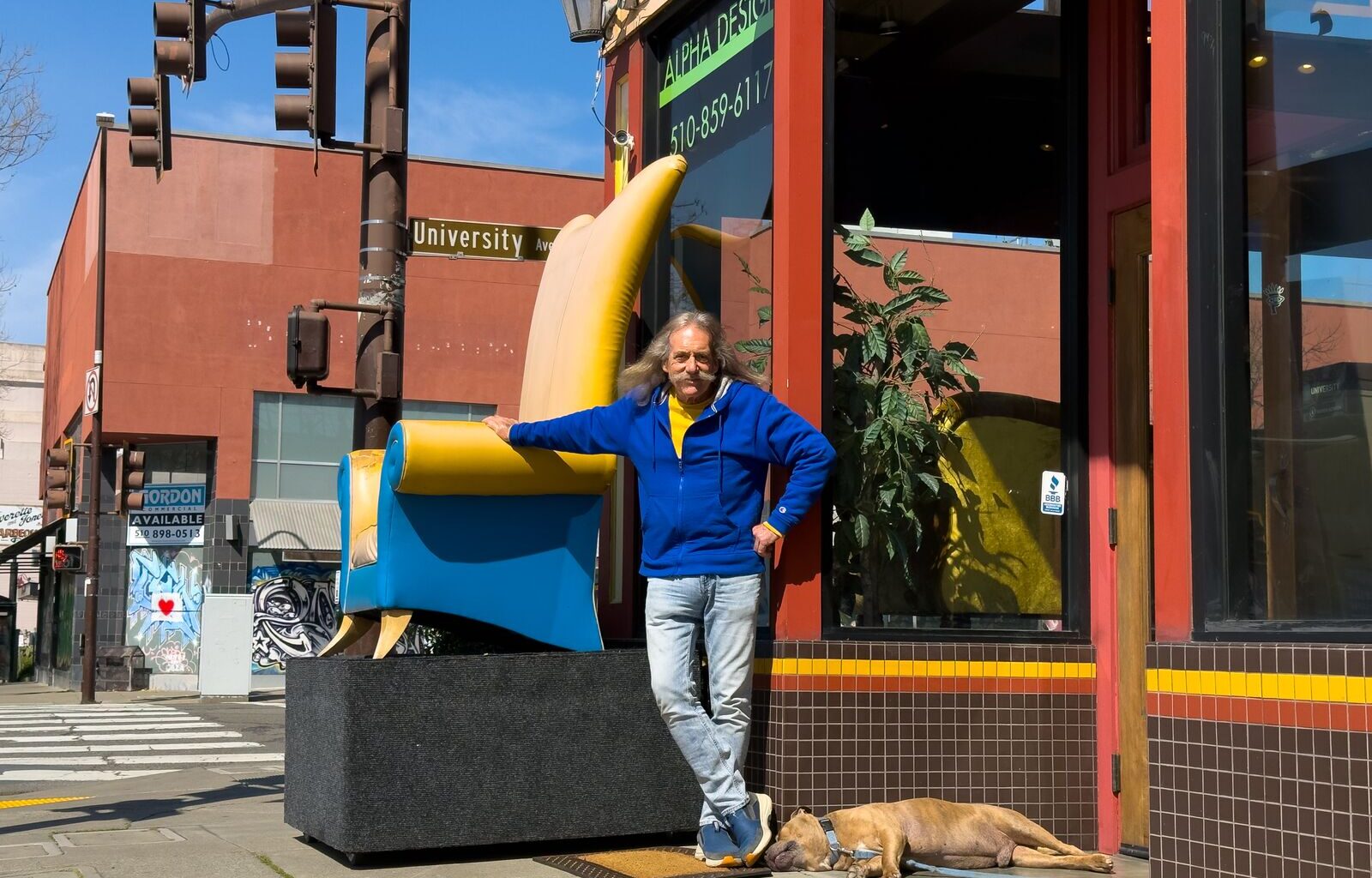
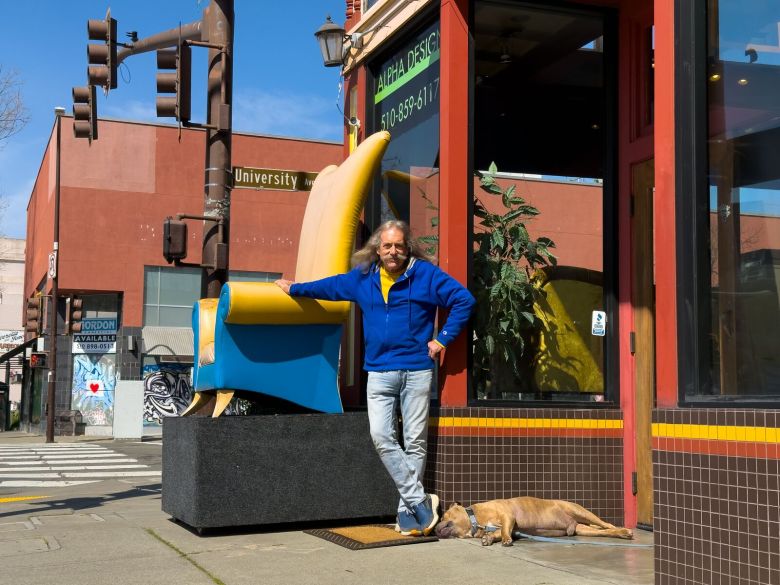 Hans Reinhardt, owner of Alpha Design Custom Furniture, and his dog, outside his store, currently the only open business on the San Pablo-University intersection. A giant Snoopy used to sit on the oversized chair. Credit: Ximena Natera, Berkeleyside/CatchLight Local
Alpha Design, known for its life-size Snoopy doll sitting in an oversized chair outside the shop, has been a fixture on the northeast corner since 2012.
Alpha’s location was once a liquor store, and sat empty for several years before being renovated by the building’s owner.
The 1930 building, designed by Spiveck & Spiveck and known as the Weisbrod building, is a Berkeley Architectural Heritage Association Structure of Merit. It also houses Califa’s Greens on the University Avenue side and ACE Cash Express on San Pablo Avenue.
Hans Reinhardt, the store’s owner, grew up in Germany, and came to the U.S. in the early 1990s. He moved to San Francisco in 1999 where he got his first job in the furniture industry and ultimately decided to start his own business.
Alpha operates more as a showroom, where customers pick from a variety of shapes, sizes, colors and fabric types. Each piece is then manufactured in Los Angeles and delivered straight to the customer’s home. Reinhardt pays about $7,000 per month for his 1,800-square-foot space.
During the pandemic Reinhardt had to make “about ten price increases” to his furniture, he said, with prices remaining steady since 2023. But with the new tariffs enacted by the Trump administration, which will affect supplies his manufacturers use from Mexico, Canada and China, he is concerned he will have to increase prices again.
His business challenges at the moment have “nothing to do with the neighborhood,” he said. “It’s what’s happening in the economy.”
Crime is not a major concern for Reinhardt, other than the recurring theft of his life-size Snoopy dolls.
“ I cannot put it outside anymore,” said Reinhardt about the dolls, which cost about $500 each. “Customers called me and said, ‘Oh, we saw your Snoopy in the middle of the street, all the way down University.’”
Slated changes could be good for businesses, pedestrians
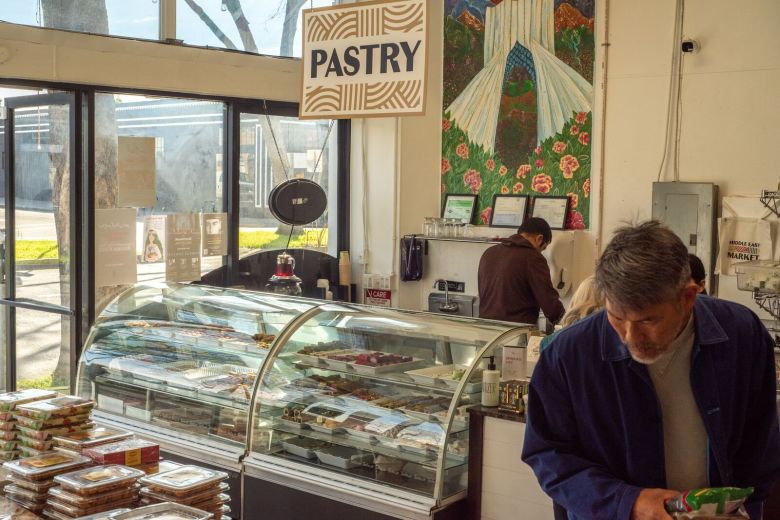 People shop at Middle East Market, a specialty grocer on San Pablo Avenue, ahead of Eid, on March 22. Credit: Ximena Natera, Berkeleyside/CatchLight Local
Stakeholders in the San Pablo-University area say they believe the key to revitalizing the intersection is to deepen business owners’ buy-in and interconnection; celebrate non-corporate and minority-owned local shops; and show appreciation for the vibrancy of the neighborhood through art.
The city is also in the early stages of planning for more “public right of way improvements” and “open space” along San Pablo Avenue, with a proposal expected to make its way to the City Council this fall, Planning Director Jordan Klein said. The San Pablo Avenue Specific Plan, funded by a grant from the Metropolitan Transportation Commission and the Association of Bay Area Governments, “articulates a vision for San Pablo Avenue,” according to city documents, and will “outline programs and policies to encourage and support diverse housing, commercial activities, and public amenities.”
San Pablo Avenue doesn’t have an official business association, but Councilmember Terry Taplin who represents the southern corners of the San Pablo-University intersection, wants to create either a merchant’s association or a business improvement district, he said in an email. Patel, the new president of the University Avenue Association, said the group “fell off” during the pandemic, but he has recently been going from business to business along the avenue to recruit new members.
We’re actually a very vibrant hub for the city that is very representative of the international essence of Berkeley.” Amir Razavi, owner, Middle East Market
And over the years, a few homegrown organizations have emerged to support local businesses and community members in the area.
Perhaps most exciting, a number of restaurants and local business owners have banded together to revive the Berkeley International Marketplace, a designation given to the area in 2006 with funding from the city’s economic development office.
Along with the banners installed on light posts throughout the area — some of which remain today — events were held in the parking lots of the 99 Cent Only Store and Wells Fargo, celebrating the multicultural heritage of the neighborhood.
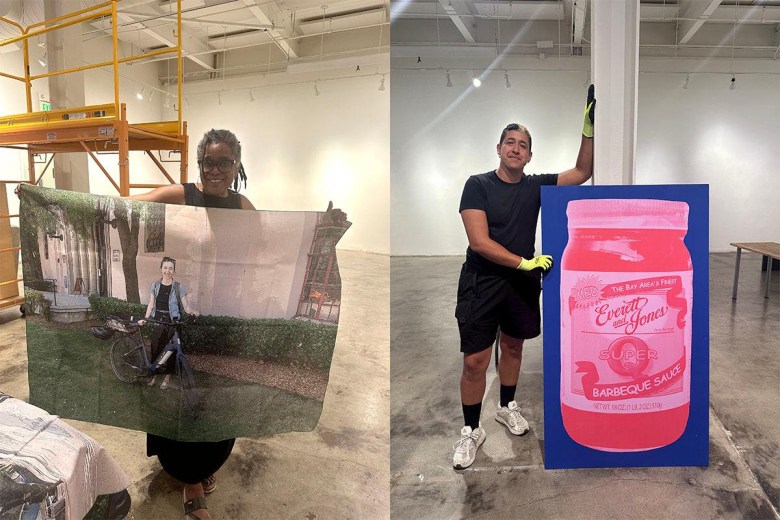 Cheryl Derricotte and Marcel Pardo Ariza with artworks that were shown at Kala Art Institute’s Roadwork exhibition that focused on several businesses near the junction of San Pablo and University avenues. Credit: Kala Art Institute
The international flavor of the area was highlighted in a recent project orchestrated by the Kala Art Institute in partnership with the city of Berkeley. Artist Marcel Pardo Ariza picked seven local businesses near the San Pablo-University intersection: Casa Latina, Belmo Cafe, Middle East Market, Heyma Yemeni Coffee, Rainbow Donuts, Everett & Jones, and Mi Ranchito Bayside Market. He then spent months interviewing and documenting the businesses, culminating in an exhibit called Roadwork, which ran at Kala from October 2024 to February 2025, and served food from all the businesses involved.
Deepak Ajmani, who took over Bombay Spice House on University in 1991, was involved with the International Marketplace in the mid 2000s, but said that, after a few years, enthusiasm and funding “slowly died down.” Now he is serving as vice-president of the new Berkeley International Marketplace. He said Bombay Spice House, first opened in 1947, was once a central part of the “hub” that drew people from all over the region seeking spices, specialty foods and community.
“People used to come from Reno to Fresno,” he said. “We had a music store here, two grocery stores, jewelry and clothing stores, so it was a hub for everybody.”
Ajmani’s wife, Shelly Ajmani — who recently opened Lishq, an “Indian-inspired” jewelry and wedding store inside the former Bombay Jewelry Company space on University — used to visit the area many referred to as “Little India” as a child growing up in San Francisco.
Around the corner from Bombay Spice House on San Pablo sits Middle East Market, a specialty grocer that opened in 1974 and imports items from around the world.
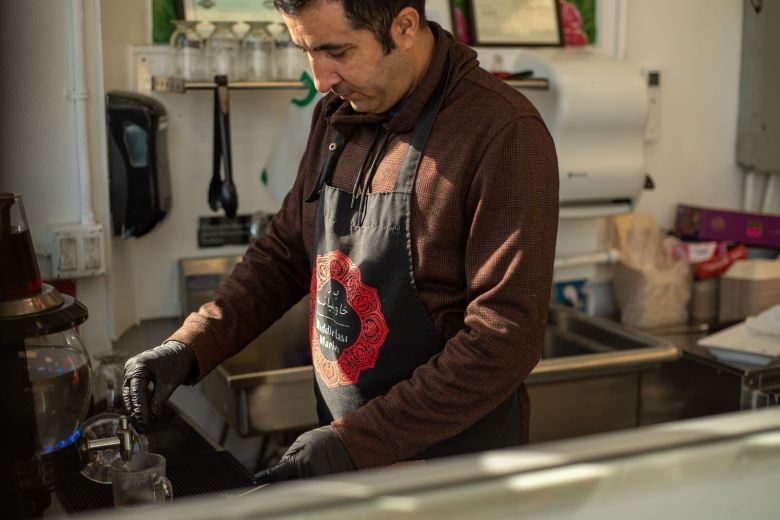 An employee at Middle East Market prepares tea. Every patron who shops there receives a free cup of tea. Credit: Ximena Natera, Berkeleyside/CatchLight Local
“ It was the first Middle Eastern market in Northern California,” said Amir Razavi who took over the market in 2015 with his father, Hossein, who became a loyal patron of the shop soon after emigrating to the U.S. from Iran in 1976.
“My dad’s dream was to have a business where people could get great food and have, an authentic experience with community,” said Razavi. “ So I wanted to fulfill that with him.”
Razavi is the president of the new Berkeley International Marketplace initiative.
“ We’re trying to revitalize and be like, Hey, we’re actually a very vibrant hub for the city that is very representative of the international essence of Berkeley,” he said. ”We want to incorporate everybody to have that sense of community amongst the merchants as well as the people living around the area.”
Let’s be real …
These are uncertain times. Democracy is under threat in myriad ways, including the right of a free press to report the truth without fear of repercussions.
One thing is certain, however: Berkeleyside was built for moments like these. We believe wholeheartedly that an informed community is a strong community, so we’re doubling down on our mission of reporting the stories that empower and connect you when it matters most.
If you value the news you read in this article, please help us keep it going strong in 2026.
We’ve set a goal to raise $180,000 by year-end and we’re counting on our readers to help us get there. And a bonus: Any gift you make will be matched through Dec. 31 — so $50 becomes $100, $200 becomes $400. Will you make a donation now in support of nonprofit journalism for Berkeley?
Tracey Taylor
Co-founder, Berkeleyside
“*” indicates required fields