
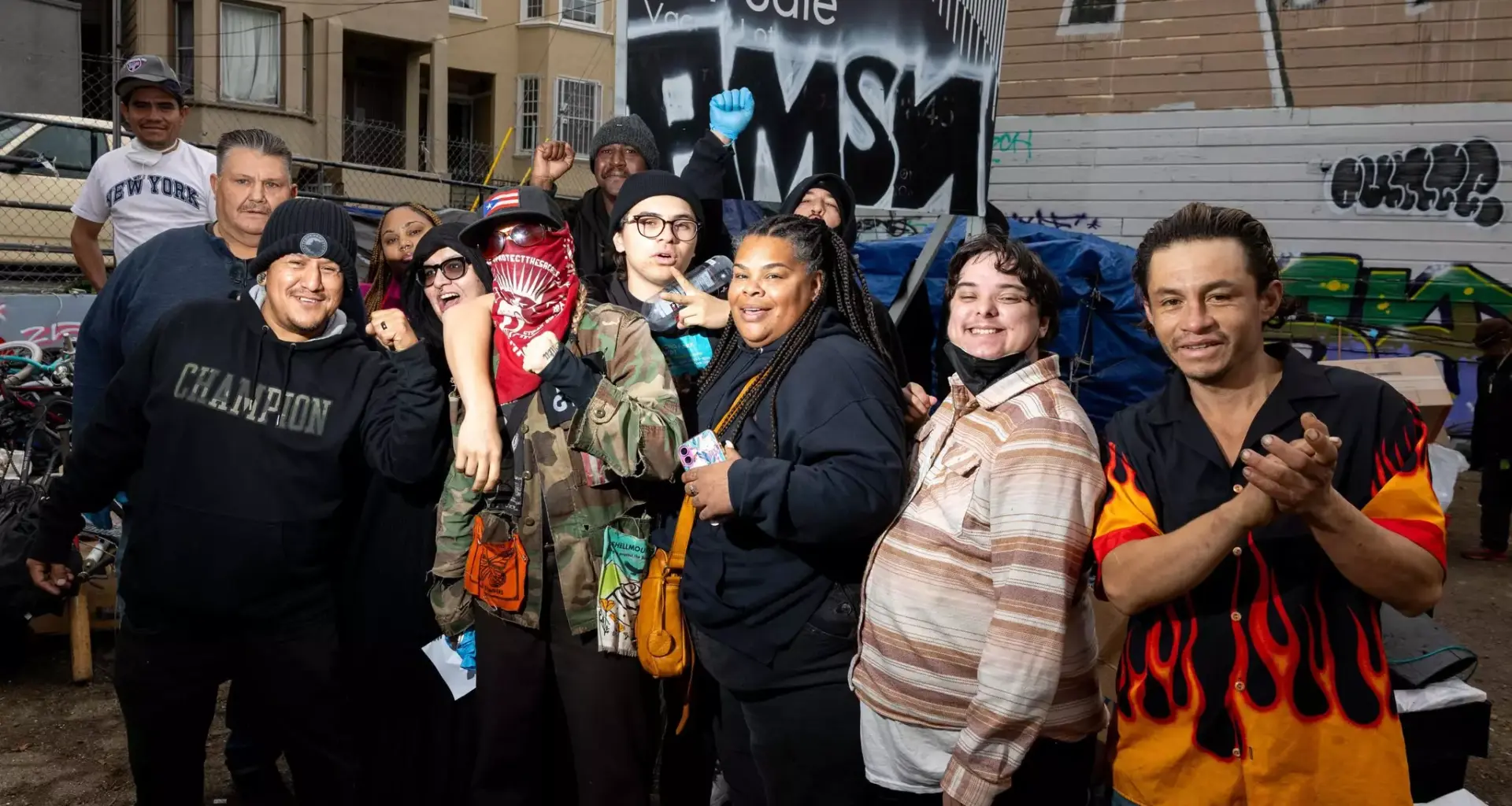
Look at the vacant lot wedged between Capp and Cesar Chavez streets, and all that’s apparent is a triangle of cracked cement, surrounded by graffiti. But Lisa “Tiny” Gray-Garcia sees a “pizza slice” of potential in the Mission.
“It’s very small, but one day this land will be rent-free, forever housing for poor and no-income families and elders,” she said. “We can’t build wide, but we can build up.”
A group of fundraisers purchased the fenced-in sliver of land in October for $475,000 and granted the deed to Poor Magazine, the media and advocacy organization Gray-Garcia founded with her mother in the 1990s while sleeping on the streets in Oakland. The lot will be the latest site of the group’s Homefulness Project (opens in new tab), a “homeless-person-led solution to homelessness,” that has already built an eight-unit townhome complex on Oakland’s MacArthur Boulevard. (opens in new tab)
Even as San Francisco has spent billions battling its homelessness crisis, the demand for housing far outpaces availability. Poor Magazine is trying to chip away at the problem in its own way. Gray-Garcia sees the Homefulness Project as a form of “radical interdependence” that gives poor and homeless people a voice and sweat equity in real estate.
“We’re moving past top-down charity models where people take the crumbs that rich people will give them and instead are self-determining their own solutions and creating ecosystems where you can be fed by the community and give food to the community,” said Mohini Mookim, a lawyer with the Sustainable Economies Law Center (opens in new tab), or SELC, which works with Poor.
Acquiring the land in the Mission was just the first step of what will be a complex, multiyear fundraising and development process. But the Poor team is activating the lot in other ways in the meantime.
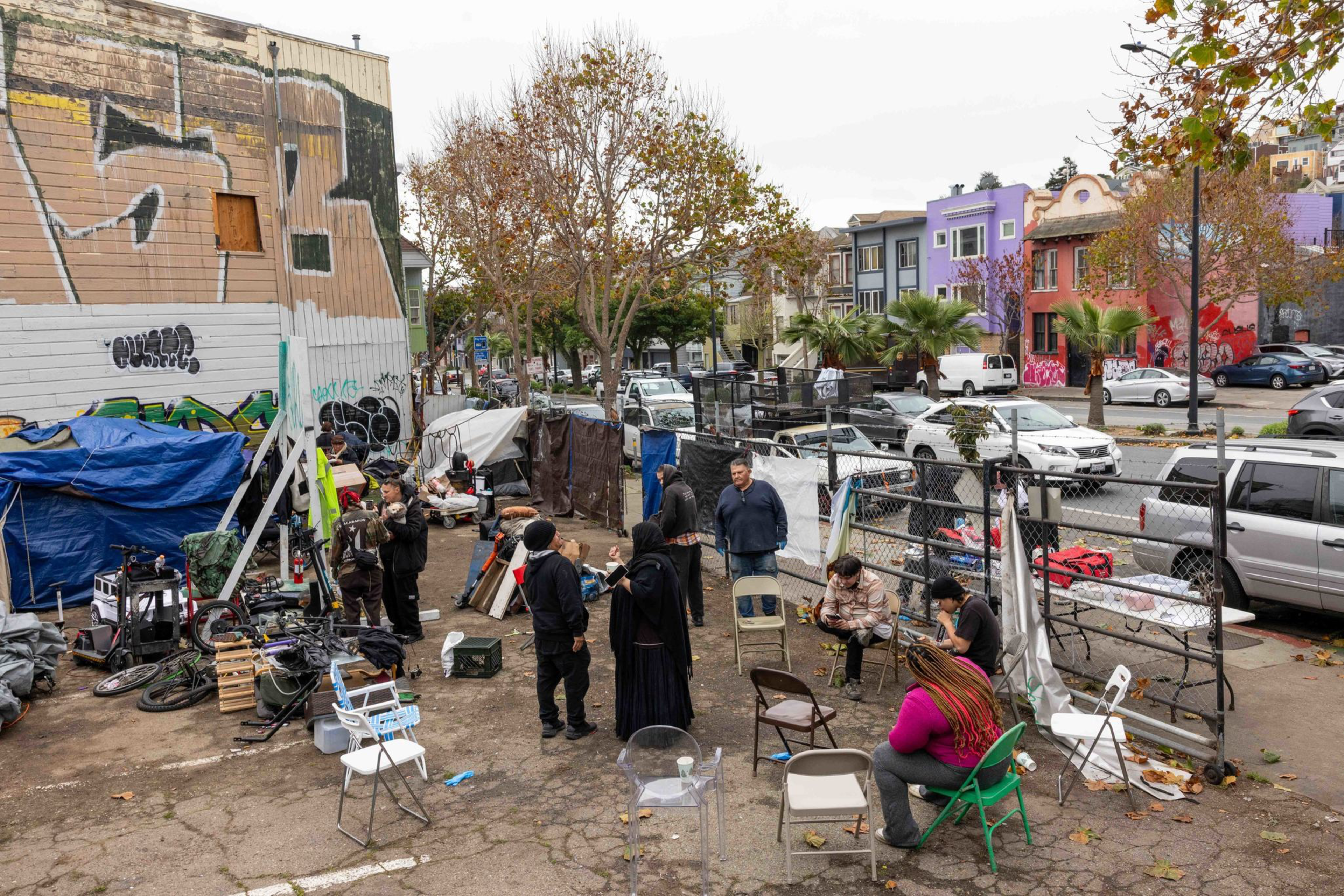 The Poor Magazine team meets at the lot at 3390 Cesar Chavez St. in December. | Source: Amanda Andrade-Rhoades/The Standard
 Lisa “Tiny” Gray-Garcia serves up meals to the people living at and around the lot. | Source: Amanda Andrade-Rhoades/The Standard
 The nonprofit aims to build rent-free housing on the site. | Source: Amanda Andrade-Rhoades/The Standard
On one Friday this month, Gray-Garcia and Poor Magazine supporters passed out food and clothing from the site and chatted with passersby about their ambitions.
“We’re talking to all of our poor and homeless community members on this particular block, because they’re going to guide us in our process,” Gray-Garcia said. “They’ll even perhaps be the future residents of this Homefulness Project.”
“We’re talking to all of our poor and homeless community members on this particular block, because they’re going to guide us in our process,” Gray-Garcia said. “They’ll even perhaps be the future residents of this Homefulness Project.”
Building ‘Trimalot’
Funding for the Cesar Chavez site came primarily from the local chapter of Resource Generation (opens in new tab), a wealth redistribution nonprofit, which raised $500,000 for Poor Magazine this summer.
Mookim, who also works with Resource Generation, donated extensively to the cause and said a team of volunteers worked with Poor to scout sites in the Tenderloin, Bayview-Hunters Point, and the Mission. They considered existing apartment buildings as well as empty offices and settled on the Cesar Chavez lot because of its combination of location, price, and potential.
“We endearingly call it ‘Trimalot,’” Mookim said. “It’s a sweet little triangle with zoning that allows for multifamily development.”
A previous owner’s abandoned plans from 2016 (opens in new tab) proposed a mixed-use commercial and residential building for the lot, with six units. The land is zoned for development up to 65 feet high.
Poor is working on plans with architects and engineers who are offering their services pro bono.
Architect Josh Cuthbertson is conducting a feasibility study for the lot; initial ideas include a three-story building with 13 units or a five-story building with 26 units. Over the next six months, he hopes to collaborate with other professionals to finalize designs, complete cost estimates, and prepare a preliminary package for submission to the Planning Department.
“The directive from Poor is, how do we help the greatest number of people in a way that they can actually fund?” Cuthbertson said. “It’s going to be really difficult, but they have the drive and the passion — they’re going to find a way.”
Poor publishes magazines, books, and articles, leads journalism workshops, streams radio broadcasts from homeless encampments, and provides PeopleSkool training (opens in new tab), which teaches people with race and class privilege about “degentriFUKation” and ways to build solidarity with people in poverty, among other advocacy.
In addition to the apartments, the building will ideally have a ground-floor cafe, which would operate with sliding-scale prices, as well as a community center that can act as a “healing hub,” according to Gray-Garcia, adding that it’s crucial that the facility have resources to help people process and work through the trauma of living on the streets.
“There’s going to be so much time, effort, and work involved, and we’re going to have to raise a whole gaggle of money,” Gray-Garcia said. “As poor and homeless people, we don’t have resources, so it’s likely going to be slow. But we know it’ll happen someday.”
 Ideas for the lot include a three-story building with 13 units or a five-story building with 26 units. | Source: Amanda Andrade-Rhoades/The Standard
The project’s stakeholders were wary of putting a timeline on the project. Poor Magazine learned through its Homefulness project in Oakland that the process can be arduous: That inaugural effort took more than a decade to complete (opens in new tab), during which the Building Department and other city agencies “were negligent or outright hostile” to the plans, according to SELC. For example, standards changed from inspection to inspection, timelines dragged out, and some fees and requirements seemed arbitrary (or infuriating) (opens in new tab).
The group doesn’t expect its Cesar Chavez process to be easier. San Francisco has a notoriously laborious development process, and complaints from neighbors have shut down past efforts to provide housing for homeless people. The office of Supervisor Jackie Fielder, whose district includes the Cesar Chavez site, didn’t respond to a request for comment about Poor Magazine’s plans.
Still, Gray-Garcia is optimistic.
“I’m not very patient,” she said with a laugh. “I work on the street every day supporting my fellow houseless people, so I see the need. I don’t want something to take a decade. I’m hoping for more like five years.”