
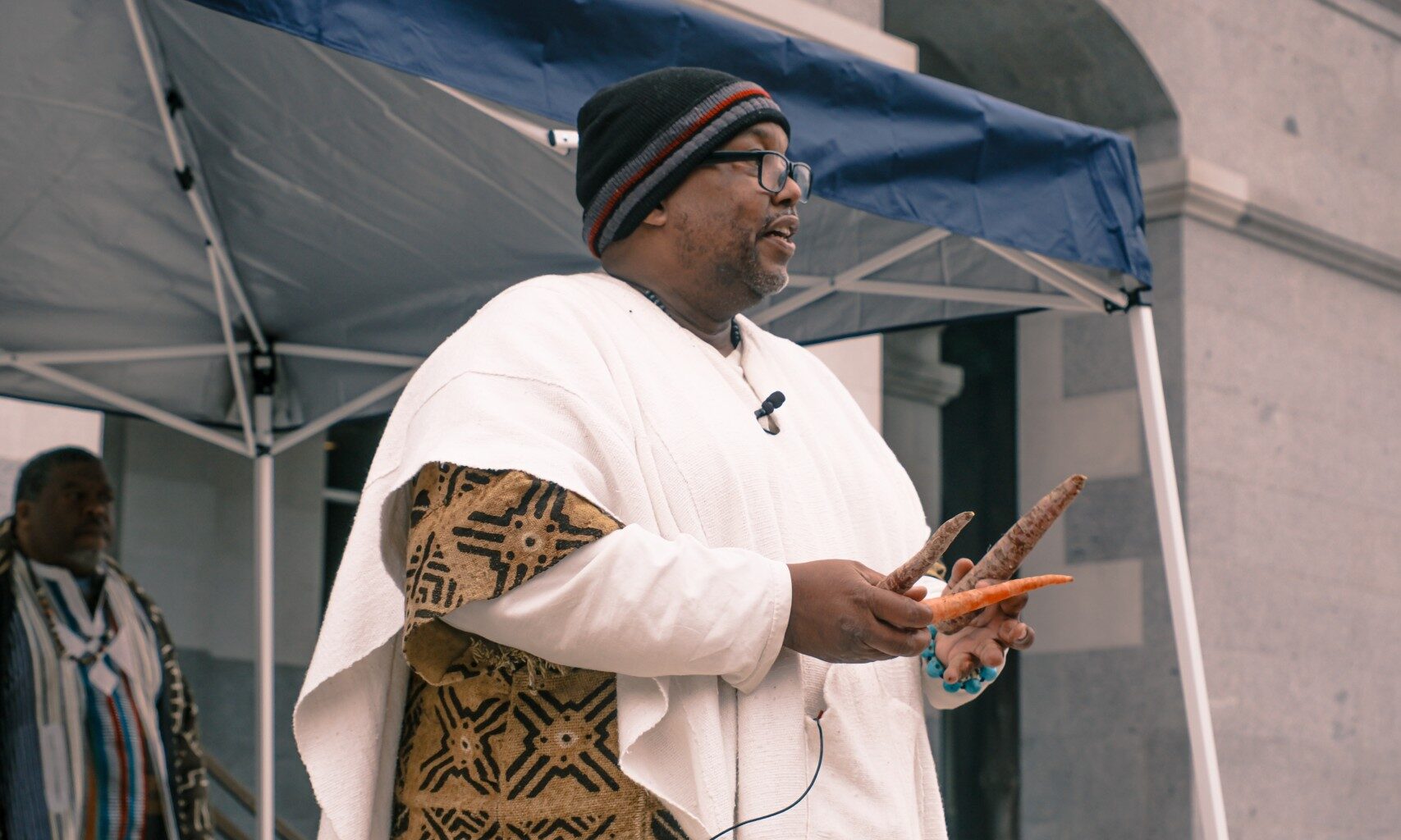
The 27th annual State Capitol Kwanzaa Celebration took place on the Capitol steps in Sacramento on Monday morning. The California Black Agriculture Working Group joined the Sacramento community in celebrating Pan-African culture.
The first Kwanzaa was celebrated in 1966 by its creator Maulana Karenga, who wanted to create a cultural holiday to celebrate African heritage. Michael Harris, who helped organize the event, said the holiday celebrates harvest traditions of many African cultures.
The seven days of Kwanzaa, which began on December 26 and run through January 1, represent seven different ideals of African Heritage that Karenga set out: Umoja, meaning unity; Kujichagulia, meaning self-determination; Ujima, meaning collective responsibility; Nia, meaning purpose; Kuumba, meaning creativity; and Imani, meaning faith.
Harris talked about these principles after libations were poured on the Capitol steps.
“Throughout the year, we try to live the principles of Kwanzaa,”Harris said. “[We try] to encourage the members and staff to consider the legacy, the history of Kwanzaa, and how it was created here in California.”
The Black Agriculture Working Group aims to work with legislators at the Capitol to represent the state’s African American population.
“[We want to] infuse some of the principles of Kwanzaa into the public policy that makes up the fourth largest economy on the planet,” Harris explained.
Harris also discussed the Bureau for Descendants of American Slavery that’s being established in the new year. The mission of the new state agency is to educate and advocate for reparations and against disenfranchisement.
Harris said that while the bureau is a step in the right direction, there’s still more to be done for African American representation in California.
“1,918 of the colored troops that fought, bled and died [in the Civil War] came from California. They’ve never been honored,” Harris said. “Juneteenth is not a holiday in the great state of California. We’re going to work on that this year.”
The state of California recognizes Juneteenth as an official state holiday, but state employees do not automatically get the day off as a paid holiday.
He said that an important conversation is set to take place this year for Black representation and reparations.
“The best and brightest were stripped from Africa and brought to this country, and worked for many years without pay,” Harris said. “There’s an economic conversation that’s going to happen here in California, and this is the first official place it’s going to happen.”
CapRadio provides a trusted source of news because of you. As a nonprofit organization, donations from people like you sustain the journalism that allows us to discover stories that are important to our audience. If you believe in what we do and support our mission, please donate today.