
This year was daunting for Silicon Valley leaders and their efforts to confront homelessness.
Actions to stem the growing tide of people falling into homelessness were threatened by federal and state funding cuts, on top of a record number of people losing their housing, driven by rising costs. Santa Clara County and San Jose leaders rose to the occasion by adjusting their strategies to buffer the storm.
San Jose opened nearly a dozen new temporary housing sites and brought hundreds of people indoors. At the same time, the city made it increasingly harder for people living on the streets through policies that criminalize homelessness, including arresting those who refuse shelter, RV bans and no-encampment zones. The county continued its work funding numerous permanent affordable housing projects to help stabilize life for hundreds of residents.
Here are the top policies and changes to homelessness and housing that defined 2025.
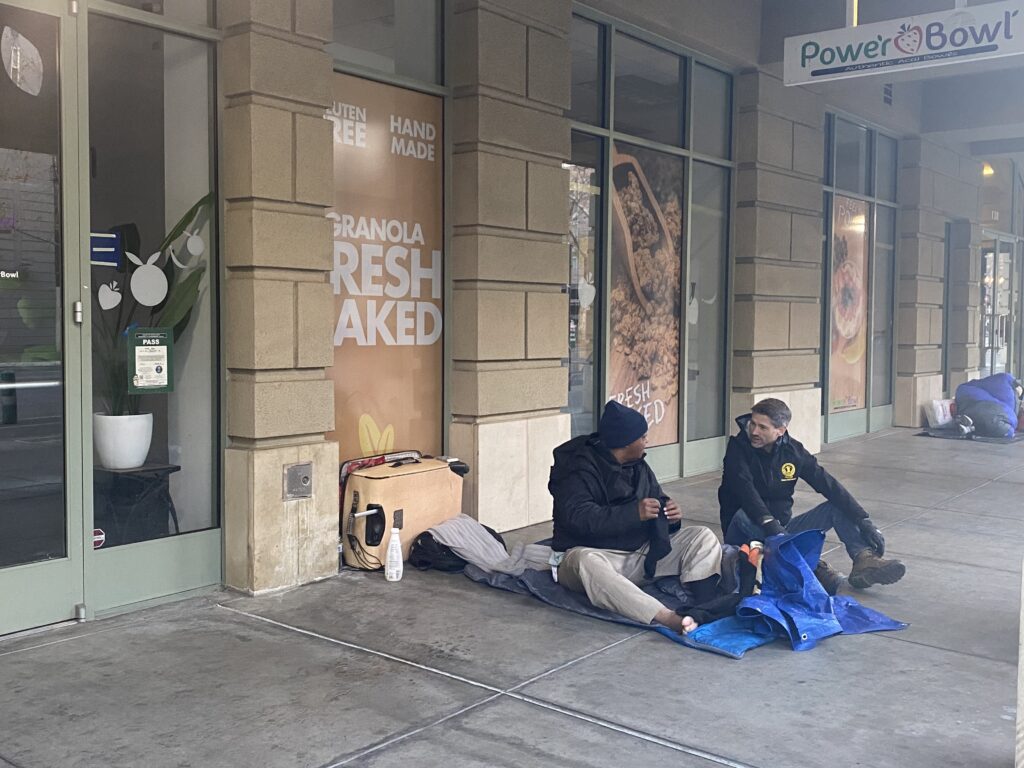 San Jose Mayor Matt Mahan (right) speaks with a homeless person in downtown for the point-in-time count on Jan. 22, 2025. Photo by Joyce Chu.
Homelessness by the numbers
Santa Clara County has a record number of more than 10,700 homeless people, according to a January point-in-time count conducted every two years. San Jose has 6,503 homeless residents, up 237 people from the 2023 point-in-time count. Chronic homelessness has increased 21% from the 2023 count, with 4,650 people who have been homeless for a year or longer.
More people are reporting being homeless for the first time, at 58% of the more than 1,500 homeless people surveyed during the count. That’s almost double from two years ago.
The loss of a job or income is the primary reason 27% of people report becoming homeless.
Even though homelessness continues to rise, deaths have dropped more than 20%. Approximately 155 homeless people died between Dec. 1, 2024 to Nov. 30, 2025, down from 197 the previous year.
 The vacant lot at 1157 E. Taylor St. in San Jose has room for up to 56 people to sleep in tents without fear of being swept, and includes eight ADA tents. Photo by Joyce Chu.
Expanding shelter and housing
San Jose more than doubled its temporary housing this year, adding nearly 1,000 new spaces across 11 sites, including the tiny home villages at Cherry Avenue, Via del Oro and expanded Rue Ferrari. In total, the city has more than 1,700 temporary housing spaces.
The city added another safe parking site at 1300 Berryessa Road and opened its first safe sleeping site at 1157 E. Taylor St. in the summer. It also converted five motels to house homeless people.
This has led to a significant drop in San Jose’s unsheltered homeless population despite the rise in homelessness. About half of the city’s homeless population is now sheltered, according to Mayor Matt Mahan, down from when only a quarter were sheltered in 2022 and 5,000 lived on the streets.
The county and San Jose also began a joint partnership to bring treatment services directly to residents living in temporary housing. The county and city’s referral process is now streamlined under one system so homeless people in need of mental health or substance use services can get the appropriate treatment.
In addition, more than 900 new affordable apartments were built throughout the county. Construction began on another 655 apartments using Measure A funding, the $950 million affordable housing bond passed by voters in 2016.
This year the county also had to contend with federal government disruptions for permanent housing funds. Over the past decade more than 5,700 affordable apartments have been built with Measure A funds.
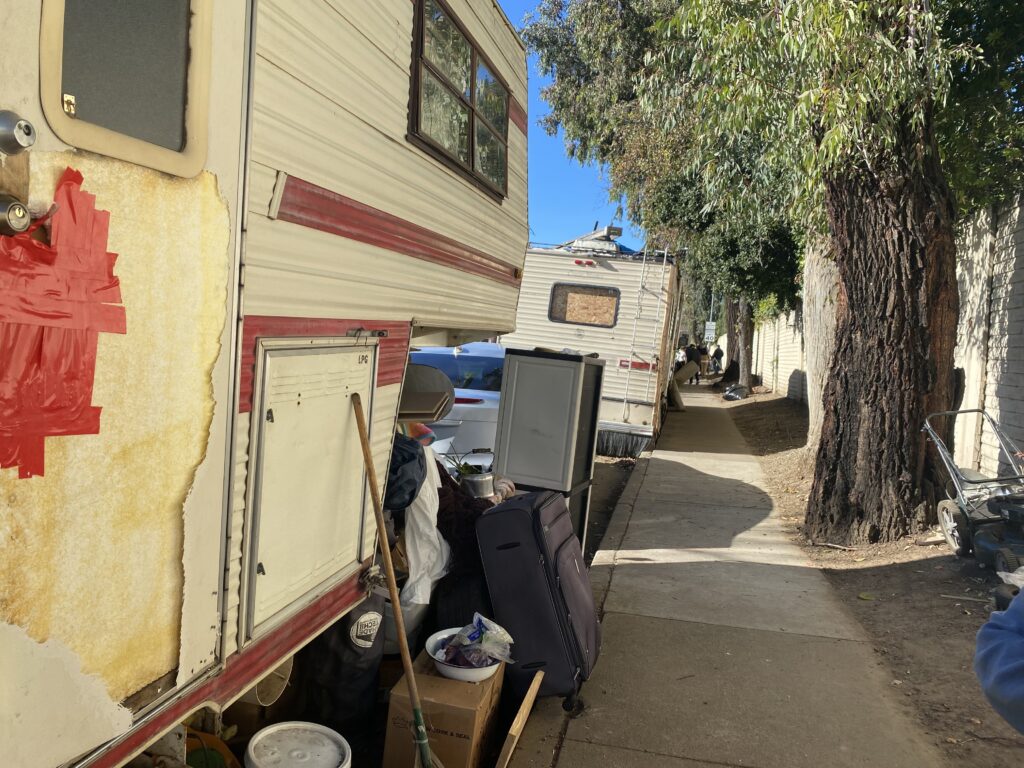 There were 19 vehicles parked along Chynoweth Avenue, the first site targeted in the city’s temporary RV ban. Photo by Joyce Chu.
San Jose City Council homelessness policies
Mahan introduced his controversial policy to cite and arrest homeless people who refuse multiple offers of shelter, and the City Council voted to approve the policy. To enforce this policy, the city formed a new police unit called “Neighborhood Quality of Life” comprised of one sergeant and six officers. It also created an in-house outreach team to build a case file of every homeless person encountered.
Mahan said it’s meant to connect people to the county’s Behavioral Health Court and into treatment.
But in order to access the system, the person must be in jail and appear before a judge. State law prohibits holding people who commit nonviolent misdemeanor charges in custody. Homeless people will often be released within hours or days, thus preventing them from connecting to treatment.
Councilmebers also voted to shift up to 90% of Measure E money to help fund temporary shelters through fiscal year 2026-27. Measure E is a property transfer tax passed by voters in 2020 to fund permanent affordable housing.
The city started a program temporarily banning RVs from dozens of sites and prohibited “vanlording,” or renting RVs to homeless residents to use as homes.
It began citing and towing vehicles with expired registration of more than 6 months.
San Jose also launched “Homeward Bound” — a program to bus homeless people out of the city to reconnect them with family.
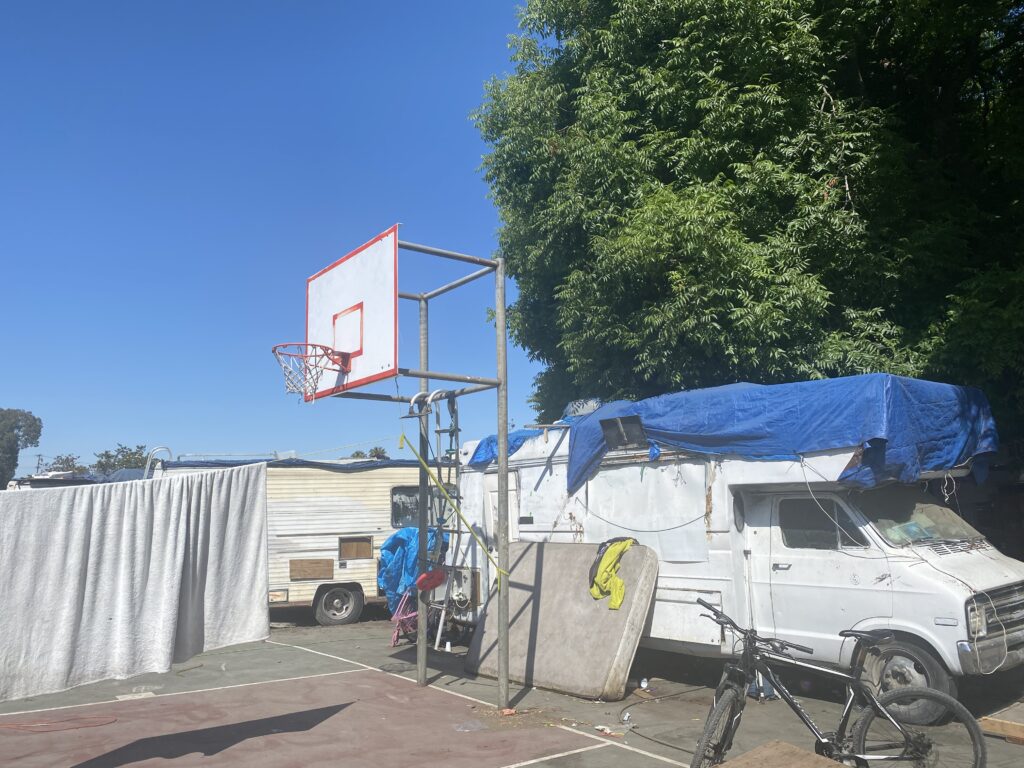 San Jose swept its largest homeless encampment at Columbus Park earlier this year. File photo.
Increasing encampment sweeps
San Jose disbanded its largest homeless encampment at Columbus Park this summer, where roughly 370 people and 120 lived-in vehicles congregated. Those willing to participate in the city’s RV buyback program were moved into five recently converted motels.
San Jose cleared nearly 23 miles of encampments and trash along the waterways and removed 12 million pounds of debris. It’s part of the city’s effort to comply with the Clean Water Act and reduce pollution in the waterways — or face a fine. Mahan has said roughly 90% of pollution in local creeks and rivers is caused by homeless encampments.
The city installed new no encampment zones, bringing the number up to more than a dozen.
Federal actions
State and federal funding cuts are making it challenging for the county to continue the progress it’s made.
This fiscal year, the state zeroed out its main source of homelessness funding called the Homelessness Housing, Assistance and Prevention Program. Due to the timing of when state dollars are distributed, the impact won’t be felt until next fiscal year, resulting in a loss of about $30 million for San Jose. In July, President Donald Trump called for the end of a strategy to address homelessness called “housing first,” which prioritizes providing permanent housing with no job or sobriety requirements. Following an executive order, the U.S. Department of Housing and Urban Development rolled out a plan to cap permanent housing grants at 30% and shift the rest to temporary housing.
Santa Clara County and a coalition of 10 local governments and nonprofits sued the federal administration. The December lawsuit has temporarily halted efforts that would have put more than 1,800 county residents at risk of getting evicted.
Contact Joyce Chu at [email protected] or @joyce_speaks on X.