
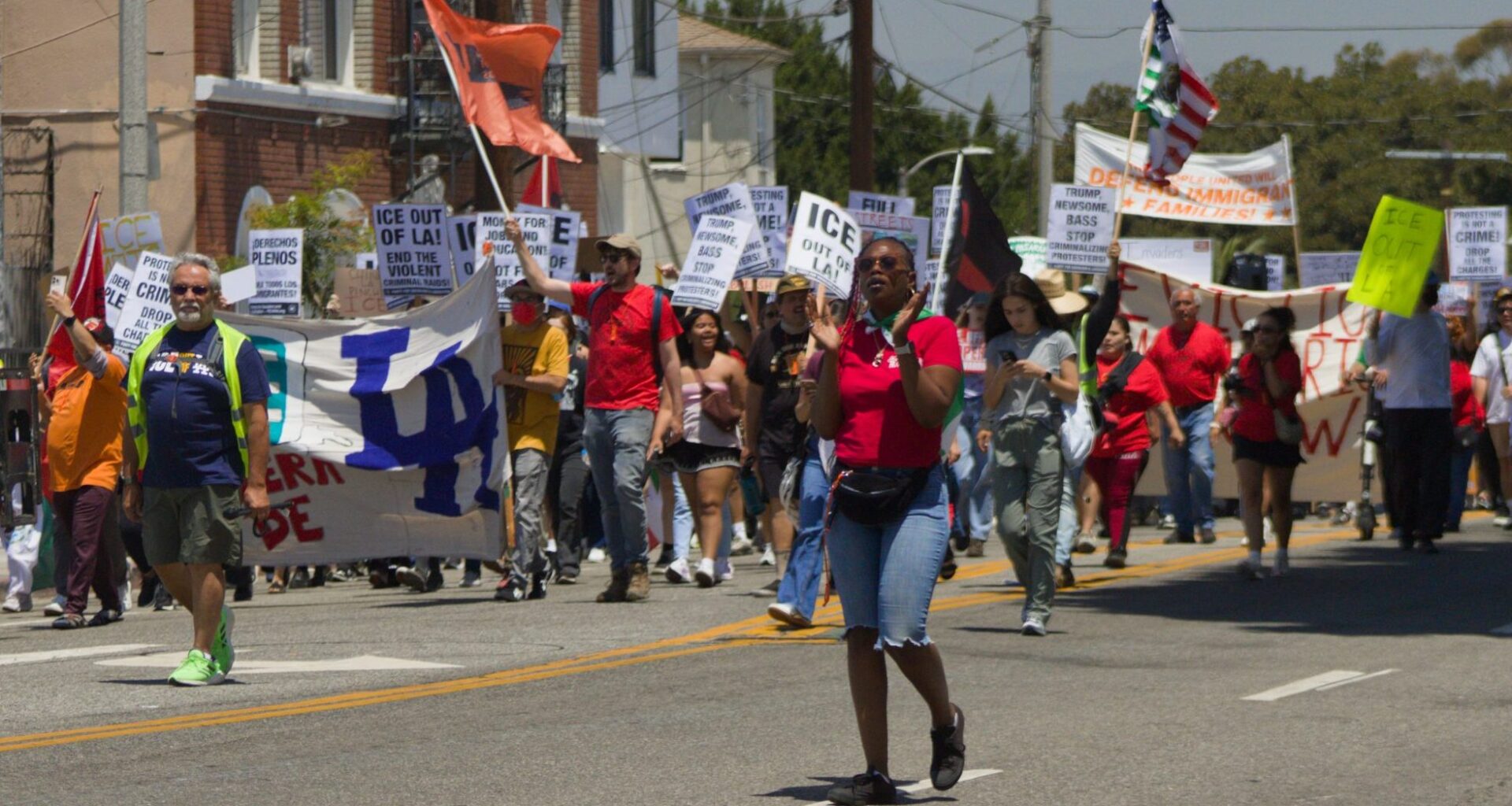
My goodness, 2025 won’t go down without a fight. But neither will Los Angeles.
The recent violent, tragic deaths of some great Angelenos — Rob and Michele Reiner — to end the year serve as a heartbreaking reminder that life is so fleeting and we are all blessed to still be here fighting.
Don’t get me wrong. It’s hard to be optimistic if I look back at the past 365 days too narrowly.
This year of fire and ICE flew by, but the days often dragged on in what feels like the most challenging and consequential 12 months Los Angeles has faced since … well, since the previous 365 days? And the year before that? When was the lockdown again? Could we possibly feel nostalgic for that time when we all stayed home?
Back in the first few terrifying months of the COVID shelter-in-place orders, LA felt pretty united. That unity was a silver lining for a sprawling metropolis that is often divided by freeways, arguments about what is really the true Eastside and social class.
Half a decade later, LA County’s roughly 10 million residents began 2025 arguing about housing, traffic, local and national politics, restaurant closures and the Golden Globes — bracing, as always, for whatever the titular angels who guide this beautiful, messy metropolis might throw at us.
Then the wind picked up.
And the fires came.
Some 39,000 acres scorched resulting in 32 deaths, 100,000 people displaced, and more than 16,000 structures burned. And those deaths are not counting the smoke inhalation-related fatalities that officials are still trying to unravel.
But what followed wasn’t just those massive losses.
It was neighbors knocking on doors, group chats turning into supply chains, mutual aid networks scaling overnight because they’d already been rehearsing during years of unreliable leadership, soaring health care costs, workers’ strikes and post-pandemic growing pains.
 A man sorts through donations at Boyle Heights City Hall. Photo by Andrew Lopez / Boyle Heights Beat
As that humble hero of a bygone era, Fred Rogers, once noted, “Look for the helpers,” and you will find good even amid the horrific. As the fires blazed with seemingly no end in sight, the people of Los Angeles came together to help the people of LA. Angelenos opened their homes to displaced families they’d never met, while neighborhood Facebook groups became ad-hoc logistics hubs — coordinating spare bedrooms, pet fostering, N95s, diapers and generators. Local restaurants cooked for free, feeding evacuees and first responders even as their own dining rooms sat empty. Mutual aid groups that once organized rent support and grocery runs during the pandemic pivoted overnight to fire relief.
Those same networks didn’t disappear when the smoke cleared, and ICE besieged the city.
When immigration raids tore through families and workplaces, when fear spread faster than any evacuation order, mutual aid groups once again sprang into action — quietly helping families relocate, raise bond money, educate people on their rights and keep kids in school when parents disappeared from job sites.
That’s the part of 2025 that doesn’t always make the headlines: the way crises trained us to show up for one another, and how the infrastructure built in disaster became a tool for resistance, care and survival.
In the end, “the helpers” were us.
If I had to guess, 2025 will remain one of the most consequential years in the recent history of El Pueblo de Nuestra Reina de Los Angeles.
But the story of 2025, the year LA fought fire and ICE, isn’t about the struggle. It’s about the fighters.
And, hey, the Dodgers won the World Series.