
Happy New Year, readers!
Between UC Berkeley Chancellor Rich Lyons testifying before the U.S. House, Cal football firing its coach after a major Big Game loss and UC Berkeley turning over 160 names to the federal government, it’s certainly been a year to remember. Walk down memory lane with me as I highlight some of the most newsworthy events in the city and on campus this year, with a little background info from the brilliant reporters who covered them. Without further ado, here are the top 10 stories of 2025 from The Daily Californian.
— Ella Carter-Klauschie, senior staff news reporter
(This story appeared in our daily newsletter. Click here to subscribe.)
April 15: International students fight visa terminations, allege biometric tracking
At the onset of Trump 2.0, the Department of State and the Department of Homeland Security began eliminating the immigration and travel status of international students across the country. The cuts came fast, with little identifiable pattern explaining why some international students faced status termination and why some did not. UC Berkeley was one of the most affected, with 23 Student and Exchange Visitor Information System, or SEVIS, terminations. Alongside Ava Hu from the J-School, I came into contact with a group of international students organizing across the country in internet chatrooms and message boards that were employing data analysis to determine what factors led the federal government to terminate visas or SEVIS statuses. We worked with international students at UC Berkeley and other universities and found fingerprinting in a law enforcement interaction to be the single greatest correlator. We were the first to publish the news that President Donald Trump’s administration had begun to reverse all SEVIS and visa terminations nationwide. Ava and I won an SPJ NorCal Breaking News Award for our story on status reversals.
— Aarya Mukherjee, Fall 2025 University News Editor
July 4: Nationwide education funding freeze puts BUSD and UC Berkeley programs at risk
This article made clear how abruptly federal decisions can reach into local classrooms. Reporting on the funding freeze meant covering the scale of the money involved and the smaller effects on students and educators. Conversations with teachers and administrators revealed how much planning depends on funds that are usually considered reliable. Instead of abstract budget numbers, the reporting centered on programs, staff roles and student support systems at risk. Working on this piece was a reminder that education policy is felt most strongly at the start of a school year, when uncertainty can reshape plans for schools, families and the people responsible for supporting them.
— Emily Wong, news staff
July 15: LIVE: UC Berkeley Chancellor Rich Lyons testifies before Congress on campus antisemitism
Reporting on Chancellor Lyons’ congressional hearing on alleged campus antisemitism was truly a team effort. The Daily Cal ran comprehensive coverage of the hearing from start to finish thanks to tireless work from news editors, night editors, social media producers and especially Aarya Mukherjee and Hayes Gaboury, who reported live from Washington, D.C. From an in-depth analysis of Lyons’ performance to a short-form video recap, the Daily Cal machine was firing on all cylinders. Nowhere was this more apparent than in our live updates on our website and on social media. The Daily Cal team assembled at the office at 7 a.m. to watch the livestream and collaborated to pull out the most important moments to highlight for our readers — from interruptions from protesters to grilling from multiple representatives — without removing quotes from their context. As a whole, the nearly 24 hours of nonstop coverage is some of the best work we’ve published this year.
— Clara Brownstein, Fall 2025 Managing Editor
August 7: Berkeley one of 18 sanctuary cities targeted by federal government
Reporting on Berkeley’s inclusion on the Trump administration’s sanctuary city list was a reminder of how national politics show up at the local level. While much of the reporting focused on policy, lawsuits and official statements, it was also important to highlight how these decisions impacted the community. As a reporter, the experience reinforced the responsibility to explain government actions accurately, especially when the stakes are high for those in Berkeley.
— Emily Wong, news staff
September 10: UC Berkeley turns over personal information of more than 150 students and staff to federal government
Amid intense negotiations between the federal government and the UC Office of the President, or UCOP, concerning a potential deal to restore more than $500 million pulled grants from UCLA, the UC Berkeley administration sent an email to roughly 160 students and staff informing them that their names and information had been shared with the Trump administration. The 160 were told that the disclosure was something of a legal obligation, which has not been verified and still faces scrutiny. I broke the news of this disclosure. The backlash was immediate. Thousands of faculty, staff, students and union members decried the move as state legislators demanded answers. The disclosure was made at the UCOP’s discretion and the OCR investigation turned out to be something of a witch hunt, as reported by ProPublica and the LA Times. The U.S. Department of Justice lawyers who were sent to investigate UC Berkeley have since quit. University community members and state watchdogs called the disclosure a “capitulation” and Gov. Gavin Newsom announced an independent review into the move.”
— Aarya Mukherjee, Fall 2025 University News Editor
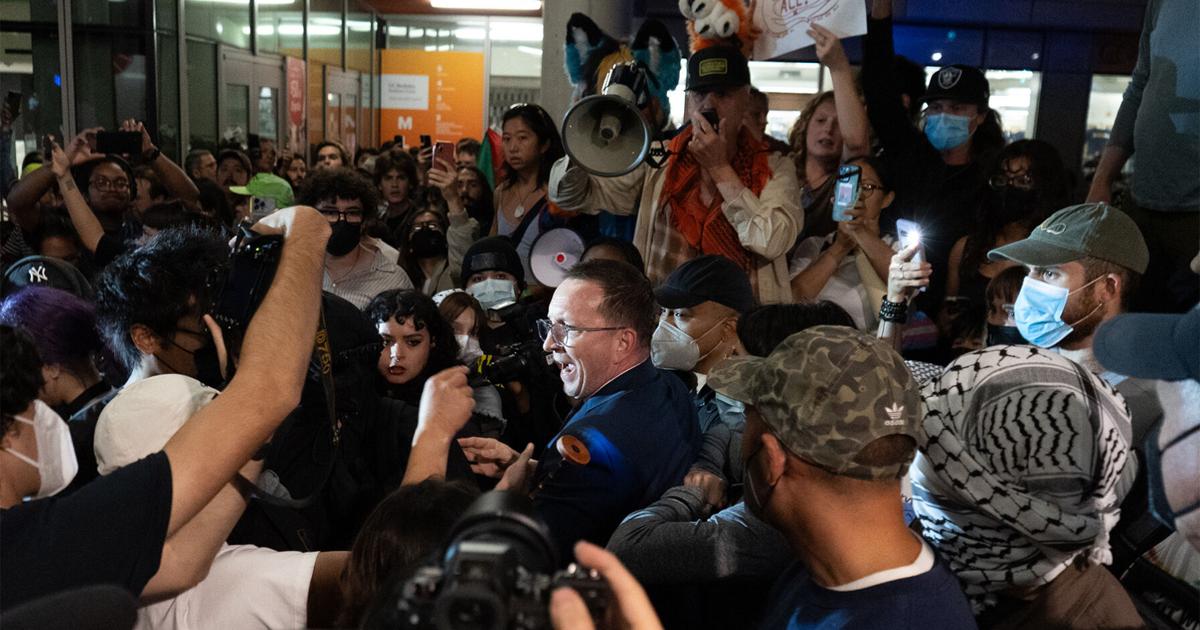
November 11: Protesters, armed police swarm UC Berkeley at turbulent Turning Point USA event
When Turning Point USA announced that the final stop of its tour following the death of right-wing commentator Charlie Kirk would be at UC Berkeley, our newsroom got to work. In the hours leading up to the event, a group of the Daily Cal’s best reporters, photographers and videographers fanned out across campus, capturing the event as passionate protesters chanted behind police barricades and attendees in line rallied in support of Kirk’s legacy. Within hours, we pulled it all together into a 1,500-word story that looked past the spectacle the event would become online and captured the moment as part of UC Berkeley’s long history of political action.
— Alexa Vazquez, Spring 2026 University News Editor
November 14: ‘Middle Housing’ aims to reduce costs for entry-level homeownership
I was grateful to build on (fall deputy news editor Paarth Mishra’s) coverage of “middle housing.” As I interviewed community organizations that hoped for justice or feared the worst from these policies, Paarth made sure I pressed my sources on how effective the ordinance would actually be. I worked on this piece for four days. Once I put my notes together, I realized I had enough information from all sides of the “middle housing” debate to put my sources in conversation with each other within my article. I was proud that (fall city editor) Chesney liked my approach and saw the dialogue I tried to create between nonprofit leaders, city planners, professors and ultimately Daily Cal readers with this story.
— Syontoni Hattori-Chatterjee, news staff
November 23: Cal fires head football coach Justin Wilcox after Big Game loss
Following the Big Game, we all had suspicions regarding Wilcox’s fate, so when fall sports editor Michelle Moshkovoy reached out with the news, we immediately jumped on the piece. It felt like a once in a lifetime story as an undergraduate football reporter — Abel and I wanted to get it right. The cherry on top was being able to confirm with our own sources, not just ESPN.”
— Stefania Bitton, sports senior staff
We got a text: “It happened.” I immediately ran to my computer. After texting my editors and seeing the Pete Thamel tweet on Twitter confirming everything, Stefania and I volunteered to write the story. It happened all too quickly and I was probably processing the news as we wrote it.
— Abel Anguiano, sports senior staff
November 24: Amid development delays for People’s Park supportive housing, mixed messages suggest a change of plans
People’s Park has long been a Berkeley institution, and the recent development projects on the land have caused many points of contention within the community. What started as a short follow-up story on campus’s plans for supportive housing turned into a month of investigation thanks to a tip from an anonymous source. The story reinforced the importance of keeping in close contact with the Berkeley community, not just campus and students, and never taking people’s statements at face value.
— Nora Lounibos, news staff
December 8: UC Berkeley suspends lecturer Peyrin Kao for pro-Palestinian speech in the classroom
The Daily Cal was the first to cover Kao’s suspension, beating competing publications, including the San Francisco Chronicle, by more than 24 hours. We obtained news of Peyrin Kao’s suspension prior to its official announcement and immediately got to work. We left no stone unturned, speaking with student groups, union leaders and Kao himself. We also linked Executive Vice Provost Benjamin Hermalin’s letter to the EECS department, which was cited by every other article on the suspension.
— Litong Deng, Spring 2025 Deputy News Editor