
When Ki Kim was outlining the dishes for Restaurant Ki, his 10-seat modern Korean tasting-menu counter secreted in the basement of Little Tokyo’s Kajima Building, he knew his meal needed a center of gravity — a midpoint course to balance the opening parade of seafood snacks with several heftier, saucier, pre-dessert dazzlers.
Just before the pandemic Kim had been sous chef at Blanca, a now-closed restaurant in Brooklyn run by the people behind pizza icon Roberta’s. A raviolo filled with gushing ’nduja had been Blanca’s center-of-gravity dish. It was carb-rich, it was compact, it was sating without wiping out diners’ appetites. At his own place, Kim thought, he could achieve these qualities with a bowl of noodles.
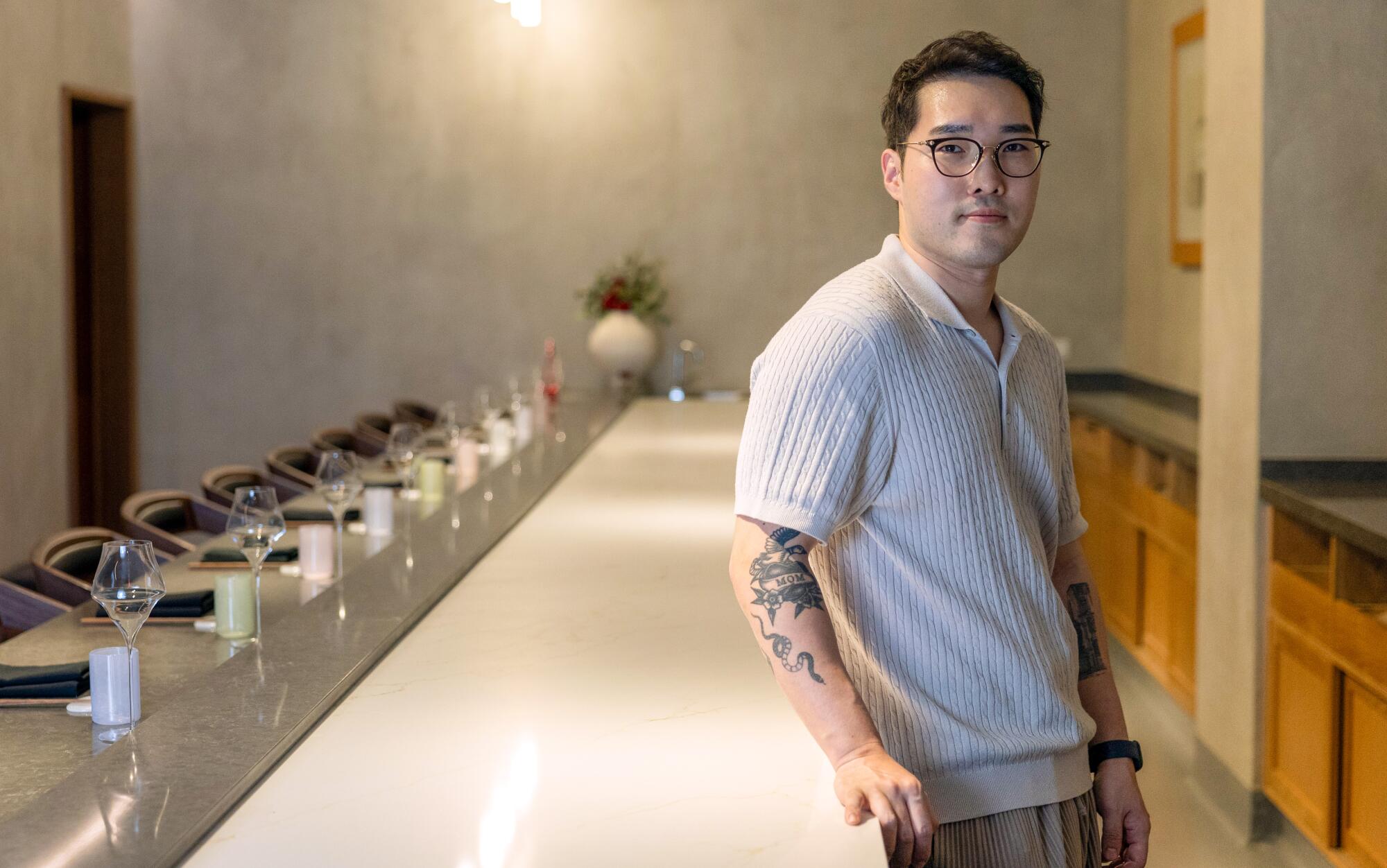
Restaurant Ki chef Ki Kim first introduced his cooking to L.A. at 20-seat Kinn in Koreatown. His signature there paired crispy octopus with gochujang aioli, a riff on a course at New York’s pioneering modern Korean restaurant Jungsik, where Kim once worked.
(Myung J. Chun / Los Angeles Times)
He opened in January 2025, and by late spring Kim and his team had landed on an ideal, adaptable recipe.
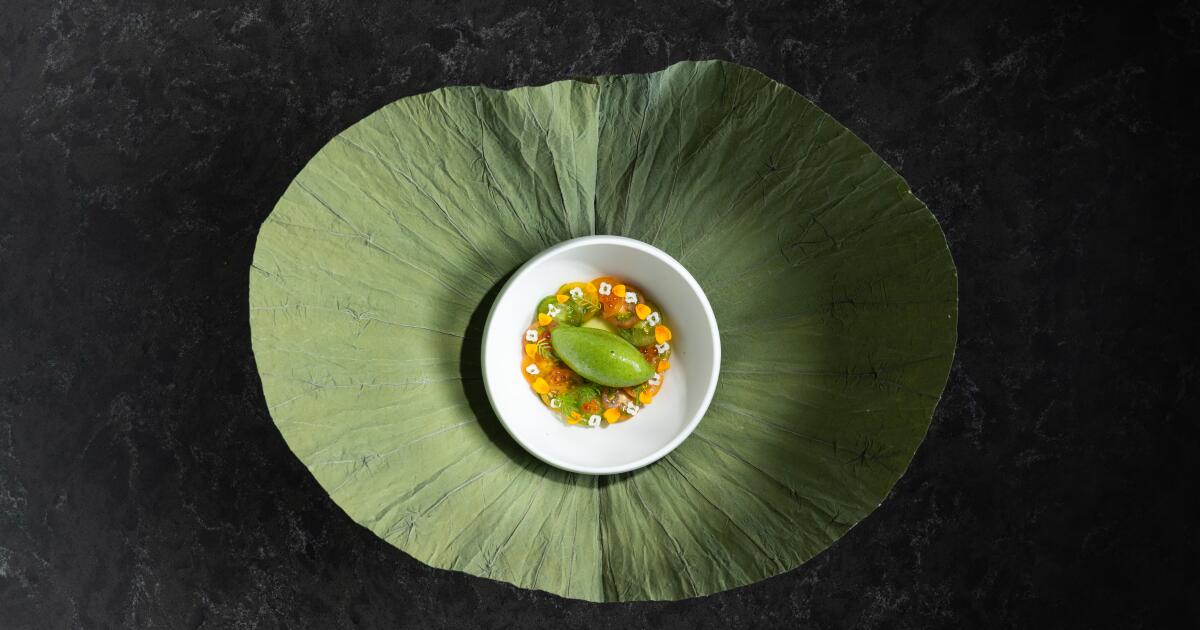
No one plate or moment specifically makes Restaurant Ki the best new restaurant to open in Los Angeles in 2025. It’s the flowing sum of the meal: a stinging two bites of minty perilla-leaf sorbet, the surprise when gochujang and tarragon meet on the palate, the way a splotch of doenjang gives sunny beurre blanc sudden brooding depths.
I never stop thinking of the noodles, though. They’re the finest example of how, beyond thrilling skill and narrative clarity, Kim carries off the rarest of feats in fine dining: He conveys heart.
Keizo Shimamoto, who ran the too-short-lived Ramen Shack in San Juan Capistrano and still hosts occasional pop-ups (including for his ramen burgers) in Orange County, supplies customized noodles for Kim. They have the crucial spring to them, but they’re also slightly weightier to hold their texture in concentrated Dungeness crab stock.
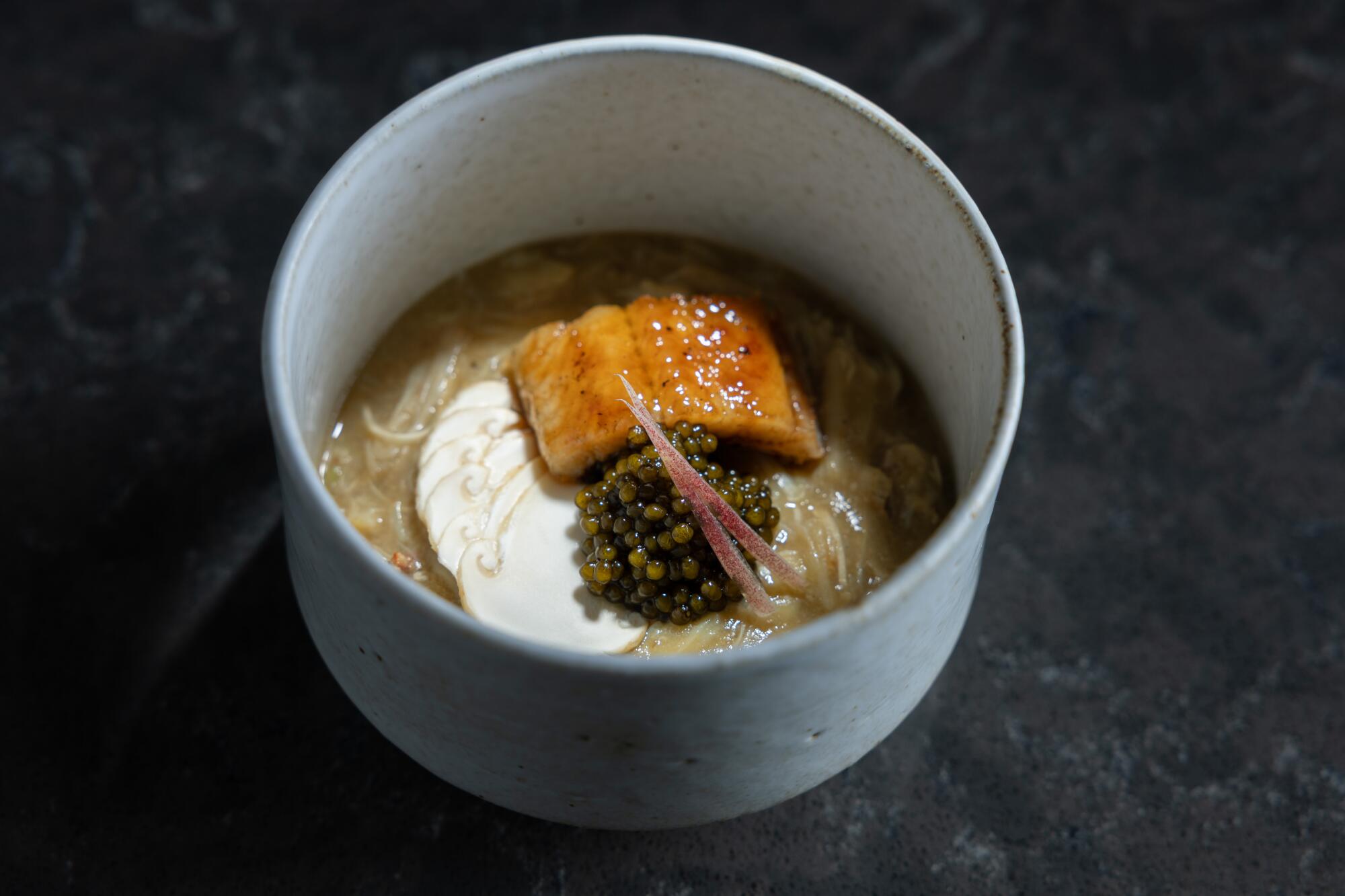
A noodle dish with concentrated Dungeness crab stock at Ki with customized noodles from Keizo Shimamoto, garnished here with grilled eel.
(Myung J. Chun / Los Angeles Times)
The scent of the stock brings to mind seafood-studded chawanmushi, mineral and electric. Flecks of sweet meat spiral through the broth like murky images of the Milky Way. Garnishes fluctuate but tend toward combinations like smoky-sweet grilled eel, fragrant pine mushrooms and a teaspoon of caviar. As luxury signifiers, they gild without overly distracting from the essential, nourishing goodness of the soupy noodles.
The dish is a linchpin in a meal that’s longer and more elaborate, and certainly pricier at $300 per person, than the concise tasting menu by which Kim first introduced his cooking to Los Angeles at 20-seat Kinn in Koreatown. His signature there paired crispy octopus with silky-funky gochujang aioli, a riff on a marquee course at New York’s pioneering modern Korean restaurant Jungsik, where Kim once worked.
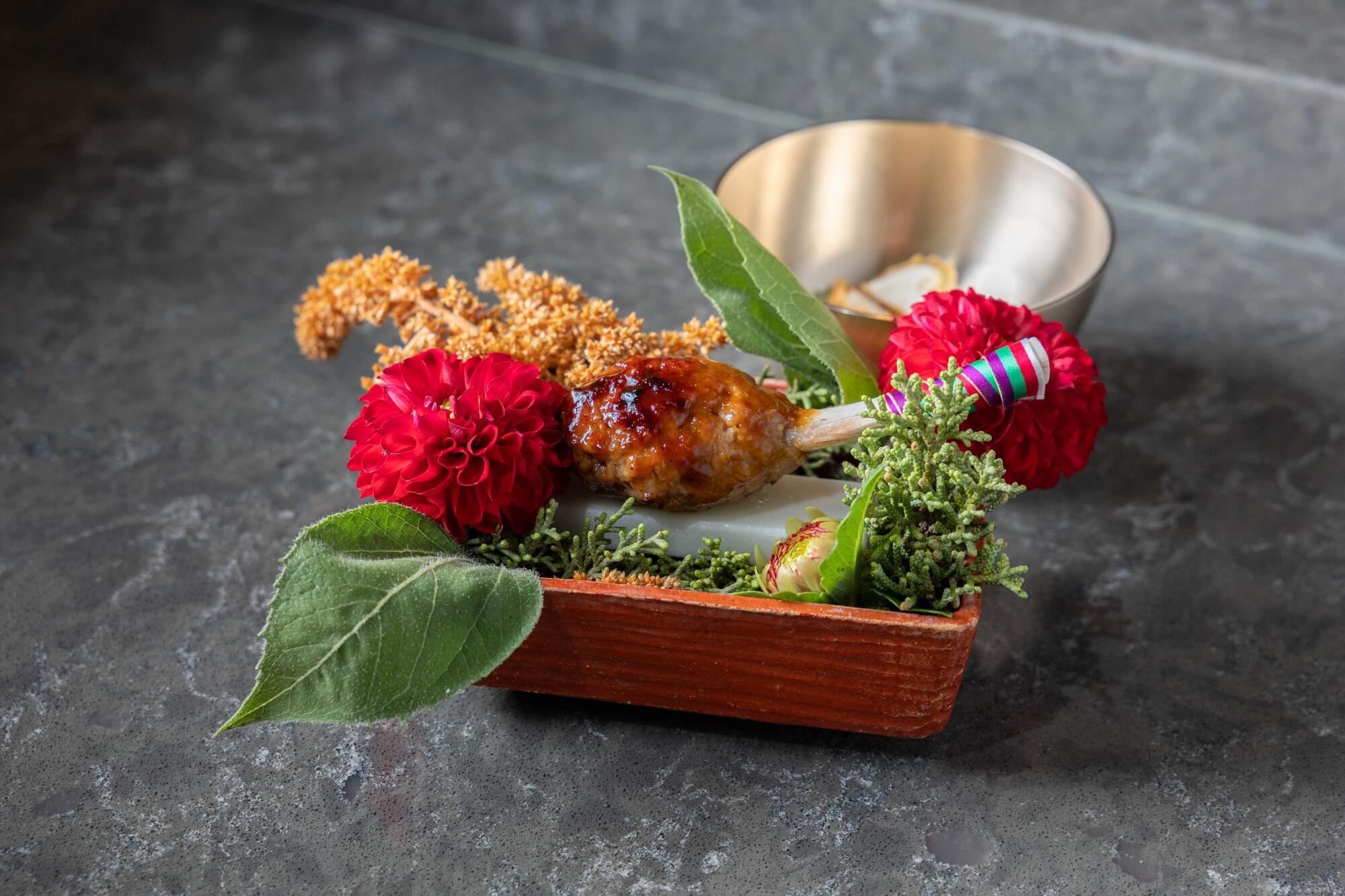
An elaborate $300-per-person meal might include Kim’s dish of wild boar.
(Myung J. Chun / Los Angeles Times)
He was brave enough to attempt some fairly radical innovations in the L.A. neighborhood famous for its time-honored Korean cuisine. Kinn had a two-year run, ending in late 2023, and Kim discussed the stress and anxiety its closing wrought with my colleague Stephanie Breijo.
He found immediate support in the chef community, landing jobs at Morihiro and Meteora. Then an unexpected opportunity arose.
A friend of Kim’s was a regular at Sushi Kaneyoshi, one of the city’s top-three omakase counters, and had taken him there for dinner. The friend was chatting with chef-owner Yoshiyuki Inoue about the expanding warren of restaurants on this subterranean level of the Kajima Building, which already housed Sushi Kaneyoshi and its more casual sibling, Bar Sawa. Inoue would be moving to a smaller space to offer a more premium experience, and chef Kato Shingo would take over the Kaneyoshi room, serving a tasting menu entwining Japanese, French and Thai cuisines. (It’s called Maison Kanatha and opened in October.) A storage closet was also being renovated and …
Inoue abruptly turned to Kim. “You know what, what are you doing?” Inoue asked.
“Me?” Kim recalls saying. “How did I get into this conversation?”
Kim shrugged it off, but the next day Inoue called him and said, “I wasn’t joking.”
Ten months later, behind a knotty wooden door with an “Employees Only” sign winkingly left in place, Restaurant Ki had a home.
There is no casually strolling into the underground Kajima Building restaurants. Reaching them for the first time is a rite of passage. Enter through the second floor of the attached parking garage. A beleaguered security guard, who ushers the same set of instructions dozens of times a night, will direct you to the one elevator in a bank of three that descends to the B-level. The doors open up to an antechamber set with chairs and benches. Check in with a staffer, who after a short wait ushers diners into Ki in the order of their arrival.
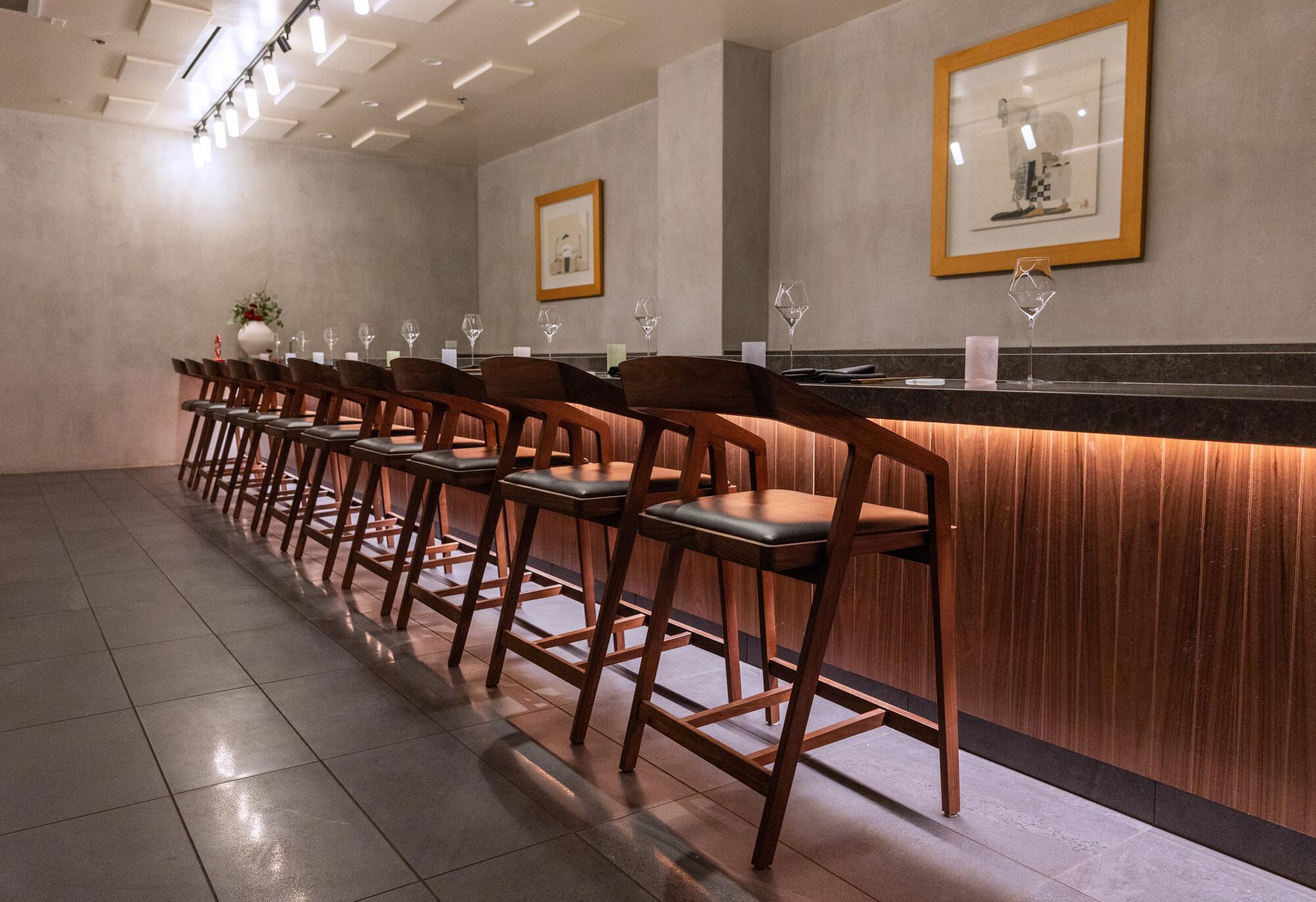
Ki is a 10-seat tasting-menu restaurant serving modern Korean cuisine, tucked away in a building in Little Tokyo.
(Myung J. Chun / Los Angeles Times)
Stone and earth tones evoke calm in the handsomely spare room. Ceramic ladybugs may appear on the end of whimsical cutlery. Cubes of duck liver might arrive in a glass vessel shaped like a hen. Kim’s taste in music runs to 1980s-era Lite FM R&B. Some might find it annoying to hear James Ingram’s “One Hundred Ways” piped over an otherwise hushed dinner. I’m the guy at the end of the counter trying to be quiet about singing along.
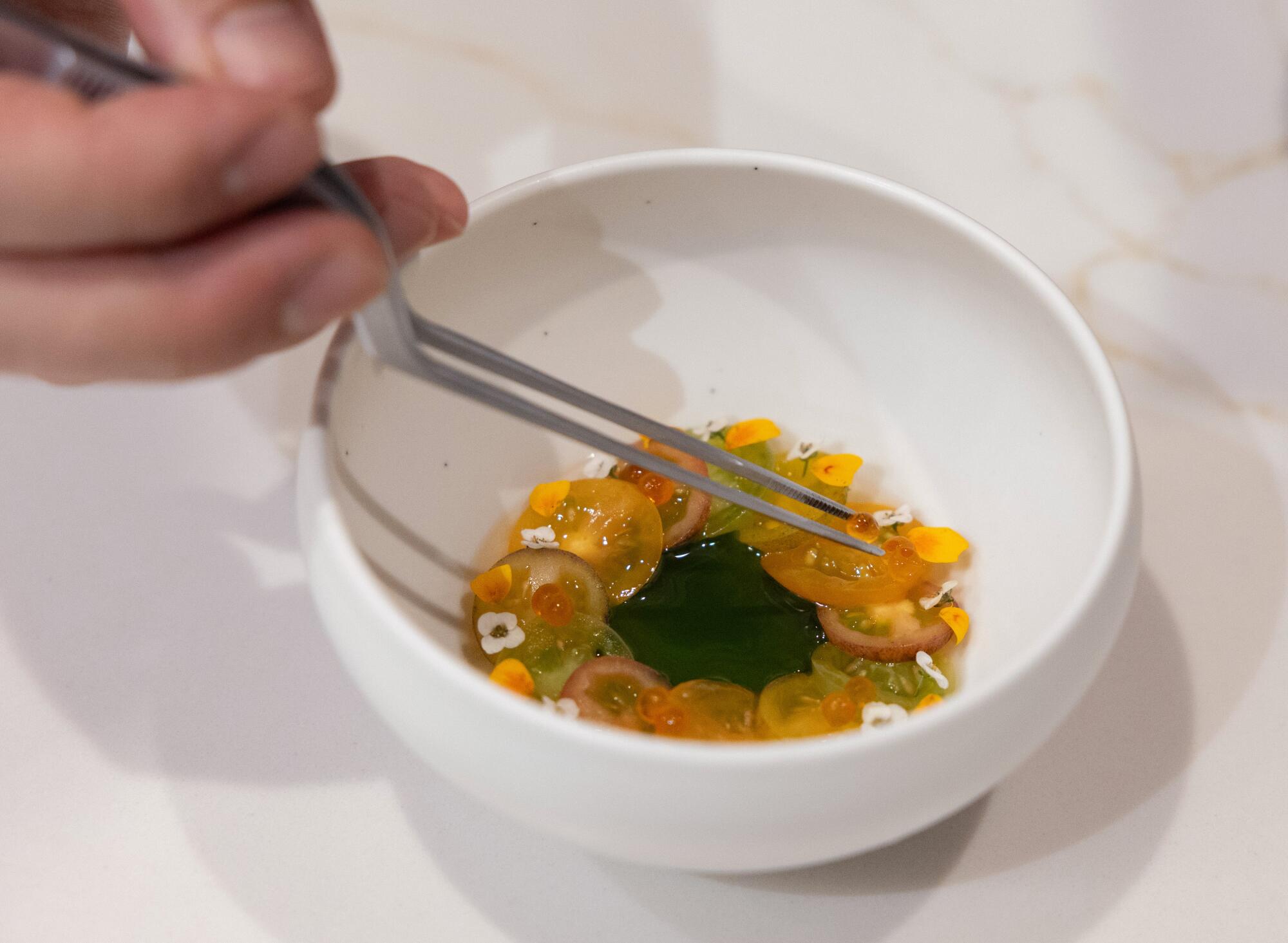
Smoked trout roe garnish for a dish of perilla leaf sorbet, smoked tomato and lemon fern at Restaurant Ki.
(Myung J. Chun / Los Angeles Times)
Kim, chef de cuisine Ryan Brown and their crew dash back and forth between a small back kitchen, reappearing to fall into tightly choreographed assembly lines to compose plates. The first snack is a laborious, one-bite marvel — a reimagining of bugak, a fried chip often made of glutinous rice and dried vegetables. This team sandwiches seaweed sheets and rice paste into five micro-thin layers; the next steps involve dehydrating, resting, frying and shaping the end result into small cylinders filled with a tiny dice of tuna, or maybe cod milt in the winter. Honey mustard and thyme leaves number among the seasonings. The whole thing crunches, melts, zings and primes the taste buds for more.
It’s also a tiny encapsulation of Kim’s philosophy. Most everything he creates can trace back to South Korea, where he was born, even if at face value the root inspiration may not be recognizable in the dish’s final form. In his approach I see kinship to Jon Yao’s wondrous transformations of Taiwanese cuisine at Kato.
The signature octopus arrives shortly after, in the form of a few crisp-soft rounds served with a fluorescent-orange, masterfully intense dipping sauce derived from the creature’s long-simmered innards, scented with tarragon and dusted with parsley powder. Its funky mysteries flicker in my brain until the perilla sorbet a couple of courses later washes it away.
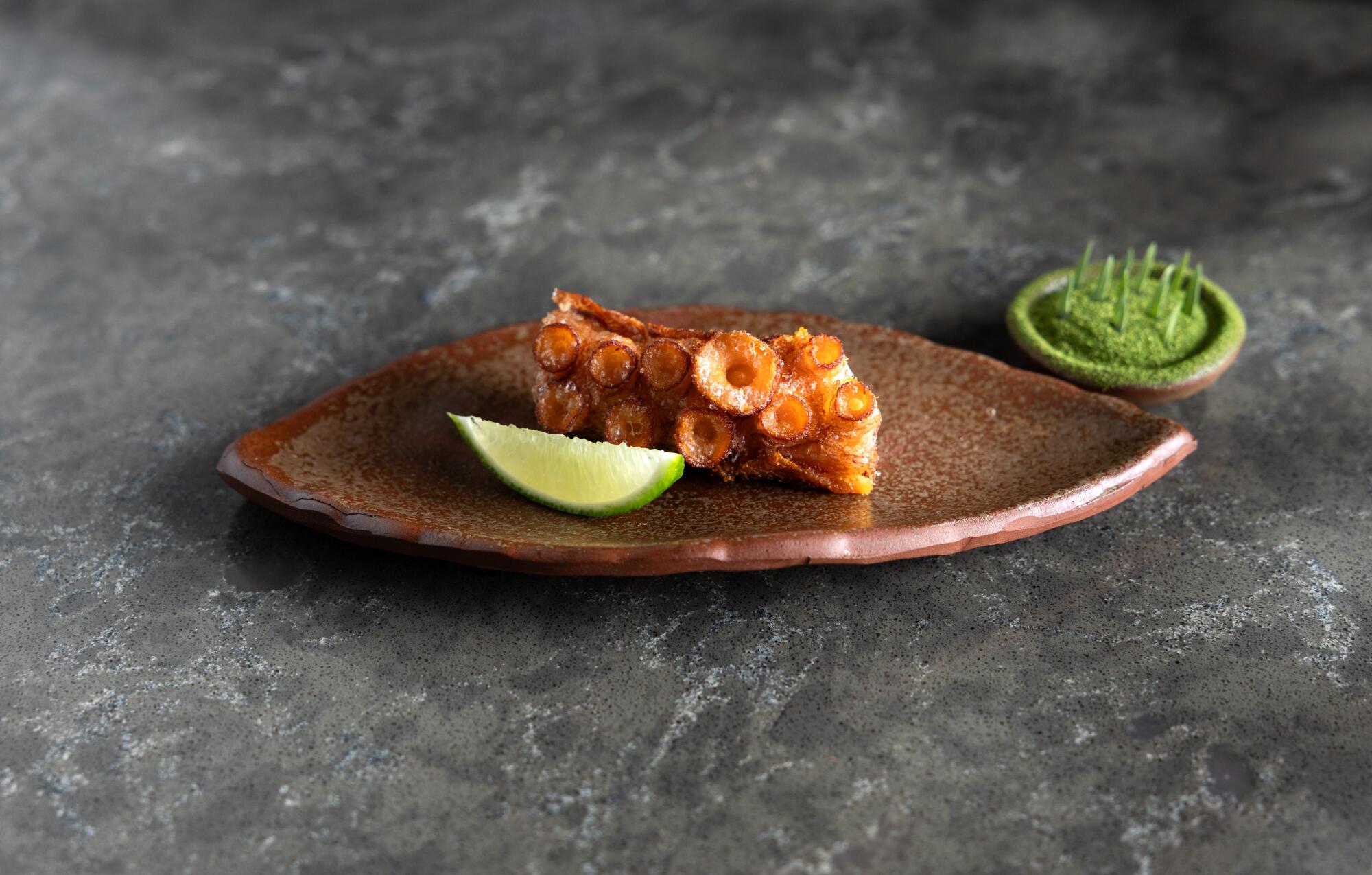
Octopus at Restaurant Ki.
(Myung J. Chun / Los Angeles Times)
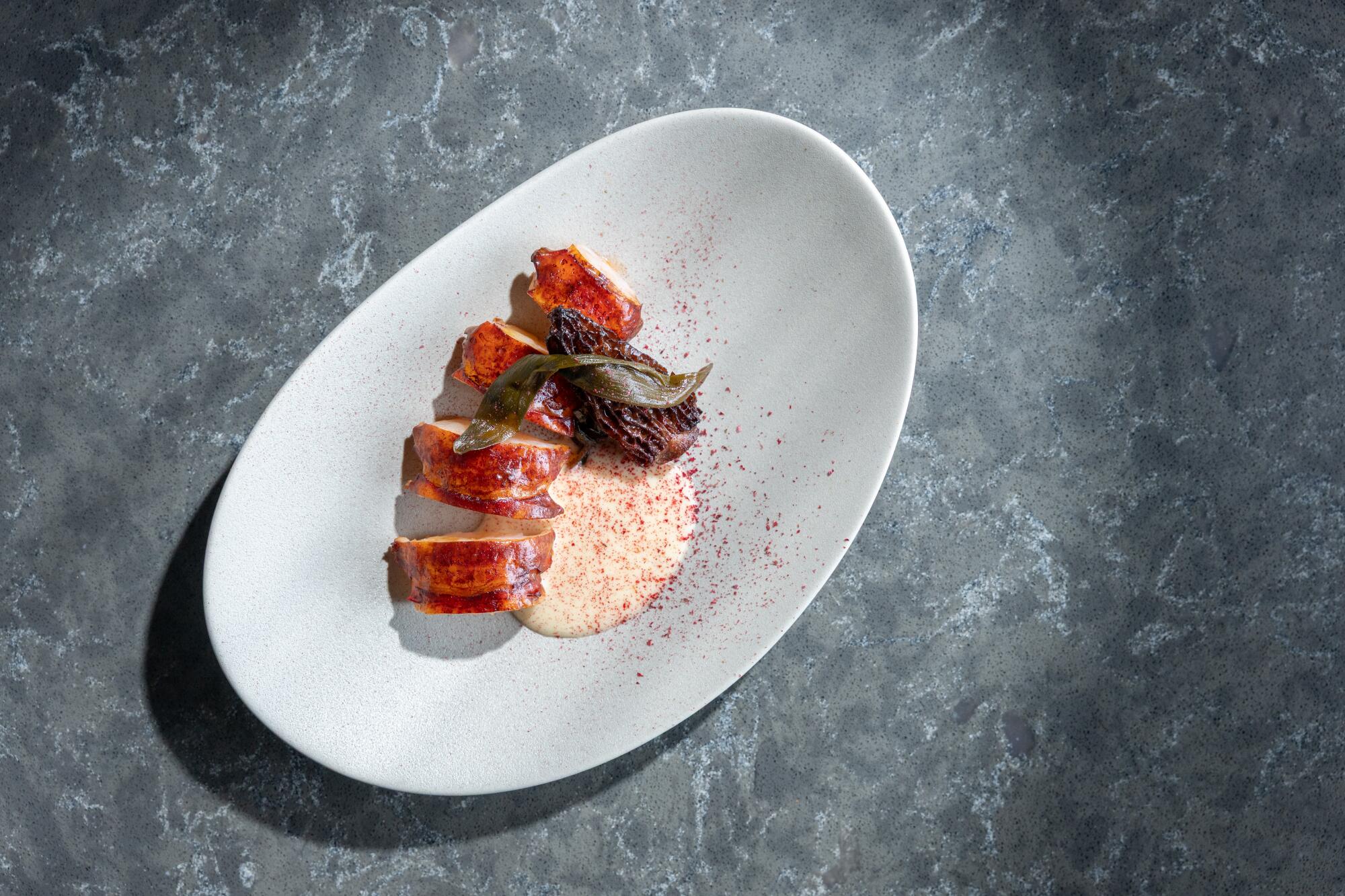
Lobster, doenjang and raspberry at Restaurant Ki.
(Myung J. Chun / Los Angeles Times)
Lacquered meats, fish draped over pools of complex chile and herb sauces and geometrically cut fruits arranged around shaved ice will change with the seasons. One consistent dish, along with the noodles, has been barbecued lobster arrayed over doenjang beurre blanc, its blend of richness and fermented depths prodding unexpected nuance from the smoky-sweet crustacean. For fun, a hit of acid comes from a pink-red dusting of powdered raspberries, shaken over the dish in front of you from a bundled piece of cheesecloth. The bit of showmanship is usually performed by a chef other than Kim, who has moved onto the next task of adjusting salt in a coulis or carving quail into quarters. He’s soft-spoken and serious, but he looks far happier than I remember him at Kinn.
Back then in a review, I called his first restaurant “the future of fine dining in L.A.” At Ki, I’m listening to Luther Vandross singing “Here and Now” overhead while I scrape the last sticky bits of crab from my bowl of noodles. Luther always knew what was up. The future has arrived.
Restaurant Ki
111 San Pedro St., Los Angeles, restaurantki.com
Prices: Tasting menu format, $300 per person
Details: One seating at 6:30 p.m., Wednesday to Sunday. Street and lot parking. Chef-owner Ki Kim is an oenophile, and the beverage pairing (at $190 per person) leans into French and German wines and boutique sakes. Also ask about nonalcoholic options, including drinks like tomato water mixed with gooseberry juice, that mostly sidestep over-sweetness.