
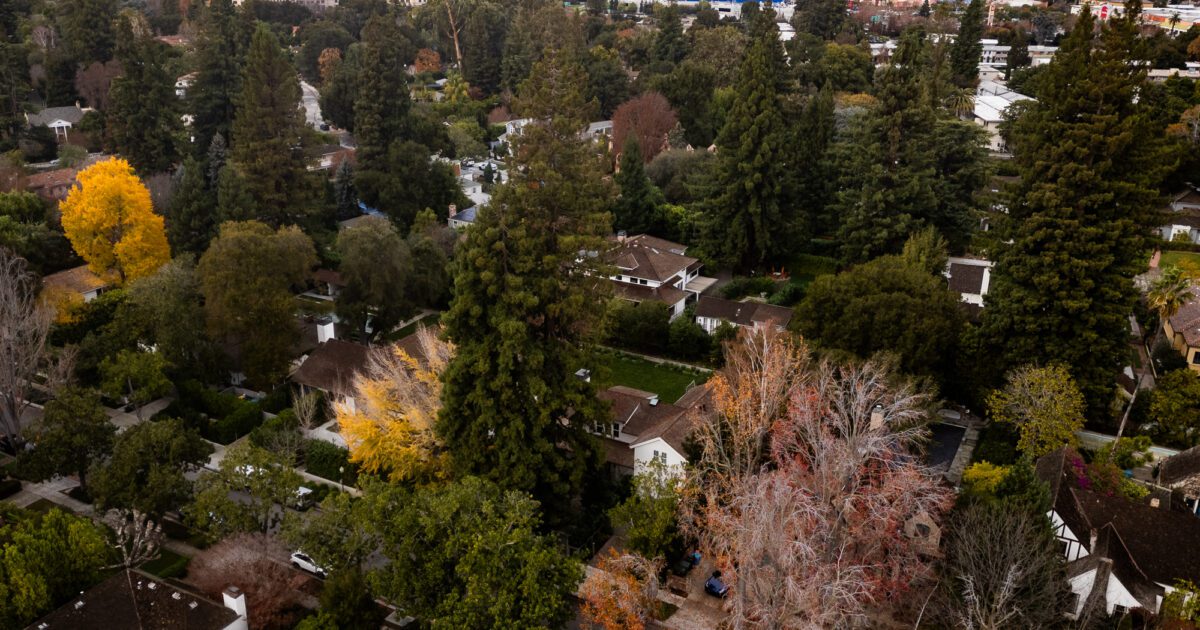
When asked in August about the private school and the neighbors’ complaints, Aaron McLear, a spokesperson for Zuckerberg, confirmed the New York Times account and noted that Zuckerberg, his wife, Priscilla Chan, and their children have made Palo Alto their home for more than a decade.
“They value being members of the community and have taken a number of steps above and beyond any local requirements to avoid disruption in the neighborhood,” McLear said.
Among the most common complaints is the constant construction. Since Zuckerberg began his buying spree in Crescent Park, he has remodeled and, in some cases, consolidated homes to create his four-home compound on Hamilton Avenue. The city’s permit records show that between June 2017 and September 2019, the city had approved at least 10 building permit applications for various projects just at 1451 Hamilton Ave., with projects including a new roof and replacement of the swimming pool. The long period of construction and the subsequent conversion of a home into a private school irked neighbors, with some accusing the city of turning a blind eye to the illegal use.
They weren’t the first to raise this issue. Even before the construction spree began, the city’s Architectural Review Board issued a warning about Zuckerberg’s plans. In 2016, when the board was reviewing Zuckerberg’s plan to demolish four homes and build three others in their stead, several board members suggested that the proposed complex didn’t jibe with the residential feel of Crescent Park.
“I can’t read these plans for additional dwelling as credible single-family dwellings,” former board member Peter Baltay said during the public hearing. “This is something you might find in Atherton: a large estate, a series of guest houses, recreational facilities, movie theaters surrounding the house.”
Former board member Wynne Firth suggested that the proposed frontages along Hamilton Avenue were “incompatible with the neighborhood and present too much of a unified design” for a single-family zoning district where most homes have a maximum lot size of 20,000 square feet.
“Do the rest of you find the other houses credible single-family houses?” Firth asked, shortly before the board rejected the plan.
The board’s 2016 vote didn’t stop the project; it just prompted Zuckerberg to divide the big project into a series of little ones, which would then be approved by the city’s planning staff. Several Crescent Park neighbors, fed up with the constant construction, subsequently criticized the city’s planning staff and building inspectors for effectively ignoring the board’s concerns and letting Zuckerberg have his way. But Planning Director Jonathan Lait rejected that description of the city’s actions.
“The characterization that the City reached a different conclusion from the ARB (Architectural Review Board) is not accurate,” Lait told this publication in an email. “The applicant withdrew the application and refiled in a way that is allowable by local laws and that did not trigger the requirement for ARB review. All work was permitted and processed in accordance with the City’s municipal code.”
Even so, every neighbor that has spoken to this publication said they were disappointed with planning staff, with some accusing city officials of being too cozy with the billionaire on their block. Even though the construction is now in a lull period, a sense of “dread” continues to linger over the neighborhood, said Michael Kieschnick, who lives on the Hamilton Avenue block. Neighbors fear that before long, another wave of projects will commence as Zuckerberg buys up more properties on Hamilton and Edgewood Drive.
“There’s definitely a feeling of abandonment by the city, that at so many steps along the way, someone could have stepped up and said, ‘This doesn’t fit with either the letter or the spirit of the law,’” Kieschnik told this publication.
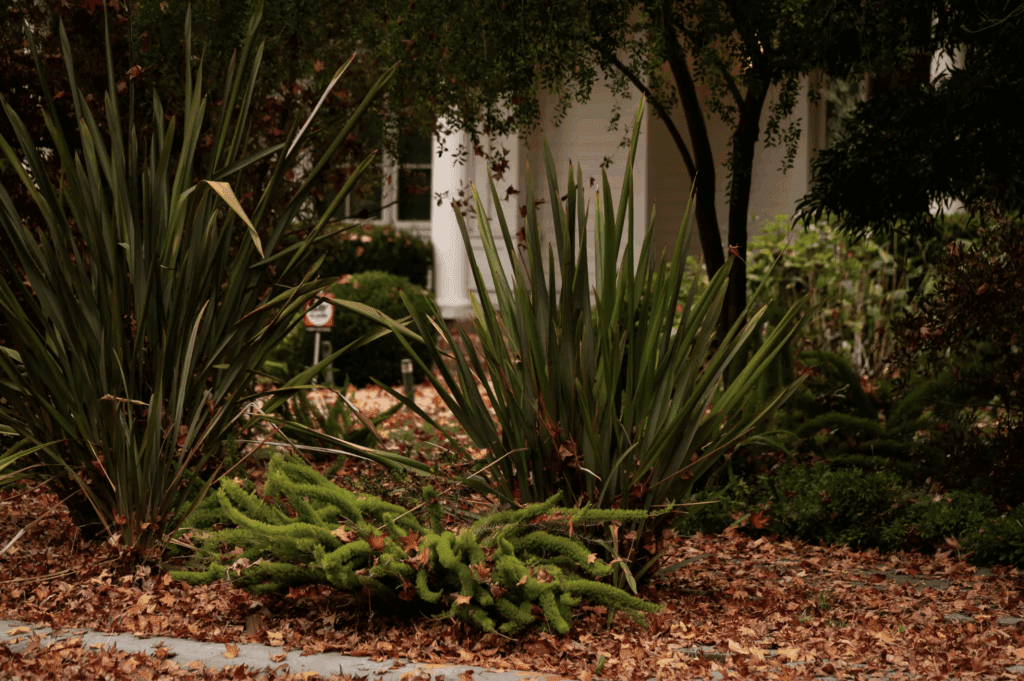 A house on the 1400 block of Hamilton Avenue in Palo Alto on Dec. 19, 2025. Photo by Seeger Gray.
Under pressure
While the city has been fielding complaints about Zuckerberg’s compound since at least 2019, the pressure intensified in the summer of 2024, when a group of Hamilton Avenue neighbors held two meetings with then-Mayor Greer Stone to discuss the situation. By that point, they had been dealing with more than seven years of construction, and many said they were tired of the constant sight of trucks and vans parked on their block, at times blocking driveways and making it difficult for cars to pass.
To Stone, the meetings felt like a homecoming of sorts. In his youth, he attended Duveneck Elementary School and two of the residents in attendance were parents of children he went to school with, he said. Some neighbors complained about the illegal school that had been there since the early days of the pandemic; others said they were unhappy about Zuckerberg constantly “poaching off” neighbors as part of the homebuying spree and then tearing down beautiful old homes. Several said they were put off by the attitude of security guards toward visitors, though others reported feeling a “peace of mind” from having their street under constant surveillance, Stone said.
Stone said he believes Zuckerberg’s efforts to consolidate numerous homes and turn them into a compound run counter to the city’s status as a “residential community.”
“Behind the success of companies like Facebook, HP, Tesla and others, to me Palo Alto is a community. There are friends and families and neighbors who all care deeply about one another,” Stone said in an August interview. “There are other cities in the region where if Mr. Zuckerberg wants to build the compound or build a massive mansion, he’s free to be able to do that. God knows he has the money to be able to do so.”
“While I understand his desire to call Palo Alto home, he needs to play by the rules like everyone else.”
After meeting neighbors, Stone didn’t wait long to act. According to documents obtained by this publication through several Public Records Act requests, Stone emailed Lait, the planning director, about two weeks after the July 2024 meeting to follow up on the neighbors’ concerns. He specifically focused on the private school, which appeared to be illegal and which had already been the subject of numerous code enforcement complaints.
“I would imagine we would require a CUP (Conditional Use Permit) for the school assuming this residential area is not zoned for a private school,” Stone wrote to Lait. “Can you please confirm and let me know anything you know regarding the school?”
Residents were also ramping up pressure on the city. In September 2024, a resident of the 1400 block of Hamilton sent an email to Lait and then-City Attorney Molly Stump, complaining about the private school. Every weekday between September and June, the email stated, parents and students arrive at the property before 8 a.m. and “are greeted by professional teachers and staff to begin the school day.” Parents then arrive at about 3 p.m. to pick up the roughly 20 students after they are dismissed. The enrollment has increased each year, the resident wrote.
He also raised concerns about the overall pace of construction on the 1400 block of Hamilton and its impacts on the neighborhood.
“Along with this unpermitted business operation, the ongoing construction related to this compound has already caused a long term (8+ years) untenable traffic and parking situation in the 1400 block of Hamilton Avenue,” the email stated. “The addition of daily traffic from the teachers and parents at the school has only exacerbated an already difficult situation.”
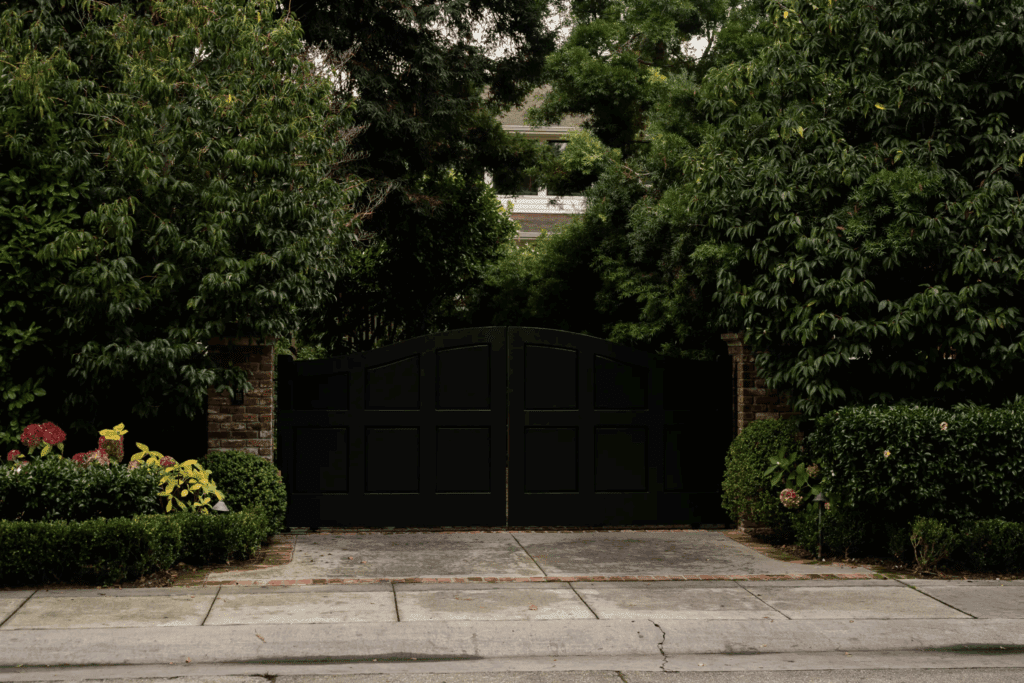 A gate in front of a house on the 1400 block of Edgewood Drive in Palo Alto on Dec. 19, 2025. Photo by Seeger Gray.
A nuanced solution
The author of the letter told this publication that he has been frustrated by the city’s failure to act during the three years of the school’s operation. City records show that the city’s code enforcement staff investigated various Zuckerberg properties on the block since 2019 but did not issue any notices of violation. Code enforcement officers looked into the complaint about the illegal school in 2021 and 2022 but closed the case each time. Lait confirmed to this publication that no notices of violation had been issued.
This time, the city took a more aggressive approach. Two hours after Stone sent him an email about the private school, Lait reached out to George Hoyt, the city’s chief building official, to ask him to investigate whether a private school was operating on the 1400 block of Hamilton Avenue and to issue a notice of violation if one was found. The city’s code enforcement division once again investigated the property. But while an initial inspection failed to confirm the illegal use, Lait ultimately determined later in the year that the property was indeed being used as a private school. He formally laid out this finding in December 2024 to Christine Wade, Zuckerberg’s attorney.
“Based on our review of local and state law, we believe this use constitutes a private school use in a residential zone requiring a conditional use permit. We also have not found any state preemptions that would exclude a use like this from local zoning requirements,” Lait wrote. “Our next step would be to send a notice of violation to the owner to cease this use and to apply for a conditional use permit if there is an interest in having a home school at this location.”
Over the next two months, Lait and Wade exchanged several emails to negotiate a path forward. Zuckerberg’s attorney assured the city that Zuckerberg had begun the process of trying to obtain a license to operate the property as a “large family daycare,” which would be allowed by local zoning regulations. Wade also noted that the family’s properties provide taxi and rideshare services to staff and that the Zuckerberg family (referred to simply as “The Family” in all correspondence) employs someone who monitors the area and makes sure that people affiliated with the property only park in front of properties owned by Zuckerberg.
Wade also noted that the occupants of the school building were concluding their lease and would soon be relocating. Given the shift of uses, Zuckerberg and his team understood that the city “will not be taking any formal compliance action,” she wrote.
“Should that position change, the Family reserves all legal rights to challenge such action and/or resume lawful activity at the Property,” Wade wrote to Lait in March 2025.
The two sides settled on what Lait referred to as a “nuanced solution” — allowing the school to finish up the academic year and then letting it relocate after the end of June without a notice of violation. Lait also confirmed in a February email to the neighbor who filed the complaint that Zuckerberg’s private school violated the city code but would be allowed to wrap up the academic year.
“To be clear, I do consider the current operation a violation of the municipal code. However, I also believe a more nuanced solution is warranted in this case, one that responds to the disruption caused by the activity and that can reasonably be authorized by the zoning code,” Lait wrote. “Through continued dialogue I hope to achieve that end but can take other actions if that goal is not achieved.”
Not everyone was thrilled about the proposed compromise. The resident who had filed multiple complaints, including the one that triggered the 2024 investigation, followed up with several requests for updates in early 2025 before learning about the proposed compromise, which he found unsatisfactory.
“Would I, or any other homeowner, be given the courtesy of a ‘nuanced solution’ if we were in violation of city code for over 4 years?” he asked in a March 2025 email.
He requested that Stump send a cease-and-desist letter and put an “immediate stop to the ongoing code violations on these properties.”
“Please know that you have not earned our trust and that we will take every opportunity to hold the city accountable if your solution satisfies a single billionaire property owner over the interests of an entire neighborhood,” the resident wrote. “Finally, just as you have not earned our trust, this property owner has broken many promises over the years and any solution which depends on good faith behavioral changes from them is a failure from the beginning. If you somehow craft a ‘nuanced solution’ based on promises, the city will no doubt once again simply disappear and the damage to the neighborhood will continue.”
The neighbor told this publication that he was frustrated by how long it took for the city to start enforcing its rules on non-residential uses at the compound. He had been complaining to the city since at least 2019, to little avail.
Another neighbor said that he had made a complaint about the illegal use through the 3-1-1 platform, only to be told by the city that the property owner had been contacted and had denied the accusation. The city’s records also show that code enforcement officers had driven by the property in both 2019 and 2024 but did not see any external signs that there was a school operating.
With the school use confirmed, Lait and Zuckerberg’s attorneys agreed in March 2025 that the school would shut down and would not be reestablished without a conditional use permit. Zuckerberg’s team also confirmed to the city that it had leased a different property in Palo Alto for its education needs and provided a copy of a lease for the said property.
“I can appreciate this timeline may be longer than you and perhaps others would have preferred but it also provides a specific date for resolution,” Lait wrote to a resident who complained about the school.
When asked why it took so long for the city to confirm the illegal use, Lait told this publication that numerous investigations had reached the conclusion that there was no violation. It was only in 2024, after he received a letter from a neighbor, that Lait conducted an independent investigation and determined that a private school was indeed operating on site. This resulted in its closure, he said.
As far as the “nuanced solution,” Lait said he was acting consistently with prior cases in which the city gave leeway to property owners who had violated their conditional use permits and who needed time to achieve compliance. He cited as examples First Baptist Church, which fielded complaints from its Old Palo Alto neighbors in 2017 for renting out its facilities to medical professionals, a music school and other secular clients in violation of its conditional use permit. He also mentioned Castilleja School, which famously exceeded its permitted student limit to the chagrin of its neighbors in Professorville.
In both cases, Lait noted, the city allowed uses that required a conditional use permit (or an amendment to a conditional use permit) to continue operating during application processing.
“Similarly, a reasonable timeframe aligned with the academic calendar was provided in this case to submit an application, relocate to another permitted location or abate the use,” Lait said.
 Hedges in front of a house on the 1400 block of Edgewood Drive in Palo Alto on Dec. 19, 2025. Photo by Seeger Gray.
A bolder solution
While Lait was negotiating with Zuckerberg’s attorneys about halting the school use, Stone was brainstorming broader and bolder solutions. In an August interview, Stone told this publication that he is researching possible policy proposals that he could bring to his council colleagues by the end of the year. In December, he and Council member Keith Reckdahl submitted a colleagues’ memo that tries to do just that.
The memo doesn’t mention any property owners by name, which seems consistent with the city’s broader approach in responding to information requests about Zuckerberg and his properties (his name was systematically redacted from all the emails that this publication obtained from the city through multiple Public Record Act requests). But even though the New York Times characterized the Stone proposal as a plan to rein in billionaires throughout the city, the memo seems tailored to one particular billionaire. Its introductory paragraph includes a less-than-subtle reference to a property owner who “acquired more than ten homes within a concentrated area, investing over $100 million to consolidate parcels into expansive private compounds.” The effects, the memo states, include non-residential uses like private schools on residential parcels, extended vacancies, long construction projects and enhanced private security that “alter the sense of privacy and community within surrounding blocks,” examples that are consistent with Crescent Park situation.
“Residents in affected neighborhoods describe these changes as fundamentally altering community character and disrupting the close-knit social fabric that historically defined Palo Alto’s residential districts,” the memo states. “These developments highlight the need for city policies that ensure neighborhood protections, limit excessive impacts from property aggregation, and safeguard the availability of housing.”
o address the aggregations, Stone and Reckdahl are proposing new regulations to govern situations in which a property owner, either in their individual capacity or through a corporate entity, buys three or more parcels within a single area. Under the proposal, property owners with projects lasting more than 180 days would have to provide a parking and circulation plan. These projects would have to be completed within 24 months, though applicants can request an extension of up to six months if they can demonstrate that the delay was caused by factors beyond their control. Once the project is completed, there would be a moratorium on major new construction, including remodels, for 36 months, though the city would be authorized to grant exceptions to address health and safety conditions, code deficiencies or property damage.
Enforcement would largely be up to neighbors, who would now have standing to bring forward civil suits against the property owner. The city, for its part, would refrain from issuing building permits during the moratorium period unless an exception is authorized.
Lastly, the proposed ordinance would create regulations for private security vehicles, which would have to display clear identification markings and obtain permits from the city. The memo states that private security “shall in no way harass or intimidate members of the public, or otherwise imply that public right-of-ways are private property.”
If approved, the law would represent a dramatic response by the city to the problem of billionaires transforming residential neighborhoods. Its path ahead, however, remains uncertain. Lait noted that the City Council would need to provide direction to staff to initiate a policy change, which has not yet happened. Staff resources, he noted, have not been directed to study this issue. He also noted that staff is not aware of parcel consolidation being a citywide problem.
Kieschnick, one of the Crescent Park neighbors, lauded the goals of the Stone proposal, but said it might be challenging to implement. He suggested that project applicants be required to publicly disclose if they or their affiliates own nearby properties and affirm their legal obligation to comply with residential zoning. He also said he hopes that the ordinance will not spur applicants to rush their construction applications before any new law kicks in.
“I urge all owners of compounds, current and future, including Mark Zuckerberg, to respect the integrity of the council process and pause any plans for additional construction until new rules, if any, are in place,” he said.
While the city is mulling new restrictions, the neighbors are engaging in their own diplomacy with Zuckerberg’s staff. In February of this year, one of the neighbors submitted a letter to Zuckerberg’s staff requesting a list of concessions. The letter, which was purportedly based on a survey of 15 households, requested that they receive notification well in advance of major construction activities; that parking affiliated with Zuckerberg’s properties be limited to the driveways and curbs in front of these properties; and that Zuckerberg “ideally stop — but at a minimum give us extended breaks from — the acquisition, demolition and construction cycle to let the neighborhood recover from the last 8 years of disruption.”
“We all want to be good neighbors (and hope the feeling is mutual),” the letter states. “We hope that this message will start an open and respectful dialogue about our top concerns.”
It didn’t take long for them to win some concessions. In March, a representative for Zuckerberg sent a letter to the neighborhood assuring residents that the family took their concerns seriously and listed several actions that had already been taken to address them. These include improved communications, new parking rules that are consistent with the neighbors’ recommendations, and policies to ensure that all staff who work at the residence “carry themselves in a professional and non-disruptive manner.”
“I recognize and understand that the nature of our residence is unique given the profile and visibility of the family,” wrote the Zuckerberg representative. “I know that the effects of that can feel unusual. I hope that as we continue to grow our relationship with you over time, you will increasingly enjoy the benefits of our proximity – e.g., enhanced safety and security, shared improvements and increased property values.”
Read more about how Crescent Park became one of Palo Alto’s most exclusive neighborhoods here.