
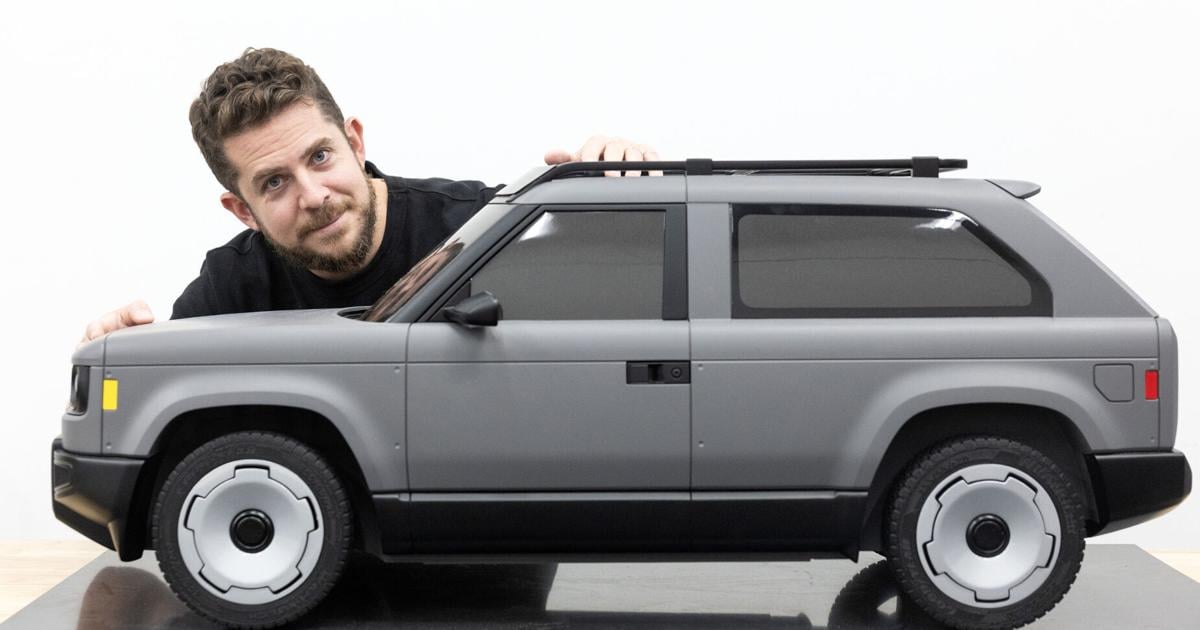
In an echoing studio in Long Beach, California, an ambitious team of designers is trying to reinvent how electric vehicles are made.
Slate Auto has assembled a team of EV engineers from Tesla, Rivian and elsewhere to develop what it calls America’s least expensive EV truck. In a warehouse space near construction supply shops and a Western-themed bar, designers have built clay models and prototypes of a customizable EV truck that could cost about half as much as the competition.
The company, which has raised more than $700 million from Amazon founder Jeff Bezos and others, says it will have a truck on the market next year for roughly $25,000.
How does it plan to keep its sticker price so low?
Buyers will start with a blank slate, a basic truck without power windows or even paint and then customize it however they like.
They can pay extra for power windows, speakers or a colored wrap or paint. A $5,000 kit can even convert the truck into an SUV.
Squeezing out as much cost as possible while making it as easy as Legos to snap on different options has required complex engineering, which is why the company decided to set up its design studio in Southern California.
The region is full of experts.
Although Slate’s headquarters is in Troy, Michigan, and its vehicles will be manufactured in Indiana, much of how they will look and be assembled came together in the Los Angeles area, said Jeremy Snyder, Slate’s chief commercial officer.
“The design presence on the West Coast, specifically in Los Angeles, has been a huge part of the automotive industry for a very long time,” he said. “Having that pool of talent that resides here was super important.”
If the idea clicks with enough consumers, company executives are hopeful that their business model will help bolster broader EV adoption.
Skeptics say it has yet to be proved that American consumers really want a vehicle stripped down to the basics, but thousands of potential EV owners have already shown interest.
More than 150,000 potential buyers have put down $50 deposits to reserve a place in line to buy the truck once it is on the market.
A large share of that demand is coming from Los Angeles, Snyder said.
“Los Angeles has played such a critical role in the zero-emissions auto industry,” he said. “I think it is going to play a very important role in the rollout of Slate vehicles.”
The company’s first deliveries are expected in late 2026.
Slate is entering the EV market at a difficult moment, as demand for green cars has cooled under the Trump administration. The president ended many tax breaks and regulations that were created to nudge more consumers and companies into EVs.
Rivian laid off more than 600 workers in October, and Tesla sales have slid this year.
Tesla has shown how difficult it can be to build a business around an affordable EV, putting its own low-cost vehicle plans on the back burner.
These days, Elon Musk appears more focused on developing humanoid robots for the masses than on producing an affordable EV.
Slate believes that demand will exist at a radically reduced price point. The company is betting there are customers who do not need four doors, the size or power of a standard truck, or the autonomous driving technology found in many Teslas.
Slate’s big bet is that a lower sticker price and a new business model can rekindle excitement in the industry. The company hopes customers will be happy to save money upfront and then spend only on the features they want.
“We’re going to make the truck, and then after that, you make it yours,” said Jeff Jablansky, Slate’s head of communications.
Slate trucks have a steel frame and external plastic panels that can be wrapped in any color. Customers who want to paint their vehicle can do it themselves or take it to a partner shop.
The standard version will have an electric range of 150 miles, which can be increased to 240 miles by paying more for a larger battery.
Those are just some of the most obvious options.
Slate’s online customization tool allows customers to design their EV however they want. Jablansky said potential buyers have created more than 10 million different configurations of a Slate truck online.
Slate hopes that by making EVs more affordable to buy, a new group of consumers will discover that they often cost less to own and maintain.
“The entire company was built around this idea of the affordable vehicle,” Snyder said. “We scrutinize every accessory in the same way that we scrutinize the vehicle to keep prices as low as possible.”
Although only about 25 of Slate’s 500 employees work out of the Long Beach studio, it has a disproportionate influence on the company’s product.
To succeed in the competitive EV market, the company decided it needed a presence in California as well as near the traditional heart of U.S. auto manufacturing in and around Detroit.
“We knew we needed to have a presence in both places to really understand what people wanted,” Jablansky said. “Some companies say they’re a California company. Some say they’re a Detroit company. We need to be an American company.”