
As last year wore on, I noticed a stunning sameness to conversations I was having about Mayor Daniel Lurie, who on Thursday marks his first year in office. Everyone, it seemed, from New York to Chicago, and, yes, in San Francisco itself, wanted to buttonhole me to talk about the revival Lurie was leading. Over and over, always in this order, they said:
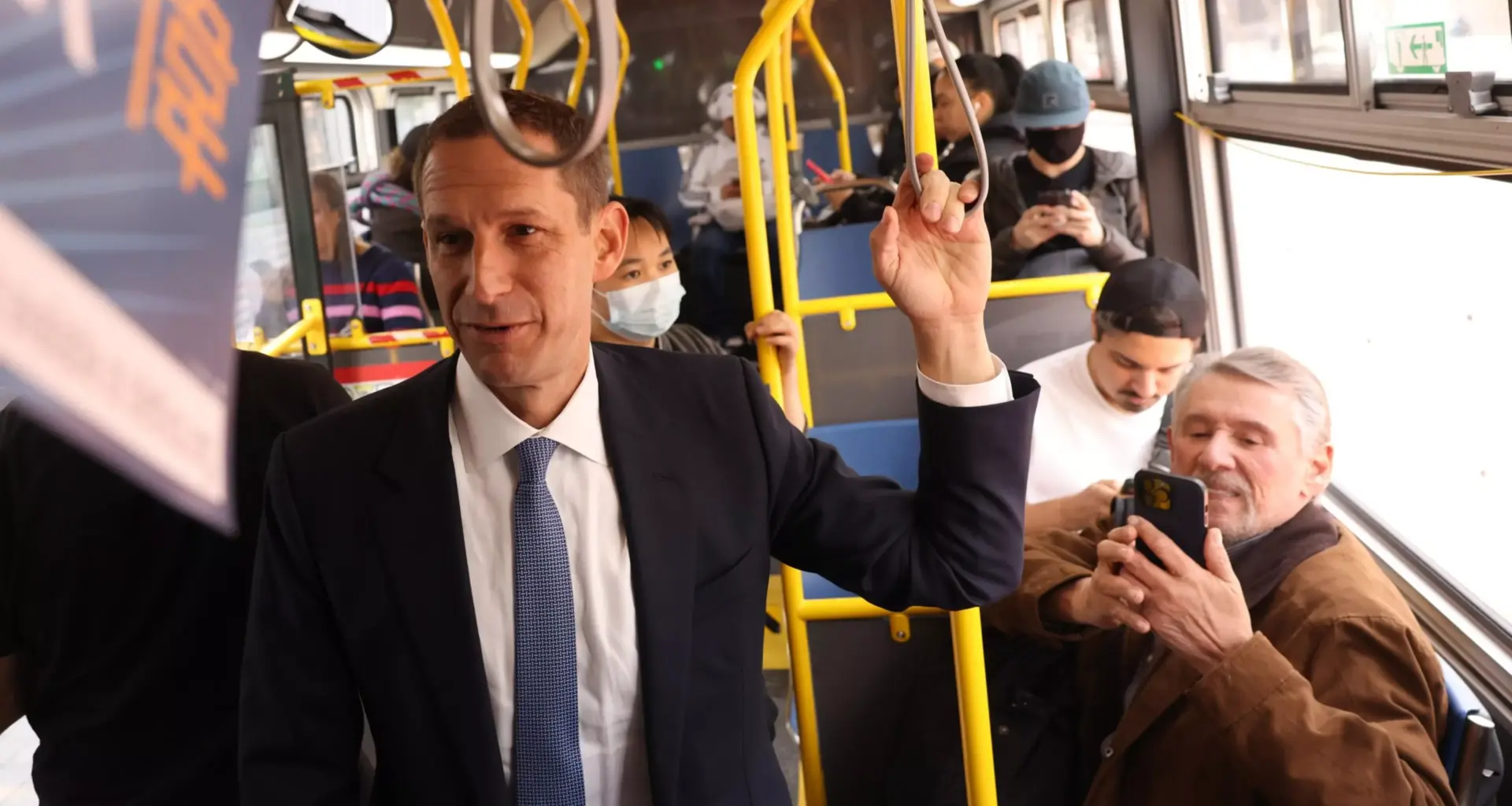
The two assertions are inextricably linked. That Lurie is popular with San Francisco voters and beyond is irrefutable. He is omnipresent, both in real life, showing up at every event and talking to every business owner, and on social media, with his digitally savvy aides broadcasting his frenetic jaunts around the city. He is the Energizer Bunny as public servant, a one-man Chamber of Commerce, a smiling promoter of good vibes, and a full-throated advocate for his constituents.
I once (opens in new tab)pooh-poohed the notion that San Francisco merely needed better public relations (opens in new tab). Fix the problems, and that will fix the PR, I contended. Lurie has provend me at least partially wrong. As he told reporters in a 29-minute roundtable the week before Christmas: “When I was running, people were like, ‘Oh, God, San Francisco. … Are you OK? Are you safe?’ I don’t think people are asking that question now.”
Facts, as the kids say (opens in new tab).
Still, such pleasantries beg the question of just how good a job Lurie is actually doing, compared to the perception of his performance.
At the risk of being the skunk at the Super Bowl (and World Cup and Dreamforce) party, I would argue that the right way to think about Lurie’s first year is as a prelude for what comes next. Objectively, he accomplished less than meets the eye in 2025. But that doesn’t diminish the potential achievements he has put in motion.
Take public safety, his No. 1 campaign issue in 2024. A fact sheet the mayor’s team distributed to reporters before our pre-holiday sit-down crowed about crime being down “nearly 30% citywide and down in every major category (opens in new tab).” While this is true and laudable, the mayor’s office didn’t mention that crime was down even more the previous year — 27.5% versus 25.4% — when his predecessor, London Breed, was mayor.
On hiring more cops, the mayor’s team bragged that “applications” for the San Francisco Police Department had risen. It didn’t note that the number of sworn officers continued to decline through the middle of the year, the last time the SFPD reported those numbers. (See Page 8 of (opens in new tab)this report (opens in new tab).)
So is the city safer under Lurie? Yes. But it already was trending in that direction. And as Lurie readily acknowledges, some parts of the city remain a mess. “Safety isn’t just a statistic,” he said in his inaugural address a year ago. “It’s a feeling you hold when you’re walking down the street.” That’s still true — and as they walk through parts of the Tenderloin, South of Market, the Mission, Lower Polk, and elsewhere, many San Franciscans hold a feeling that isn’t safety.
Lurie had a signal political accomplishment last year, the 7-4 passage at the Board of Supervisors of his Family Zoning Plan to increase housing densities in NIMBY-dominated parts of the city. Lurie and his economic development team, including the Planning Department under the direction of Sarah Dennis Phillips, whom Lurie named to the job, worked hard for this needed reform.
Municipal government wonks understand, though, that this process also began under Breed and was largely championed by a coterie with ties to state Sen. Scott Wiener. And despite the considerable drama, the responsible members of the board, particularly the self-styled progressive urbanist Myrna Melgar, a former Planning Commission head, were always going to vote for this plan, mindful as they were of the negative consequences of rejecting it.
Where Lurie truly did break ground was by shepherding in two new business groups, the CEO-heavy Partnership for San Francisco and the San Francisco Downtown Development Corporation. Neither group has made its influence felt much so far, though both could make an impact this year.
In other ways, Lurie’s results were a mixed bag. He succeeded in creating an atmosphere of comity in City Hall, notably working with supervisors on issues like permitting reform (opens in new tab). Then again, it’s just as likely that the absence of progressive flamethrowers like Dean Preston and Aaron Peskin — whose (opens in new tab)one-year prohibition (opens in new tab) on communicating with city departments ends this week — was as responsible for this mini Era of Good Feelings as Lurie’s impromptu drop-ins on the offices of supes.
Then there was the debacle over Lurie’s appointment of the inexperienced Isabella “Beya” Alcaraz as District 4 supervisor. Despite this fiasco being catnip for those of us who spend too much time gossiping about local politics, Lurie’s goof needn’t be debilitating, especially if he and his team use it as a teachable moment. They’ve learned the negative consequences of keeping their cards so close to the vest that they fail to reach out to community stalwarts who know what’s what. They shouldn’t make the same mistakes again.
In the coming year, Lurie faces far bigger political and policy challenges. His flashpoints with organized labor could be many. Unions disrespected Lurie late last year by forcing a ballot crisis over a new business tax. In mid-December, the same day he met with reporters, he convened a meeting of labor and business to work out a compromise. I’m told he asked the two sides to talk to each other, conversations that will continue this month.
He’ll need all his political skills to pass a parcel tax in November to support Muni. Lurie is talking an atypically big game about the ballot measure, vowing to spend his considerable political capital on the issue, together with the coalition of transit advocates and business interests he has assembled. “There’s a lot of people that say you cannot put any taxes on the ballot,” he told reporters last month. “I say San Francisco doesn’t recover without it, meaning it’s existential to our recovery. I’m going to go all in on it, and we’re going to pass it.”
It will be a busy year on the Board of Supervisors, with special elections of two incumbents: Alan Wong, whom Lurie appointed, and Stephen Sherrill, whom the mayor endorsed. Either of their defeats at the hands of progressives would erode Lurie’s board support. The mayor is also committed to reforming the city’s sprawling and overly prescriptive governing charter, which could become the most contentious issue of all.
I’ll end by reflecting on my coverage of (opens in new tab)Room 200 (opens in new tab). I have praised Lurie’s businesslike approach to governing, his smart handling of President Donald Trump, and his clever maneuvering in City Hall. Knowing my personal fondness for the mayor and my certainty of his sincerity, some friends and readers have ribbed me for being too easy on him. But I have criticized the mayor plenty: for not cutting enough from the city’s budget, for making a poor supervisor pick, and for failing to support an ideological ally. His fans think I am too hard on the well-loved mayor.
In any case, I sleep well at night knowing I’m doing my best to call balls and strikes as I see them.
As for Lurie, he’s recommitting to the boosterism and optimism that have won him such overwhelming popularity in his first year in office. He told reporters a few weeks ago he was looking forward to global sporting events and major conferences coming to town next year. “We have something close to 700,000 room nights for those conferences,” he said. “That’s a lot of people coming in who then go home and tell their family and friends about the state of our city. I think that the vibes are good, the feelings are good, and we still have a long way to go.”
And so many videos to record about it all.