
One of the first police officers to respond to the 2022 school shooting in Uvalde, Texas, goes on trial Monday on charges that he failed to protect children during the attack, when authorities waited more than an hour to confront the gunman.
Adrian Gonzales, a former police officer with the Uvalde Independent School District, faces 29 counts of child abandonment or endangerment in a rare prosecution of an officer accused of not doing more to stop a crime and protect lives.
The teenage gunman killed 19 students and two teachers at Robb Elementary in one of the deadliest school shootings in U.S. history.
Two days before the second anniversary of the mass shooting at Robb Elementary in Uvalde, Texas, which left 19 fourth-graders and two teachers dead, a representative for the victim’s families announced a legal settlement with the city and a new lawsuit against 98 state officers who were part of the police response.
Nearly 400 officers from state, local and federal law enforcement agencies responded to the school, but 77 minutes passed from the time authorities arrived until a tactical team breached the classroom and killed the shooter, Salvador Ramos. An investigation later showed that Ramos was obsessed with violence and notoriety in the months leading up to the attack.
Gonzales and former Uvalde schools police chief Pete Arredondo were among the first on the scene, and they are the only two officers to face criminal charges over the slow response. Arredondo’s trial has not yet been scheduled.
The charges against Gonzales carry a maximum sentence of 2 years in prison if he is convicted. The trial, which is expected to last up to three weeks, begins with jury selection.
Gonzales pleaded not guilty. His attorney has said Gonzales tried to save children that day.
Police and Texas Gov. Greg Abbott initially said it could have been worse and that swift law enforcement action killed Ramos and saved lives.
Abbott said at the time if not for the quick response of the officers, the mass shooting could have been a lot worse.
“The reason it was not worse is because law enforcement officials did what they do … and it is a fact that because of their quick response, getting on the scene, being able to respond to the gunman and eliminate the gunman, they were able to save lives,” Abbott said in 2022.
But that version quickly unraveled as families described begging police to go into the building and 911 calls emerged from students pleading for help. Abbott later said he was “livid” about being “misled” about police action that day.
The indictment alleges Gonzales placed children in “imminent danger” of injury or death by failing to engage, distract or delay the shooter and by not following his active shooter training. The allegations also say he did not advance toward the gunfire despite hearing shots and being told where the shooter was.
The Justice Department released a report Thursday identifying a vast array of failures in the police response to the mass shooting at Robb Elementary School that federal officials say contributed to the crisis lasting for longer than necessary.
State and federal reviews of the shooting cited cascading problems in law enforcement training, communication, leadership and technology, and questioned why officers waited so long.
According to the state review, Gonzales told investigators that, once police realized there were still students in other classrooms, he helped evacuate them.
Some family members of the victims have said more officers should be indicted.
“They all waited and allowed children and teachers to die,” said Velma Lisa Duran, whose sister Irma Garcia was one of the two teachers who were killed.
Prosecutors will likely face a high bar to win a conviction. Juries are often reluctant to convict law enforcement officers for inaction, as seen after the Parkland, Florida, school massacre in 2018.
Sheriff’s deputy Scot Peterson was charged with failing to confront the shooter in that attack. It was the first such prosecution in the U.S. for an on-campus shooting, and Peterson was acquitted by a jury in 2023.
At the request of Gonzales’ attorneys, the trial was moved about 200 miles (320 kilometers) southeast to Corpus Christi. They argued Gonzales could not receive a fair trial in Uvalde, and prosecutors did not object.
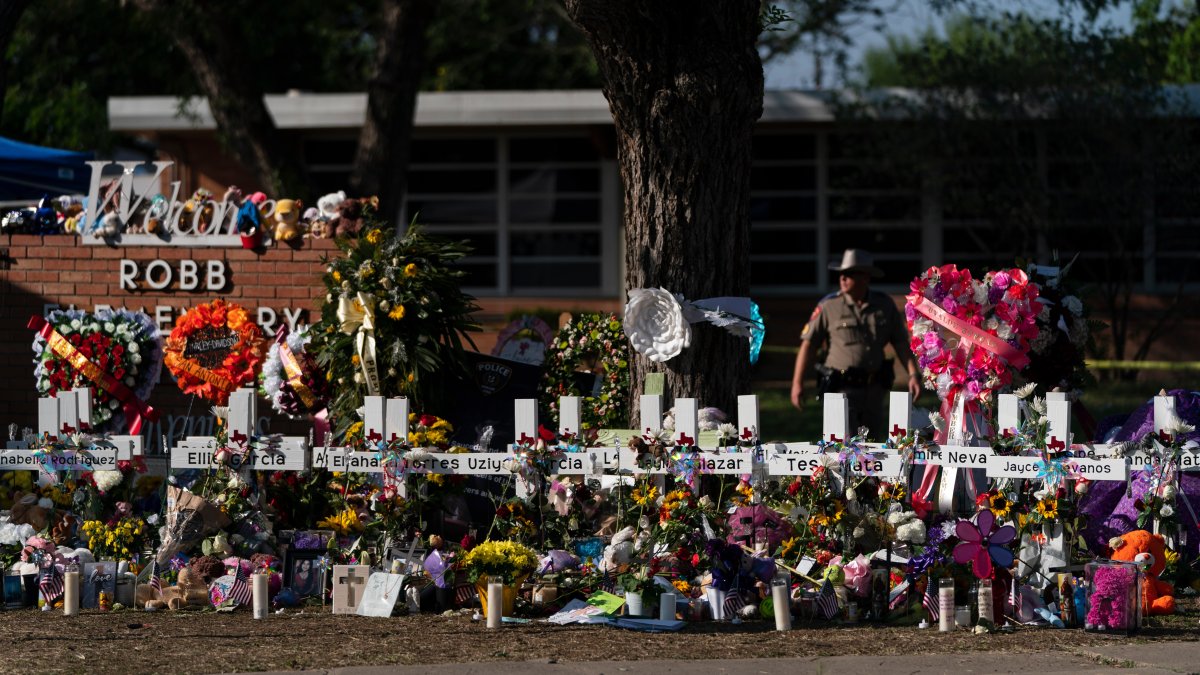
Uvalde, a town of 15,000, still has several prominent reminders of the shooting. Robb Elementary is closed but still stands, and a memorial of 21 crosses and flowers sits near the school sign. Another memorial sits at the downtown plaza fountain, and murals depicting several victims can still be seen on the walls of several buildings.
Jesse Rizo, whose 9-year-old niece Jackie was one of the students killed, said even with a three-hour drive to Corpus Christi, the family would like to have someone attend the trial every day.
“It’s important that the jury see that Jackie had a big, strong family,” Rizo said.
___
Associated Press writers Jim Vertuno in Austin, Texas, and Juan A. Lozano in Houston contributed to this report.