

When it rains, it pours. And that’s good news for California’s water supply.
After a relatively slow start to the winter rainy season, a series of atmospheric river storms has sent hundreds of billions of gallons of water pouring into reservoirs across California over the past three weeks, easing the concerns of water managers and significantly reducing the likelihood of shortages next summer.
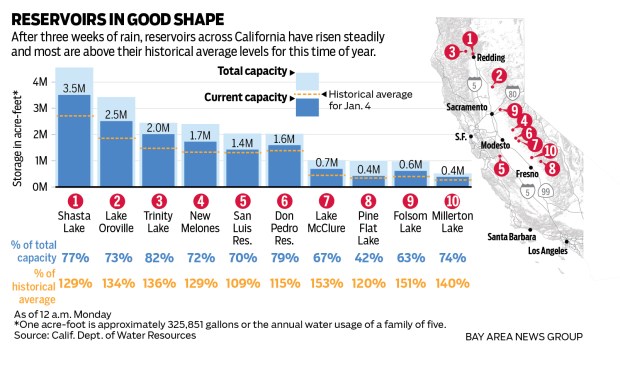
Since Dec. 16, the state’s largest reservoir — Shasta, a massive 35-mile-long lake near Redding — has risen by 36 feet. On Monday, it was 77% full, at 129% of its historical average for this time of year and still rising.
Similarly, the water level at Oroville, the state’s second-largest reservoir, has jumped 69 feet over the same three weeks. The reservoir, formed by Oroville Dam in Butte County, was 73% full and at 134% of its historical average as of Monday, having added nearly as much water in the past 24 hours as Crystal Springs Reservoir in San Mateo County holds when full.
“We’re in great shape,” said Jeffrey Mount, a professor emeritus at UC Davis and senior fellow at the Public Policy Institute of California’s water center.
Together, Shasta and Oroville have captured 1.6 million acre feet of water in the past three weeks — the equivalent of four reservoirs the size of Hetch Hetchy, San Francisco’s largest, and enough water for 9 million people for a year.
A similar shift has happened in the Sierra Nevada snowpack, the source of one-third of California’s water supply. On Dec. 16, it was 18% of normal and ski resorts were struggling to open. On Monday, it was 90% of normal following another weekend of heavy snowstorms that dumped several feet of fresh powder across the Lake Tahoe region.
Typically, California receives most of its rain from December to March.
“We’re not even halfway through the wet season,” Mount said. “We don’t know how it is going to turn out. We have had other years where we got early rains and then the taps were shut off. But what we do know is that we’ve seen a huge jump in the past few weeks. That reduces the likelihood of shortages this summer.”
The past three winters have been at or above average across Northern California, where most of the big reservoirs are located. That has left more water in the reservoirs as they start the winter season.
As a result, nearly every major reservoir in California on Monday was above its historic average capacity for this time of year.
San Luis Reservoir, the vast inland sea between Gilroy and Los Banos, was 70% full. Los Vaqueros, the biggest reservoir in Contra Costa County, was 90% full.
 San Luis Reservoir in Merced County, Calif., on Monday, Jan. 5, 2026. The reservoir is about 70 percent full. (Nhat V. Meyer/Bay Area News Group)
In Southern California, Cachuma Reservoir, the largest in Santa Barbara County, was 100% full and spilling on Monday. Farther south, Diamond Valley Lake in Riverside County, a linchpin of the water supply for 20 million people in the Los Angeles region, was 94% full.
Smaller communities saw similar trends. All seven reservoirs operated by the Marin Municipal Water District were 99% full. And Loch Lomond, the main reservoir for 100,000 people in the Santa Cruz area, hit 100% full on Sunday, and began sending water down the spillway.
“We’ve gotten a foot of rain since Christmas Eve in the Santa Cruz Mountains,” said Chris Coburn, deputy director of the Santa Cruz City Water Department. “As a water manager, it makes me happy. It gives us comfort. For at least the next year, we know we’re good on storage and will be able to meet customer demand. We’re always happy to see the rain.”
Dam operators at some reservoirs, including Shasta, Oroville and Folsom near Sacramento, have increased releases in recent days to preserve space so they can catch more water in a controlled way if there are other big storms in the coming weeks.
“If they fill the reservoir too soon, the next storm could cause them to have to spill,” Mount said, “which is what they don’t want to do. The goal is to control the flow to reduce the risk of flooding downstream on the river.”
The East Bay Municipal Utility District’s seven reservoirs, which serve 1.4 million people in Alameda and Contra Costa counties, were 82% full on Monday.
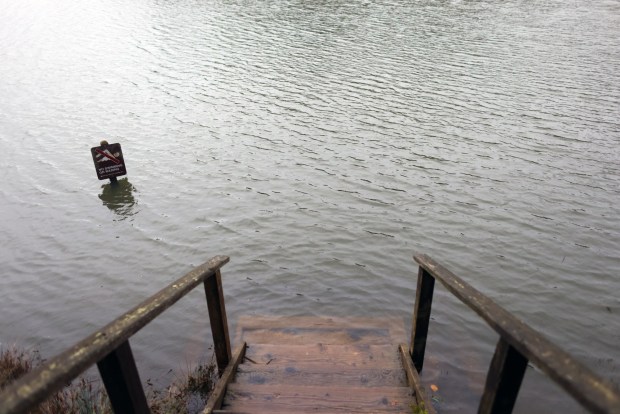 Submerged stairs at Lake Chabot Regional Park on Monday, Jan. 5, 2026, in Castro Valley, Calif. The reservoir is currently at 96% capacity. (Aric Crabb/Bay Area News Group)
“This is all good news,” said Andrea Pook, an East Bay MUD spokeswoman. “We still have a number of months to go. We’ll know more in April. But these wet months are crucial now, so we can refill our reservoirs. We’re hoping for continued storms the rest of the winter and early spring.”
 She had advice for homeowners.
“Make sure your irrigation is not on,” Pook said.
Nine reservoirs operated by the Santa Clara Valley Water District, which serves 2 million people in the South Bay, were 50% full on Monday, due in part to the fact that the South Bay received less rain than other areas in recent weeks, and because several of the reservoirs cannot be filled to the top under state rules without earthquake retrofitting. The largest in the district, Anderson Reservoir, near Morgan Hill, is virtually empty as it undergoes construction to rebuild its dam to seismic standards.
So far, Northern California has escaped serious flooding. That luck should continue, as the forecast calls for 10 days of dry weather starting Tuesday.
“The good news is that we have seen just about every spot in the whole state going above normal for precipitation for this time of year,” said Jan Null, a meteorologist with Golden Gate Weather Services in Half Moon Bay.
“But starting Tuesday, we’re going to dry off. This is a year of big contrasts — multiple weeks of dry, then multiple weeks of wet.”
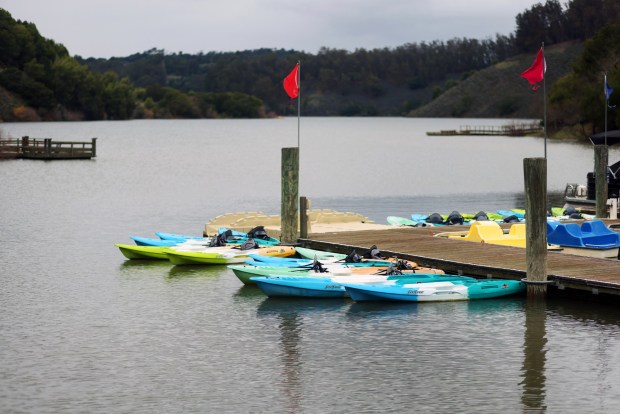 Rental boats in the marina at Lake Chabot Regional Park on Monday, Jan. 5, 2026, in Castro Valley, Calif. The reservoir is currently at 96% capacity. (Aric Crabb/Bay Area News Group)
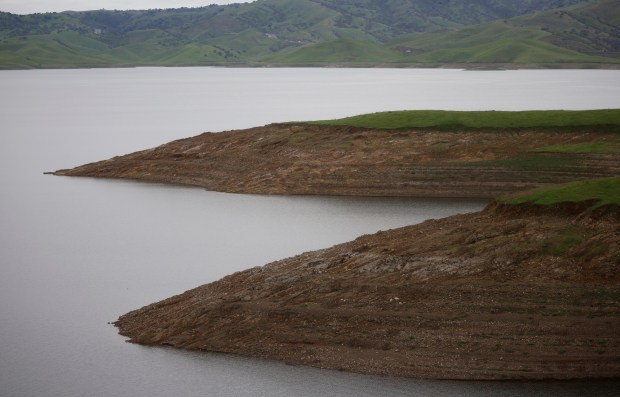 San Luis Reservoir in Merced County, Calif., on Monday, Jan. 5, 2026. The reservoir is about 70 percent full. (Nhat V. Meyer/Bay Area News Group)