
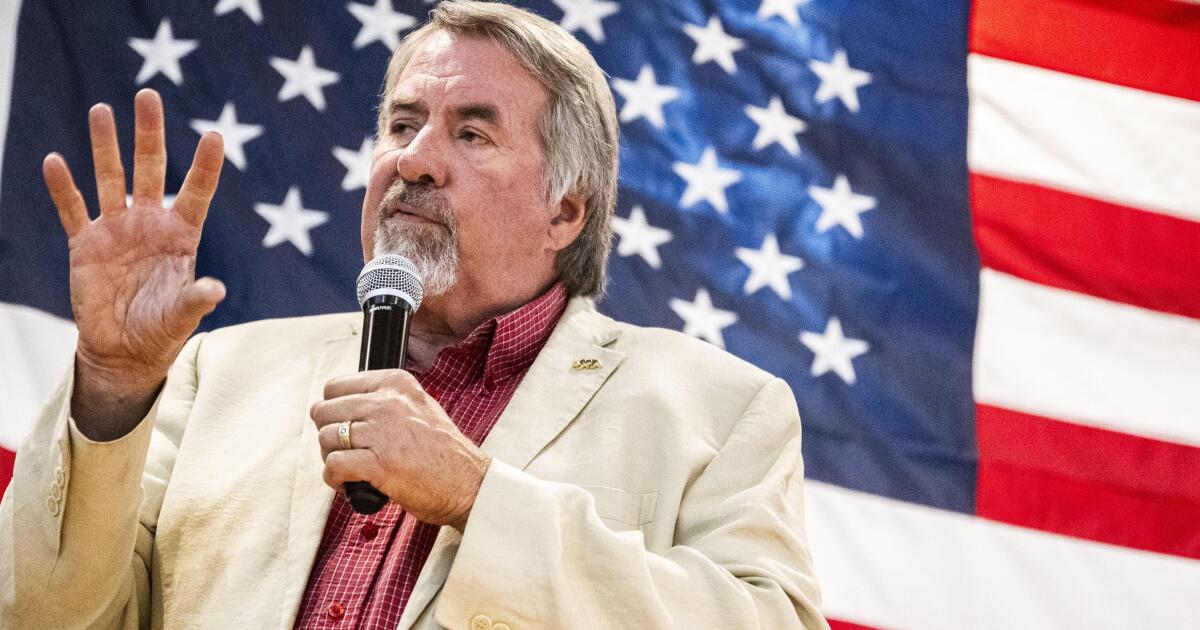
U.S. Rep. Doug LaMalfa, a Republican who represented a vast swath of rural Northern California, died while undergoing emergency surgery Monday evening, authorities said. He was 65.
The fourth-generation rice farmer from Richvale, a town of about 300 people west of Oroville, held his seat for 13 years. LaMalfa easily won reelection year after year — in 2024, he beat his Democratic opponent by 30 percentage points — but his was one of several Republican-held seats imperiled this fall when voters passed Proposition 50, which redraws the state’s congressional districts.
LaMalfa’s death puts the Republican majority in Congress in further jeopardy, with a margin of just two votes to secure passage of any bill along party lines after the resignation of Georgia Rep. Marjorie Taylor Greene on Monday evening.
“Doug was a devoted husband, a dedicated father to four beautiful children, and a newfound grandfather,” Republican Rep. Ken Calvert, who represents the Inland Empire, said in a statement. “Throughout his political career, Doug was a longtime Reagan conservative who believed in limited government, low taxes and traditional values.”
Emergency personnel responded to a 911 call from LaMalfa’s residence at 6:50 p.m. Monday, according to the Butte County Sheriff’s Office. The congressman was taken to the Enloe Medical Center in Chico, where he died while undergoing emergency surgery, authorities said.
An autopsy to determine the cause of death is planned, according to the Sheriff’s Office.
LaMalfa’s district — which stretches from the northern outskirts of Sacramento through Redding to the Oregon border and to Alturas in the state’s northeast corner — is largely rural.
There, a conservative spirit reigns in opposition to California’s famously liberal ethos. Residents have long said they felt underrepresented in the halls of power in Sacramento and Washington and have, for nearly a century, talked seriously about seceding to form their own state called Jefferson.
LaMalfa, a staunch supporter of President Trump, put much of his focus on boosting federal water supplies to farmers and seeking to reduce environmental restrictions on logging and extraction of other natural resources.
One of LaMalfa’s final acts in the House was to successfully push for the reauthorization of the Secure Rural Schools Act, a long-standing financial aid program for schools surrounded by untaxed federal forest land, whose budgets could not depend on property taxes, as most public schools do. Despite broad bipartisan support, Congress let it lapse in 2023.
In an interview with The Times as he was walking onto the House floor for the reauthorization vote in mid-December, LaMalfa said he was frustrated with Congress’ inability to pass even a popular bill like that.
The Secure Rural Schools Act, he said, was a victim of a Congress in which “it’s still an eternal fight over anything fiscal.” It is “annoying,” LaMalfa said, “how hard it is to get basic things done around here.”
In a statement posted on X, California Democratic Sen. Adam Schiff said he considered LaMalfa “a friend and partner” and that the congressman was “deeply committed to his community and constituents, working to make life better for those he represented.”
LaMalfa was facing a difficult reelection bid. After voters approved Proposition 50 in November — aimed at giving California Democrats more seats in Congress — LaMalfa was drawn into a new district that heavily favored his likely opponent, state Sen. Mike McGuire, a Democrat who represents the state’s northwest coast.
In November, just after Proposition 50 passed, LaMalfa told The Times that he was “standing in the fight.”
“They’re not going to kidnap my district here without a battle,” he said.
LaMalfa — who in 2021 questioned the secretary of Agriculture in a video call from his combine harvester while cutting rice — told The Times that California has a major rural-urban divide.
“The urban areas don’t pay much attention to us,” he said. Rural denizens, LaMalfa added, had in him “a voice that understands their plight and is willing to speak to it.”
On Dec. 18, LaMalfa spoke on the House floor in favor of the Pet and Livestock Protection Act, which would remove the gray wolf from protections by the Endangered Species Act. The apex predator has made an astonishing comeback in Northern California after being hunted to near extinction. LaMalfa said his rural constituents — some of whose children have been forced to shelter in place with wolves outside their school — had been mocked by conservationists.
“Yes, it’s real! There’s wolves that are encroaching on elementary schools in Siskiyou County,” LaMalfa said.
He then spoke about Proposition 50, bemoaning what will happen if his district is eventually represented by a Democrat from the “echo chamber of California” who doesn’t understand the small towns there.
“Are you going to have town halls up there? Are you going to go into Modoc Couny, Siskiyou County, Sierra Valley and tell them this is a Red Riding Hood story about the wolves devouring their livestock, eating up all their wildlife?” he asked.
On Tuesday, Democratic Gov. Gavin Newsom in a statement called LaMalfa a “devoted public servant who deeply loved his country, his state, and the communities he represented.”
“While we often approached issues from different perspectives, he fought every day for the people of California with conviction and care,” Newsom said.
Under state law, Newsom must announce a special election for LaMalfa’s district seat within 14 days. The election, which will use the existing district boundaries, must be held within 140 days, or 200 days if consolidated with another election.
Rob Pyers, research director for the California Target Book, a subscription-based election guide, said he anticipates Newsom will schedule the special election for the June 2 statewide primary and hold the runoff in early August.
If the winner of the special election wants to continue to represent the district under the new lines, that person would have to run simultaneously in the regular election this year, Pyers said.
Trump, addressing a gathering of GOP House members at the Kennedy Center on Tuesday, expressed “tremendous sorrow at the loss of a great member” and said his speech would be made in LaMalfa’s honor.
“He was the leader of the Western caucus — a fierce champion on California water issues,” Trump said. “He was great on water. ‘Release the water!’ he’d scream out. And a true defender of American children.”
“You know, he voted with me 100% of the time,” Trump added.
A native of Oroville, LaMalfa attended Butte College and earned an agribusiness degree from Cal Poly San Luis Obispo. He served in the California Assembly from 2002 to 2008 and the state Senate from 2010 to 2012. He was an early supporter of Proposition 209, which ended affirmative action in California. He also pushed for passage of the Protection of Marriage Act, Proposition 22, which banned same-sex marriage in California.
LaMalfa’s death will have an immediate impact on Republican efforts in the closely divided Congress, which has until Jan. 30 to authorize federal funding or else face another government shutdown. The Trump administration also is pushing for congressional action to address the expiration of expanded healthcare tax credits that resulted in premiums, on average, doubling in price for enrollees.
Adding to the GOP’s troubles, Rep. James Baird, a Republican from Indiana, was hospitalized on Tuesday for a car crash described by the White House as serious.
Although Baird is said to be stable, House Speaker Mike Johnson, a Republican from Louisiana, will not be able to rely on his attendance. And he has one additional caucus member, Thomas Massie of Kentucky, who has made a habit of voting against the president, bringing their margin for error in effect down to zero.
LaMalfa’s death came as a shock to school superintendents in rural Northern California who worked closely with him to restore the Secure Rural Schools Act.
Sheree Beans, interim superintendent of the Trinity Alps Unified School District in Trinity County, adjacent to LaMalfa’s district, wept when talking about the congressman on Tuesday. Beans had traveled to Washington more than a dozen times since 2023 and said LaMalfa and his staff always made time for her and her small-town colleagues, who often showed up without a formal appointment.
She said he was a physically big man, but humble.
Beans last saw LaMalfa on Dec. 9, when the rural schools act was renewed in a 399-5 vote. When she posed for a photo with him, Beans, who is just over 5 feet tall, laughed about their height difference; she didn’t even reach his shoulder. He showed her to a door frame in his office where his staffers had been marking their heights, and invited her to do the same.
“He was just a force,” Beans said. “When you talk about Washington, D.C., you don’t think of the name Congressman Doug LaMalfa, but, boy, did he work behind the scenes for kids and for rural America, and especially rural California. He was a champion for us.”
Times staff writers Joseph Serna and Ana Ceballos contributed to this report.