
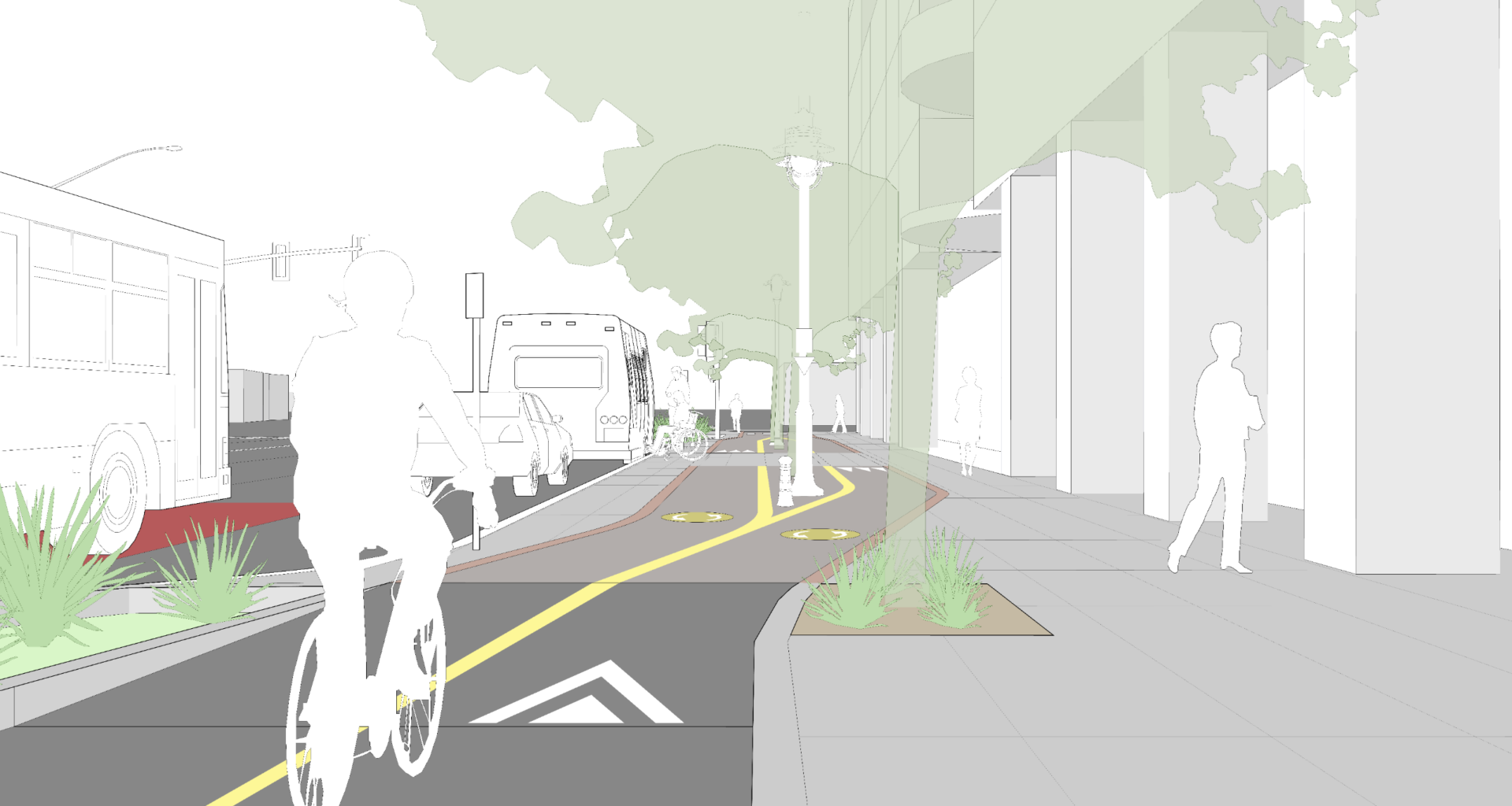
The City of Emeryville officially published the draft CEQA environmental document for the contentious 40th Street Multimodal Project on November 24, triggering the required 45-day public review period, which closes tonight at midnight.
Once public comments are collected, the city will compile and address them in a formal “Response to Comments” document to be presented at a future City Council meeting.
Biking and transit advocates have been enthusiastic about the project, citing the dedicated, protected lanes it would introduce. Local businesses along the corridor, on the other hand, have been far less receptive, arguing that the project’s benefits come at the expense of “legacy businesses” that have operated in the area for decades. Some fear increased gridlock, impeded deliveries, reduced access and egress, and impacts severe enough to threaten their viability.
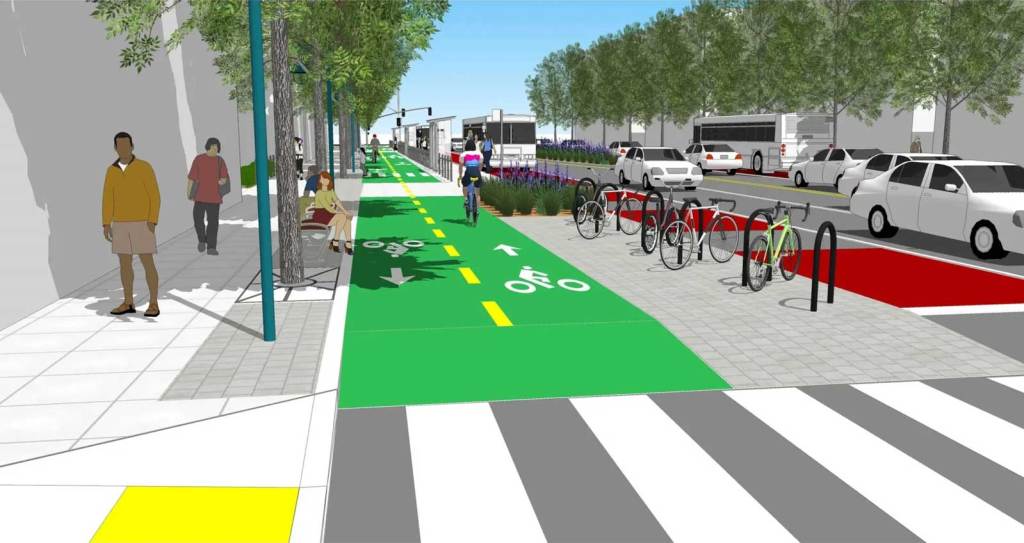
Phase I of the project—now in design and planning since 2017—includes the closure of two cross streets to accommodate a two-way cycle track on the northern side of 40th Street. The phase also proposes converting an existing traffic lane into a dedicated bus lane for the Emery Go-Round and AC Transit.
Despite the project’s lengthy planning timeline, several business owners say outreach has been insufficient, with some claiming they only recently learned about the project—and through channels other than the city.
A group of local businesses and property owners along the corridor has been organizing for more than a year in an effort to influence the project’s design. In August 2025, the group launched the website Reconsider40th.com to communicate their concerns.
Among their arguments is that the proposed bike route is redundant, given the already bike-friendly Park Avenue, and that diverting traffic from 40th Street could push vehicles onto neighboring streets. They also contend that cyclists traveling to Bay Street from the west would be better served using the Horton Street Bike Boulevard and South Bayfront Bridge.
Business owners further argue that the announcement of a future Sutter Health hospital represents a significant change for the area and that the multimodal project should be paused until the hospital’s traffic impacts are better understood. The upcoming opening of Tokyo Central Market, they say, will place additional strain on the corridor, and a projected three-year construction period could prove highly disruptive.
“At a minimum, the proposed two-way cycle track—which would eliminate or impair access to transportation and emergency services for residents of 1440 By the Bay—should be evaluated through an ADA lens before proceeding.”
One of the businesses raising concerns is 1440 By the Bay (formerly Watermark by the Bay), an assisted-living community whose main entrance fronts the project area. The facility submitted a letter warning of potential risks to the 175 seniors who reside there.
“The proposed project would eliminate the multi-space white-curb drop-off zone and additional parking spaces directly in front of our facility,” 1440 By the Bay Executive Director Robert Alvarado. “Very few of our residents can drive. The white space provides our residents with direct access to East Bay Paratransit, family members, and others who transport them to medical appointments and other activities. This space is used dozens of times daily. Emergency Medical Service vehicles also routinely use this space to respond to residents’ emergency needs.”
Alvarado also expressed concern that residents would need to cross the cycle track, noting that the higher speeds of increasingly common e-bikes could make crossings more dangerous.
He further cited a video highlighting safety concerns related to “floating bus islands,” which are included in the project design, and noted that the American Council of the Blind has called for a moratorium on such infrastructure.
“At a minimum, the proposed two-way cycle track—which would eliminate or impair access to transportation and emergency services for residents of 1440 By the Bay—should be evaluated through an ADA lens before proceeding,” Alvarado concluded.
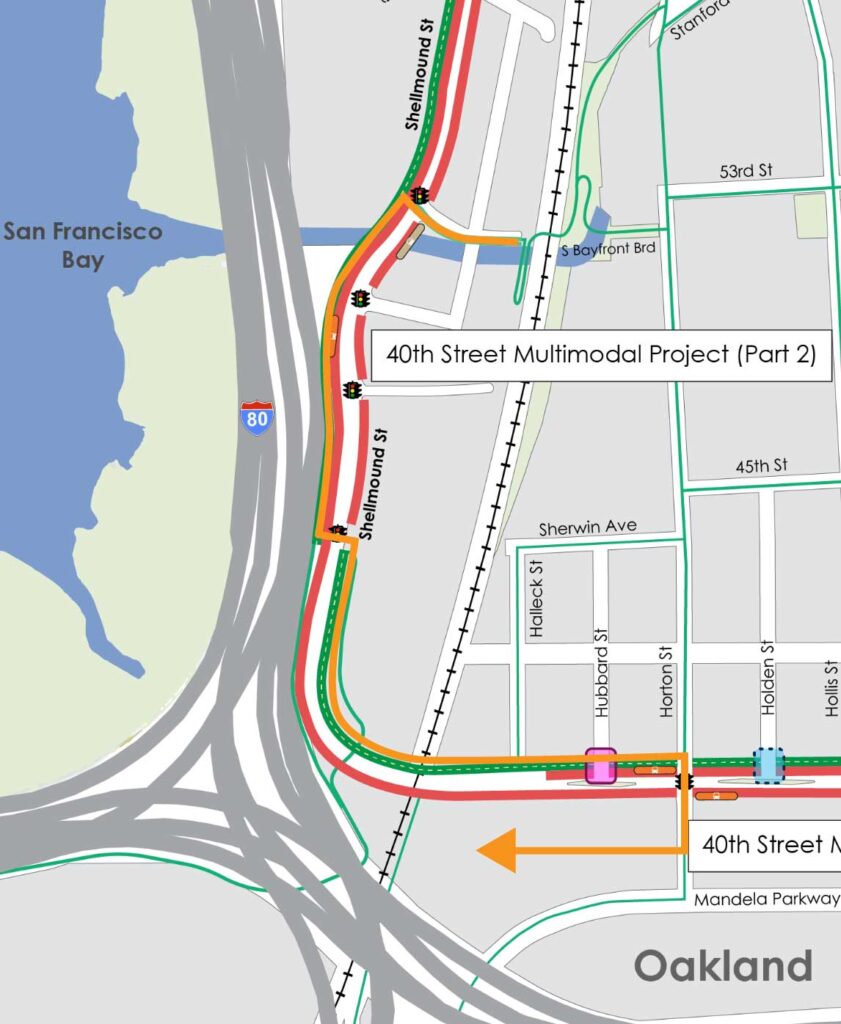
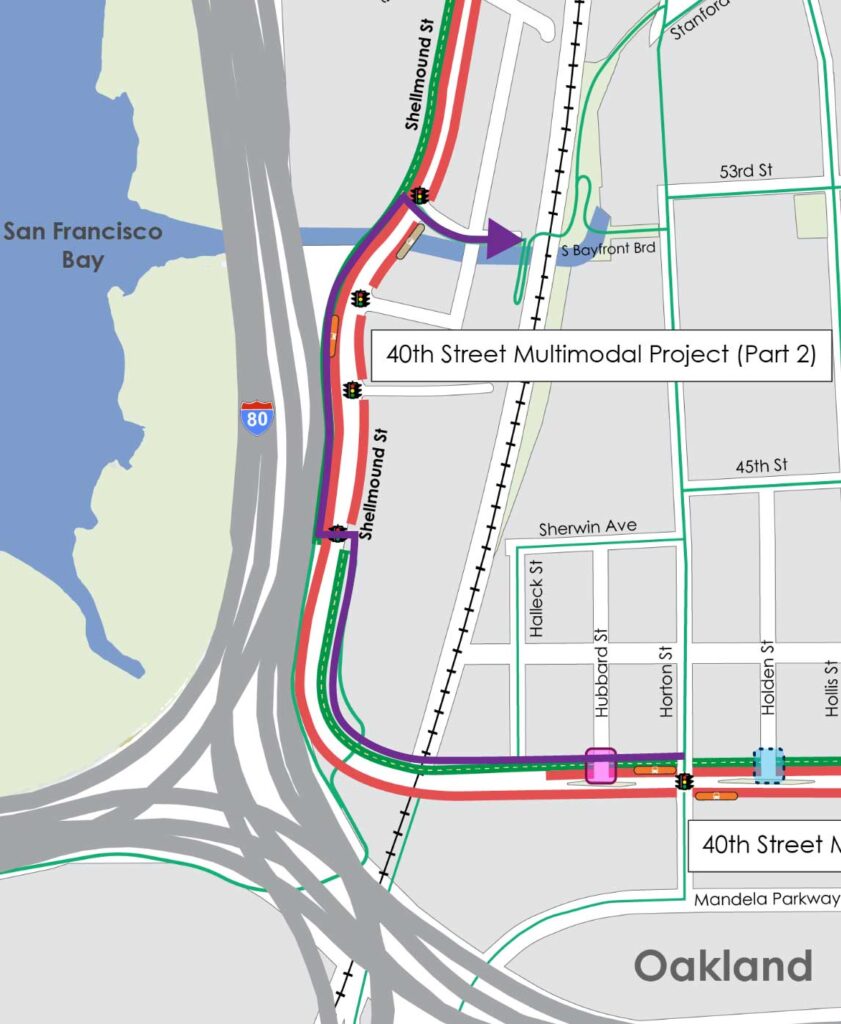
Even for cyclists, the proposed cycle track along this stretch of 40th Street may not be ideal. The existing bike lane on the southern side of 40th Street and the eastern side of Shellmound Street would be eliminated, requiring riders to cross the roadway multiple times in certain cases.
For example, cyclists traveling from 40th Street to Bay Street would need to cross to the west side of Shellmound Street at the IKEA entrance before crossing back again. Riders heading south toward Target would no longer be able to turn right into the parking lot from the 40th Street bridge and would instead be forced to take a more circuitous route.
Additional environmental docs can be viewed on the CEQA website, the MySocial Point website and the City’s website. Video of the most recent City Council meeting at which the project advanced can be viewed beginning at the 1:02:37 mark
Comments on the project may be submitted to Ryan O’Connell, Senior Civil Engineer, City of Emeryville, 1333 Park Avenue, Emeryville, CA 94608, or via email at roconnell@emeryville.org.
All public comments will be compiled and addressed in a “Response to Comments” document, which is expected to be presented at a City Council meeting tentatively scheduled for February 17 or March 3, 2026.
Related
You have Successfully Subscribed!