Along with council members and other City officials, Long Beach residents may see an item on the November 2026 ballot that would change how the city conducts its elections going forward.
RCV (Ranked Choice Voting) in the LBC is a group of Long Beach residents passionate about civic engagement trying to change the city’s voting system to ranked choice voting. This type of voting process allows residents to rank their preferred candidates from first to last rather than only voting for one candidate.
Though this voting system has been used in countries like Australia and Ireland for over 100 years, it has only recently gained momentum in the United States. According to FairVote.org, the states of Maine and Alaska have adopted a ranked choice voting system, as well as dozens of cities including New York, San Francisco, Portland and Redondo Beach.
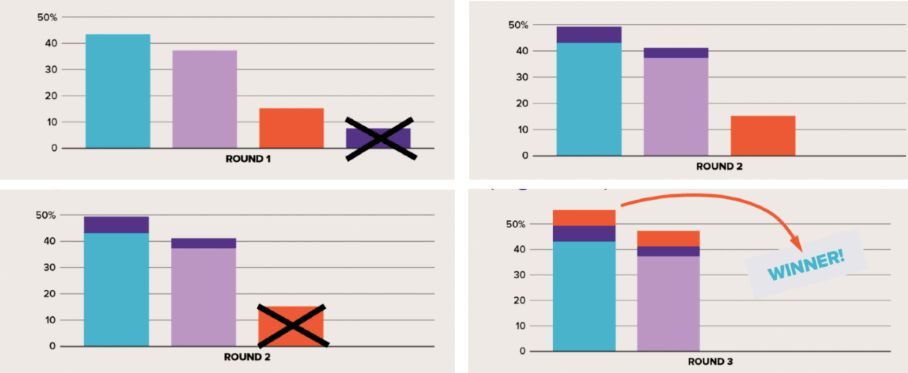 Graphic explaining ranked choice voting, courtesy of Up Vote Virginia.
“We have such a unique opportunity in Long Beach in that Long Beach is small enough that we can try things and experiment and all of us can get involved in the process and we’re big enough where if these things work, people take notice,” said Sean McMullen, who sits on the board of RCV in the LBC.
Ranked choice voting eliminates the possibility of runoff elections, as it takes voters’ rankings and eliminates the candidate with the fewest first-preference votes. People who ranked an eliminated candidate as their first choice will have their next-best option as their new preferred candidate. This continues until one candidate has attained an outright majority of ballots. However, if one candidate wins the outright majority of first-choice votes immediately, there is no need to take into account additional rankings.
Want more local news?
Sign up for the Signal Tribune’s daily newsletter
Proponents of the system say it saves money by eliminating the possibility of runoff elections, ensures the candidate with the most support wins and makes for a more civil campaigning process. In New York’s recent mayoral election, some candidates ran collaborative campaign ads, encouraging candidates with similar views on issues to pull together rather than divide a race.
Those against ranked choice voting argue it’s too complicated for voters to understand, and organizations like the Heritage Foundation claim it’s a method to manipulate elections towards left-leaning candidates.
Data from Alaska and Maine showed a rise in voter turnout when ranked choice voting was adopted, both for midterms and general elections.
“Personally I feel like the government we have is only as good as the participation in it. This is the place where I could see having the most effect and the most positive change for the most people.”
Sean McMullen with RCV in the LBC
Last month, RCV in the LBC presented their case for ranked choice voting to the Commission for Women & Girls. Immediately after, the commission voted to form an ad hoc committee to review ranked choice voting and consider a recommendation to the City Council. The organization is presenting again to the Equity and Human Relations Commission on Wednesday evening.
Organizers are hoping to gain support from commissions, confident this will translate into stronger advocacy when they attempt to take the issue to the city council. In order for residents to vote on the matter, Long Beach City Council will have to introduce it as an agenda item and approve it. RCV in the LBC aims to have the issue on the ballot for the June elections, when voters will be deciding odd-numbered council seats, city attorney, city prosecutor, mayor and more.
Residents who support ranked choice voting in Long Beach can sign RCV in the LBC’s online petition at rcv-in-the-lbc.org/. There, residents can find information on how to join the group’s campaign, as well as on their Instagram @rcvinthelbc.