
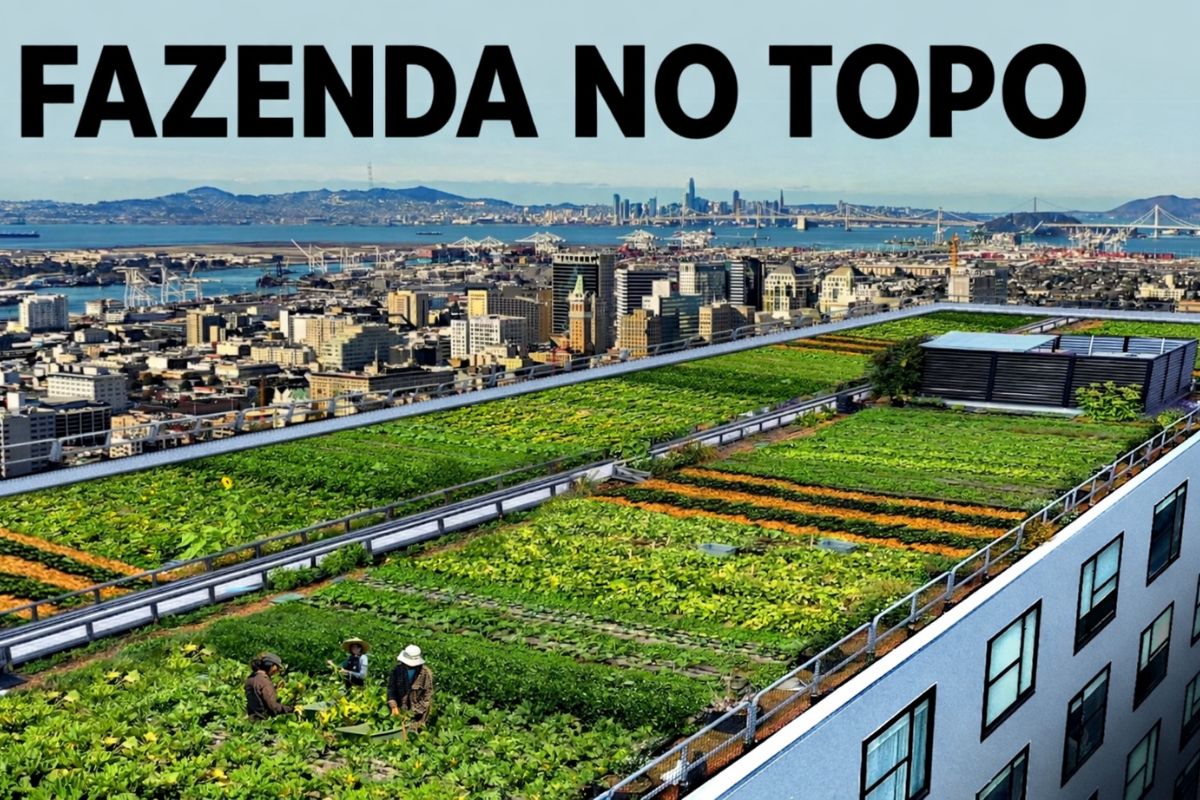
Spanning 1 acre and featuring 180 garden beds, the largest rooftop farm transforms an ordinary roof into a living system: 12 inches of soil, drainage layers, and irrigation with compost teas. The operation delivers free organic food to those facing food insecurity and puts pressure on Oakland to redesign nutrition policies and public funding.
Oakland put the impossible on top of a building and called it food. The largest rooftop farm in the West functions like a living organism: it receives engineered soil, fertigation, and harvests tons of organic food that go straight from the roof to the community on the same day.
The largest rooftop farm has also become a political test. By proving that production and donation can coexist at the same address, it pushes the city to discuss government structures that guarantee universal basic nutrition. with public support for agroecological farms and benefits that go far beyond a spreadsheet.
The largest rooftop farm turned “medicine” atop Oakland.
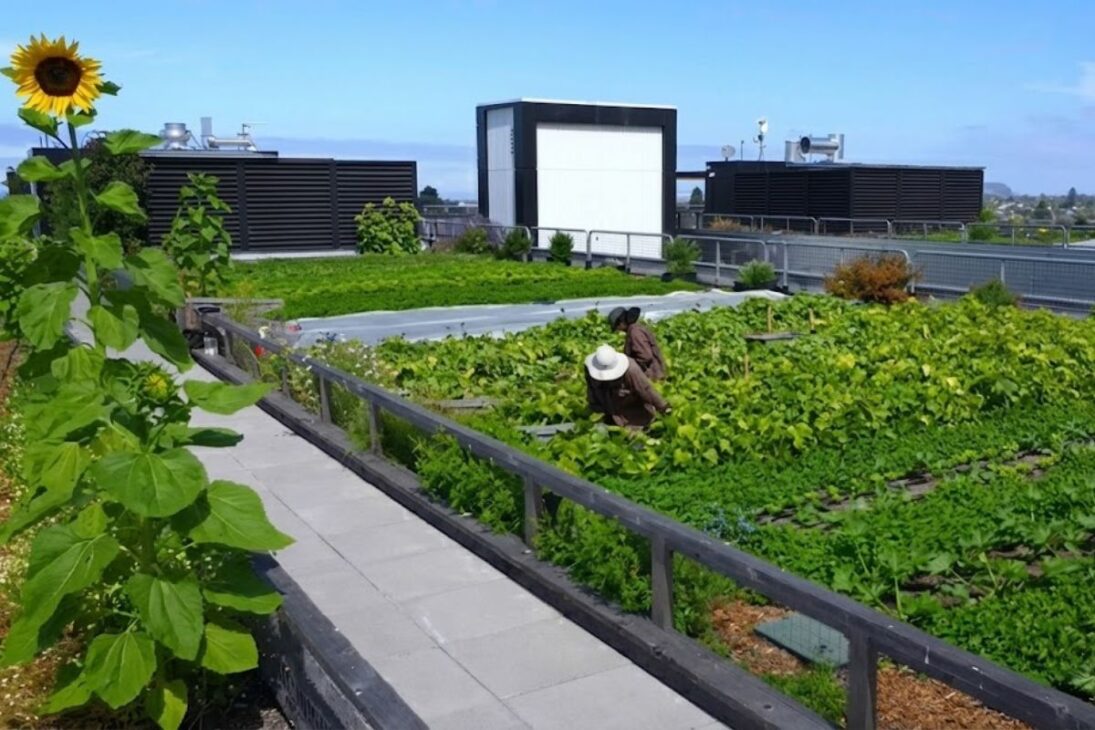
Atop a building in North Oakland operates the largest rooftop farm in the West, a 1-acre rooftop built and designed by Top Leaf Farms and operated by the nonprofit organization Deep Medicine Circle.
— ARTICLE CONTINUES BELOW —
The farm is presented as a “rooftop medicine farm,” with a central idea: Health begins in the soil..
The group treats farmers as healthcare providers. The logic is that health is not an attribute of an isolated individual, but a reflection of a system functioning for mutual benefit.
Therefore, the largest rooftop farm is not described as a “dreamy” project, but rather as a real infrastructure that attempts to transform buildings from mere shelters into active parts of the city.
How much does this farm produce and why does a same-day donation change the game?
Last year, the operation recorded approximately 20.000 pounds of food produced on the rooftop. This volume is equivalent to 9,07 tons of food.
It is certified organic food, of market quality, but intended for the community free of charge, as fresh, whole, and nutrient-dense food.
The rule that stands out is the timing: the food leaves the rooftop and arrives in the community on the same day it is harvested.
What would be considered “market value” becomes immediate access to real food., aimed at people facing food insecurity in Oakland.
The largest rooftop farm has 180 plots, each about 30 feet long. It’s not a decorative garden, but a system designed for high production in a limited space.
The method involves “stacking” the planting to maximize each square foot. A practical example: cabbages are interspersed with lettuce.
Cabbage takes 85 to 90 days to mature, while lettuce is ready in 30 days. By the time the cabbage begins to form a crust, the lettuce has already been harvested. The space is never idle; the cycle is constantly in motion..
In addition to vegetables, there are perennials such as two types of artichoke. Along paths used by residents, herbs, flowers, and various plants are grown to create a residential self-harvesting corridor.
There is also an intention to develop seeds adapted to rooftops, because, over time, the plants will adjust to the specific conditions of that elevated environment.
680,4 tons of soil on top of the building and the calculation that is startling.
The most impressive aspect of the largest roof farm is its weight. Most roofs are lightweight structures, designed to support almost nothing beyond the roofing system itself. Here, the logic has been reversed.
The roof receives approximately 12 inches of soil. The reference used is that this volume, when saturated, weighs approximately 80 pounds per cubic foot.
Spread across approximately 40.000 square feet, the calculation adds up to about 1,5 million pounds of weight on the roof. That equates to 680,4 tons.
None of this “just happens.” This weight needs to be planned for and engineered into the building. It’s not just about piling soil on top and hoping it works. It’s structural engineering being transformed into urban agriculture.
Drainage, protection, and why the question “will it leak?” is inevitable.
When someone sees a farm on top of a building, the first concern is usually leaks. The design answer is pragmatic: any roof can leak if it’s not protected. The difference lies in the layers.
The system described includes 10 to 12 inches of soil, a layer of filter fabric, and a layer called a “drain wick,” where capillary roots have constant access to water and nutrients.
This layer is presented as something close to a hydroponic component, but without being purely hydroponic.
Below this, protective underlayment, drainage mat, root barrier, and other layers are installed to protect the waterproof roof membrane.
The defense is simple: to break through all of this, something extreme would be necessary, because there are many barriers between the planting and the waterproofing.
“Engineered” soil and the farm as a living organism
The largest rooftop farm doesn’t use ordinary soil. The soil is described as an engineered medium, designed for that use, with approximately 50% rock aggregate and 50% organic matter.
The project states that it invests energy in building the soil food web, with inoculation and the presence of mycelium on the roof.
Nutrition is sustained through fertigation: compost teas are prepared and injected into the irrigation system to feed this biological network and deliver nutrients to the plants.
The result is a hybrid. It’s not hydroponic, but it’s also not “traditional soil” connected to the ground.
It is described as a living system on top of the building, capable of producing a great deal of food in a relatively small layer of soil. The building becomes a support structure, and the roof becomes an ecosystem.
Nothing is wasted: composting on the roof and only food waste is used for recycling.
A symbolic detail of the largest rooftop farm is what goes out and what stays in. The proposal states that the only thing that leaves the roof is food. The rest, such as field waste and plant material, is composted on the edges of the building.
This cycle reinforces the discourse of regeneration and an integrated system.
Production is not treated as extraction, but as a circuit, with decomposition and return of organic matter.
Native area, pollinators, and a roof that functions as a year-round habitat.
Inside the rooftop, there’s a more “living roof” area with native plants like ceanothus, coffeeberry, manzanita, and wax myrtle. There are also native California medicinal plants, poppies, salvias, and sticky monkey flowers.
The choice is strategic: to maintain nectar sources throughout the year for insects, creating a continuous habitat for pollinators.
The vision is that the largest rooftop farm isn’t just for people. It should also support urban life, connecting biodiversity in a place previously overlooked as “just a roof.”
Why rooftops are becoming urban solutions for space, heat, and rainwater.
In urban environments, space is a constant source of conflict. There is tension between open areas and development.
The proposal for the largest rooftop farm is to open a new path: you maintain housing and, at the same time, create productive green space on top of the building.
The project links this model to multiple urban effects: greening the city, improving the ecology, reducing the urban heat island effect, and managing stormwater.
The idea is that the rooftop becomes a place where the city gains environmental services along with food production.
And there’s a cultural component: visits and volunteering take place once a week.
For many people, the initial motivation is being in the garden and enjoying the view, but the stated impact is connecting people to the food system and showing that it’s possible to produce a lot in a small space.
The most difficult part: how to prove the value without turning everything into a spreadsheet.
The project argues that, without government incentives, it is difficult to convince investors.
The reason is that many results don’t fit into a standard spreadsheet: how do you value a hummingbird, bees, or the experience of picking and tasting a fresh piece of celery, broccoli, or lettuce that came from the roof?
The criticism is direct: society undervalues food and ecology.
The expectation is that climate change will force a revision of this calculation and make the environmental and social value of structures like the largest rooftop farm for urban resilience more visible.
Political pressure: Oakland may treat nutrition as basic infrastructure.
The ultimate argument from the largest rooftop farm is that this work is a seed, a model that can be replicated thousands of times.
The goal is not just rooftops, but also the ground, in urban spaces, so that “everyone eats and eats well” and participates in their own food system.
The team reports working with food organizations to innovate government structures in Oakland and create mechanisms that guarantee universal basic nutrition through public support for agroecological farms.
The comparison used is with already accepted infrastructure: streetlights, buses, sewage and sewage treatment.
If the largest rooftop farm can already produce 9,07 tons of organic food on a single roof and deliver it on the same day, the question that remains is simple and uncomfortable: Should Oakland treat nutrition as an essential service, in the same way it treats street lighting and sanitation?