
The Abridged version:
Sacramento City Unified could run out of cash as soon as this summer. If all else fails, district leaders may have to turn to the state for an emergency loan.
That could require the school district to go under state receivership, ceding control over spending.
Until the district repays the loan, with interest, further cuts to extracurriculars or staffing are possible.
Ten school districts across California have faced this reality. In Oakland, state authority lasted for 22 years.
Sacramento City Unified is on the cusp of a rare, worst-case scenario.
Leaders in the district are staring down the barrel of a multimillion-dollar budget crisis that could leave them cashless as soon as this summer.
Recent fix attempts — including program cuts, hiring freezes and shrunken supply budgets —have yet to right the ship, according to the most recent financial report from staff.
If all else fails, the district would need to turn to the state for an emergency loan.
But that money comes with interest and strings — most notably, giving up power over spending decisions. And the impacts, such as even deeper cuts to staff or operations, could very well be felt by families.
Sacramento City already at ‘high risk’
State intervention is “never better” for a district, according to Michael Fine, CEO of the Fiscal Crisis and Management Assistance Team and a statewide consultant for education agencies on the brink of budgetary disaster.
“Somebody like me will come in and replace all of you, and make the decisions that you were trusted to make to start with,” Fine said during a presentation to the Sacramento school board in December. “That’s not the right way to do it.”
Fine’s team determined that Sacramento City Unified is at a high risk — a 50.7% chance — of insolvency, in a report published at the end of last year.
The risk of insolvency is higher than the 44.8% chance in 2018, the last time the fiscal crisis team warned the district of possible state intervention. Sacramento City Unified averted disaster then with the help of a funding surge during the COVID-19 pandemic.
Dave Gordon, the Sacramento County Office of Education superintendent, has already sent financial advisers to the district, who are beginning work at the start of 2026.
“This is a terrible place to be,” board member Jasjit Singh said during the contentious December meeting. “This is a challenging space to be as an elected official, because this is not the platform we ran on.”
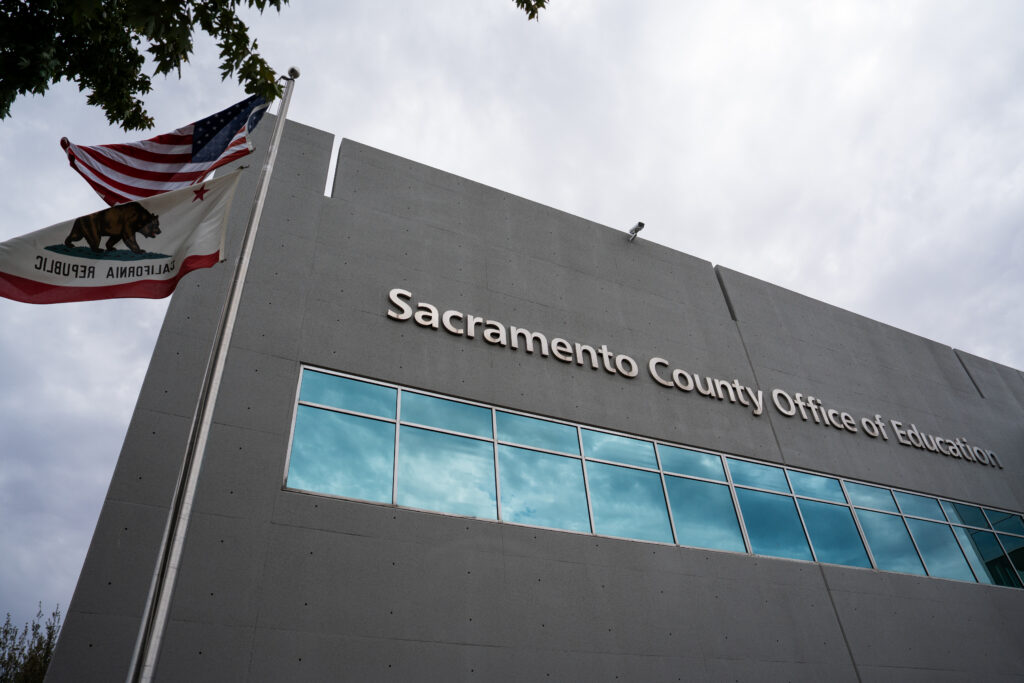 The Sacramento County Office of Education would appoint an administrator in the event of a state bailout. (Denis Akbari)
What is state receivership?
Should problems continue and Sacramento City Unified run out of cash, as the district is projected to do by June, the local crisis becomes a state issue.
The school board may request a loan from the state, which needs approval from the Assembly and Senate, plus the governor’s signature. Those one-time emergency funds would be enough to keep Sacramento City Unified afloat.
The district must repay that loan, with interest. In the meantime, Gordon — in his position as county-level overseer — would appoint an administrator to take the reins. That person becomes the de-facto decision maker for the district, replacing the superintendent and overtaking elected board members’ authority.
Not a short-term situation
“This isn’t like a three-month process,” said Jason Willis, professor at the University of the Pacific in Stockton and an expert in education finance. “This is a multiyear process.”
Willis served as budget director at Oakland Unified from 2007 to 2009. The Bay Area school district paid off the last of its $100 million state loan, the largest in state history, last summer – after 22 years in state receivership.
“That’s a generation of kids,” Willis said.
Ten school districts, out of about 1,000 in California, have had to take out a loan from the state. The average length of receivership is about 14 years. Two other districts beside Oakland needed more than 20 years to repay their loans.
Deeper budget cuts could come
Education experts have long agreed: Receivership is not a desirable outcome.
“When the state provides an emergency loan to a district that is fiscally insolvent,” Willis said, “the priority is repaying that loan.”
To do that, additional budget cuts will likely be necessary, Willis said, in order to regain solvency and afford loan payments. This can include the loss of extracurriculars or layoffs to support staff.
Getting out of receivership — or avoiding the situation altogether — will require a change in habits across the district, according to Fine and many others.
“Your crisis … manifests itself in fiscal matters,” Fine said in his presentation to the school board last month. “But it’s a crisis of leadership, and it’s a crisis of integrity.”
Savannah Kuchar is a reporter covering education. She came to Sacramento to be a part of the Abridged team and contribute to a crucial local news source.