
Artist and author Rosemary Vasquez Tuthill remembers when her father, Emigdio Vasquez, asked her to pose for one of his paintings. She was a teenager and he asked her to remain still and hold a lit cigarette.
“I was 13 years old and I didn’t understand what he wanted me to do,” Vasquez Tuthill said. “He said ‘sit like that and don’t move.’”

Emigdio Vasquez’s work titled “Saturday Night at Leo’s” features his daughter Rosemary Vasquez Tuthill posing with a cigarette.
(Sarah Mosqueda)
That’s how her likeness ended up in “Saturday Night at Leo’s ” (1974), an oil panting by her father that depicts a boisterous crowd in a busy bar, including a woman in red with a cigarette in hand.
Vasquez Tuthill’s father is widely regarded as the “Godfather” of Chicano art and a comprehensive collection of the work that earned him the well-deserved nickname is featured in the Hilbert Museum’s newest exhibition, “Emigdio Vasquez: Retrospective 50.”
“We took 50 of his most iconic paintings and we borrowed a lot of them,” Vasquez Tuthill said.
On view through May 30, the exhibit spans the highly regarded muralist and teacher’s career with work from the late 1960s until 2014.

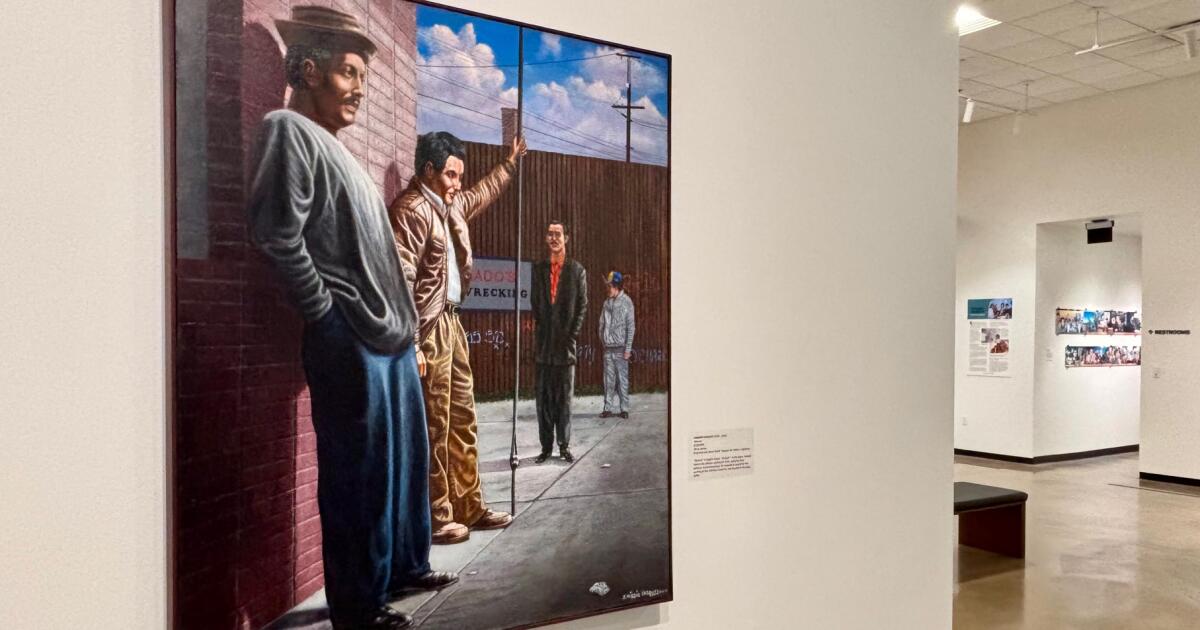
Chicano artist, Emigdio Vasquez, often painted images that honored immigrant labor.
(Sarah Mosqueda)
“The 50 oil paintings range from portraits and still lifes to depictions of Mexican American culture and life in the Orange barrio and trace his evolution as an artist from the expressiveness of the 1960s to the profound social narratives in his later years,” said Mary Platt, Hilbert Museum director.
Early on, Vasquez painted mostly from his imagination with scenes of Mexican revolutionaries a choice subject, inspired by the stories his own father would tell. One of his first works, “Los Revolutionarios,” which was painted on burlap because he did not have enough money to spend on canvas, is on view for the first time.
“He couldn’t afford canvases back then so he took a press board and he got some burlap material and glued it on there to create his own canvas,” Vasquez Tuthill said.
There are paintings of old cars parked in front of clapboard houses alongside portraits of members of the Latino communities in 1970s Anaheim, Santa Ana and Orange. There are still life paintings of culturally specific items, for example, “Beer and Vegetable Still Life” (1996) features brightly colored tomatoes, chilies and onions on a wooden table, ready to made into salsa. A common theme of labor runs through the work with pachucos, day laborers and field workers all present.

A still life painting from Chicano artist Emigdio Vasquez of ingredients commonly used to make salsa.
(Sarah Mosqueda)
Vasquez Tuthill said her father never really spent time outside of Orange County. The intimacy he had with subjects reflects the strong familiarity he had with his local surroundings. Vasquez painted 32 murals in Southern California, including the iconic 1985 Manzanita Park mural titled “Towards the Twenty-First Century” in Anaheim.
His early work has a rough sense of the photorealistic style he would come to favor, with the work progressing into sharp focus. Later in his career he relied less on his imagination for inspiration and more on the photographs he would take of his community.
A painting of Santa Ana’s 4th Street titled “La Calle Cuatro” (2001) is painted from a photograph he took in the 1990s of storefronts along the busy street. One shop window features a “store hours” sticker that almost looks as if it could be peeled off.
Hilbert Museum co-founder Mark Hilbert has been a longtime collector of Vasquez’s work.Vasquez Tuthill herself spent time working as a docent at the museum.
The exhibition is one Vasquez Tuthill dreamed of showing for years and the recent expansion of the museum, tripling the existing exhibit space, finally made her dream come true.
“Our 26 galleries give us more opportunity than ever to display the more than 5,000 oils, watercolors, illustrations, drawings, pieces of movie art and other works in the Hilbert Collection,” Platt said.
A small showing of Vasquez’s work was on view during the museum’s initial reopening, including a still life of a bowl of menudo. It garnered attention and a decision was made to move forward with a larger exhibition of his work.

Emigdio Vasquez’s painting of the former Orange Deli.
(Sarah Mosqueda)
“Since there was a lot of public interest in a smaller exhibition of works by the artist last year, we’re excited to be able to host this considerably larger retrospective curated from the collections of Vasquez’s family and other devoted collectors,” Platt said.
Although Vasquez Tuthill was barely a teenager when she posed for “Saturday Night at Leo’s” her father reimagined her as an older woman, a sort of prediction of how she might look that turned out to be quite accurate.
“That’s how I looked in my twenties,” Vasquez Tuthill said. “He really nailed it.”
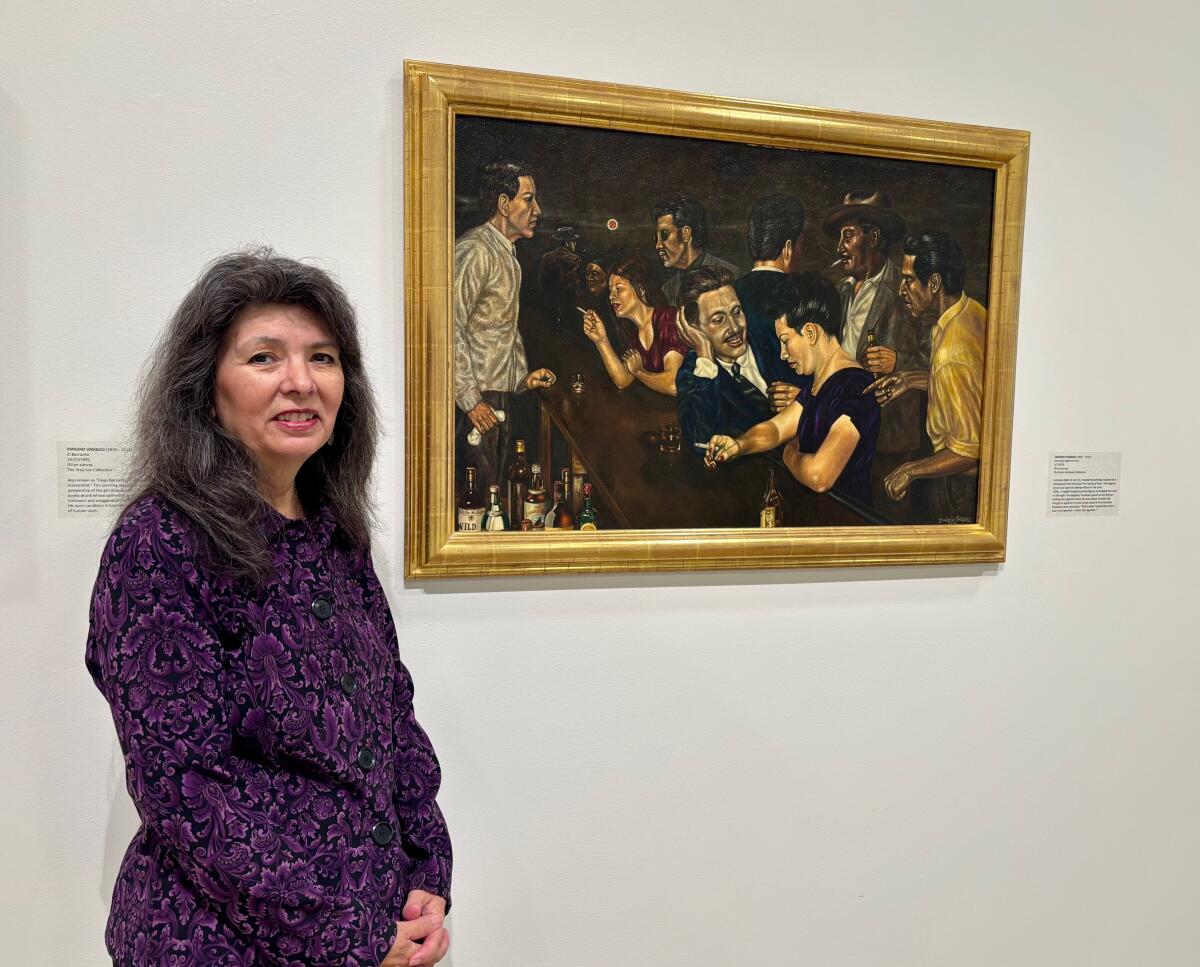
Artist and author Rosemary Vasquez Tuthill, stands with Emigdio Vasquez’s work in which she posed as a model.
(Sarah Mosqueda)
Vasquez Tuthill is present in another great work featured in the show, but in a different way. While Vasquez often painted the male workforce, near the end of his life he made an effort to depict female labor, choosing produce packers as the subject of one of his last paintings, “Packing House, Orange CA , circa 1948.” (2014/2015)
“These are his sisters, Bea and Liz,” Vasquez Tuthill said of the line of women in the painting, shown amid packing crates with oranges. “I remember seeing this at his house. It was sketched out, outlined and he had the first layer of paint on it. He had the actual black-and-white photograph on his table.”
Vasquez fell ill and passed away before he could complete the work. At the behest of her brother, Vasquez Tuthill reluctantly finished what her father had started.
“I had just started getting back into painting, but I was doing little things,” Vasquez Tuthill recalled. “I talked to my older brother about it and he said ‘just start with a shoe.’”
She did and worked her way up, finishing it in 2015. She entered it in the Orange County Fair and won a prize that year.
“Mark [Hilbert] liked it so much he kept bugging me about it. He wanted me to donate it to the museum and I resisted for a long time,” said Vasquez Tuthill. “I had a real attachment to it because it was like my transition; I was taking up the mantle.”

“Packing House, Orange, CA circa 1948” was outlined by Emigdio Vasquez and completed by Rosemary Vasquez Tuthill following her Father’s passing.
(Sarah Mosqueda)
Continuing her father’s legacy is a responsibility she takes seriously. Vasquez Tuthill authored a book about his life titled “The Boy Who Drew the Barrio.” Visitors can find signed copies available for purchase at the museum. Vasquez Tuthill hopes the show and the book will inspire people to learn more the impact her father had on Orange County’s art scene.
She did eventually give up the painting, donating it to the Hilbert where it will be on view for generations to come.
“It’s actually better here than in my house,” she said.
“Emigdio Vasquez: Retrospective 50” is on view at the Hilbert Museum of California Art, 167 N. Atchison St., in Orange. The exhibition runs through May 30. For details, visit hilbertmuseum.org.