
Last Friday night, around 10:30 p.m., Alexandra Mendoza-Gonzalez was with her wife at their home in Oakland, watching the HBO show “Heated Rivalry.” Suddenly, her phone was blowing up with messages from her mother and uncle in Caracas, Venezuela.
“The voice notes were terrifying,” she told The Oaklandside. “I was able to hear not just the helicopters, but all the shots.”
Mendoza-Gonzalez said her mother lives very close to the military zone where the US military captured Venezuelan president Nicolás Maduro, in an operation that Venezuelan officials say left more than 100 dead. “It was terrifying to hear her voice and me being here not able to do anything,” she said.
The news of Maduro’s arrest landed like a bombshell in Oakland’s Venezuelan American community.
We spoke with several of them, from an engineer to a famous muralist to a former Caracas city councilmember to a former lab analyst who now runs a successful food pop-up in deep East Oakland. All of them agreed that Maduro’s departure from power was long overdue. The country and its people, they said, have suffered at the hands of the regime. But they were divided on the question of the US role in his ouster.
Mendoza-Gonzalez said she left Venezuela in 2015 to pursue an MBA at UC Berkeley, at a time when it was becoming more challenging to find work for those who opposed Maduro. She now works in tech.
Last Friday, she said, she spent a sleepless night wondering whether her family would be okay.
Never miss a story. Sign up for The Oaklandside’s free daily newsletter.
“My family and friends are in this tensa calma,” a stressful state of calm, she said. “They didn’t know what was happening.”
Hours later, the American people woke up to the news that the Trump Administration had launched a military attack on the Latin American country to capture Maduro and his wife, Cilia Flores. The two were flown to the United States to face charges including narco-terrorism conspiracy, cocaine-importation conspiracy, and weapons charges.
In the days since the U.S. Army’s Delta Force, an elite special forces unit, captured Maduro and Flores, the legality of the operation has been hotly contested. On Jan. 7, a panel of United Nations experts declared that the actions by the Trump Administration represent a “grave, manifest and deliberate violation of the most fundamental principles of international law.”
‘Take the oil, we don’t care’
After Maduro was captured, President Trump claimed the military operation was justified. Venezuela, he said, had stolen American oil — when companies were nationalized under President Hugo Chavez — that needed to be recovered.
During a Jan. 3 press conference, Trump said, “We’re going to have our very large United States oil companies, the biggest anywhere in the world, go in, spend billions of dollars, fix the badly broken infrastructure, the oil infrastructure, and start making money for the country.”
“Take it. We don’t care,” Mendoza-Gonzalez said. “Venezuelan people, my friends, my family, spend hours in line to get gas, it’s ridiculous. We don’t have control of oil. The regime destroyed every infrastructure that we have. We can have the most reserves in the world, but we don’t actually have anything to export or take advantage of.”
Wilmer Rengifo, the former Caracas council member, who has also lived in the United States since 2015, had a similar perspective on Venezuela’s crude oil reserves.
“We haven’t benefited from oil in over 24 years,” he said. “I’m going to tell you frankly speaking, we would rather trade our oil for a guaranteed democracy in our country.”
Rengifo said that even with Maduro out of power, followers and close allies still control every branch of government down to local municipalities.
“People back home are scared to voice how they feel,” he said. “They are scared of sharing anything on social media for fear of getting arrested for speaking against the regime.”
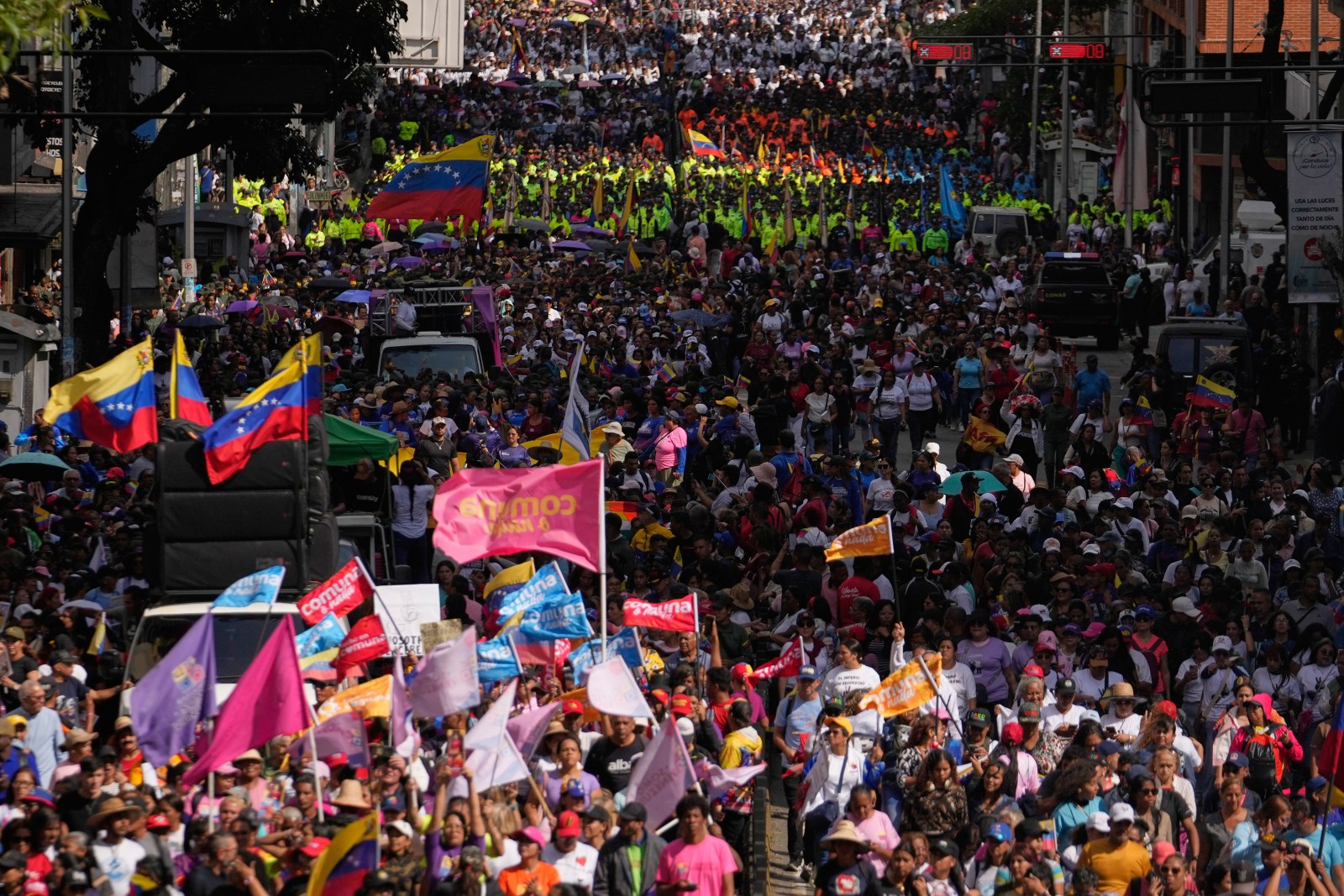 Government supporters gather for a march to demand the return of President Maduro in Caracas, Venezuela, Jan. 6, 2026, three days after U.S. forces captured him and his wife. Credit: AP Photo/Matias Delacroix
Families divided about the U.S. intervention
Vanessa Solari Espinoza, better known as DJ Agana, is an Oakland-born multidisciplinary artist whose father’s family is from Maracay, a city about an hour and a half from Caracas.
She expressed far more skepticism about not just Maduro’s capture, but whether the military operation signals more interventions in other Latin American countries.
She believes that Maduro’s capture was a setup.
“The military is heavily armed, and the country has Russia and Cuba protecting it. How was it this easy?” she said.
Espinoza also wonders what will happen to Venezuela if the United States takes control of its oil.
“We don’t want Maduro to be the president, but we also don’t want the United States to exploit all of the natural resources,” she said.
Bay Area organizers have planned a protest for Saturday at the Chevron refinery in Richmond to oppose the U.S. intervention and the way Chevron is poised to profit from it as the only US oil company operating there.
Espinoza said her family, like many others in Venezuela, has suffered at the hands of the Maduro regime.
Espinoza told The Oaklandside that her father’s health began to decline after Chavez came to power. He could no longer easily access the medications he needed, including an inhaler for his asthma. He died nine years ago.
But she said she still has family members back home who work for the government and support Maduro.
“Half of my family is against the U.S. intervention, and then the other half of my family is celebrating,” she said.
In the days since Maduro was captured, thousands of his supporters have taken to streets of Venezuela to demand the release and return of Maduro and Flores.
She said her Venezuelan-born younger sister recently made the trek from Venezuela to seek asylum at the Mexican border and join Espinoza in Oakland.
“She had an asylum appointment, the same month that Trump came into office, and her appointment was canceled, and she was stuck in Mexico,” Espinoza said. Her sister has since settled in Mexico City.
Last July, a federal judge in Washington, D.C. ruled that Trump’s decision to deny entry to people seeking asylum was unconstitutional. Still, in November, the administration halted all asylum cases following the shooting of two National Guard soldiers in Washington, D.C.
While Espinoza worries about the potential repercussions of the U.S. intervention in Venezuela, Elaine Agrizone, the former laboratory analyst, views it as a first step toward achieving democracy.
Agrizone left Valencia, a city three hours away from Caracas, 10 years ago.
“Even with having two jobs, it wasn’t enough to buy the basics, let alone be able to afford buying a house,” she said.
Two years ago, a few years after moving to Oakland, she opened a food pop-up at the corner of 90th Avenue and Holly Street called Arepas Sabor Venezolano. She said over the years she has built a loyal clientele not only among fellow Venezuelans but also among immigrants from other countries such as Mexico, Honduras, El Salvador, Nicaragua, and Guatemala.
Agrizone doesn’t believe democracy is on the horizon for the country until all pro-Maduro political leaders are ousted.
“I want my country to go back to what it was when I was little,” Agrizone said. “We were happy. We had it all. My country is beautiful. Our natural wealth is abundant.”
“*” indicates required fields