
Pacific Gas & Electric’s 5.5 million electricity and 4.5 million gas customers have come to expect not much good from the company. First it was deadly, neighborhood-leveling gas explosions (opens in new tab); then deadly, town-leveling fires (opens in new tab); then year after year of hefty rate hikes (opens in new tab). The series of lengthy power outages that hit San Francisco neighborhoods beginning Dec. 20 has only intensified local outrage.
Aren Page has reason to be just as skeptical of the utility giant — he grew up seeing friends lose their homes in wildfire-scarred Sonoma County, where PG&E is like a four-letter word. But the experience made him want to improve the grid for future Californians’ safety and energy security. He went to work for the National Oceanic and Atmospheric Administration studying wildfires, then for PG&E as an engineer on substation design and distribution safety. In 2025, he founded GridIQ (opens in new tab), which develops sensors to find grid faults before they become disasters.
While some in the city are kicking around political and financial solutions to the PG&E problem, Page is focused on the technical.
This interview has been edited for length and clarity.
You live in San Francisco. Did you lose power last month?
I would have, but I was actually out of town at the time.
Oh, lucky. The trend lines in the most recent California Public Utilities Commission reliability report (opens in new tab) for PG&E show that the grid in San Francisco is kind of on the decline. Over the last decade, power goes down more often and takes longer to restore.
What that really speaks to is the increasing demand on the grid. We still have legacy infrastructure that we’re working with, but our electrical demands increase exponentially every year. So we’re really in a transition period right now. We’re updating lots of infrastructure, lots of grid, while also trying to meet the heavy increase in demands. And that curve of being able to overlap those two can be a difficult challenge. Like, if there’s a new electric vehicle charger installation going in, that whole circuit pretty much needs to be upgraded.
The California grid is really an interconnected web, like, one substation feeds a lot of that surrounding region. So when there is something that goes wrong, it will cascade downstream.
It seemed to really surprise people that this one point in that web could fail and take out such a huge chunk of the city.
Absolutely. These substations really act almost like a large breaker system, like in your house. If something goes wrong, it’ll be a substation that has a breaker system, and also downstream, there are smaller breakers, so there are all these protection mechanisms installed in the infrastructure throughout the entire grid. When there’s an issue higher upstream from the load, it will shut down and protect everything downstream.
It’s also much more complex than a system in our house, of course, and the voltages we’re dealing with are so high that there’s physics that go into creating that breakage. It’s not just a disconnect of the circuit. It’s like, now we have to look into disconnecting the circuit, but then protecting against arcing and fires.
In a typical home, electricity operates at 120 to 240 volts. The distribution lines feeding our neighborhoods usually run in the range of 4,000 to 12,000 volts, depending on the area. San Francisco still has some legacy 4,000-volt circuits, though most of the city operates at higher distribution voltages.
When you move upstream to substations, the voltage increases dramatically. Transmission lines feeding those substations commonly operate at 115,000, 230,000, or even 500,000 volts. At those levels, the energy involved is enormous, which is why utilities build in multiple layers of protection and redundancy.
While the grid is designed to isolate problems locally, high-voltage systems demand extreme caution. If equipment degrades or a fault isn’t cleared properly, the risk of catastrophic failure — including fires — increases significantly.
PG&E has, I think rightfully, determined that its biggest risk and liability is in the woods, with overgrown vegetation and more extreme climate risks. That’s where the company has seen most of its problems in the last decade, and that’s where it has made most of its investments — though it says it has invested $3 billion in the SF grid over the last several years.
In comparison to rural areas, SF generally has far more reliable power. But the city still has some of the same electrical infrastructure that’s been in place since the late 1800s. And we’ve still got plenty of houses that use knob and tube wiring with cloth insulation that’s at least 70 years old.
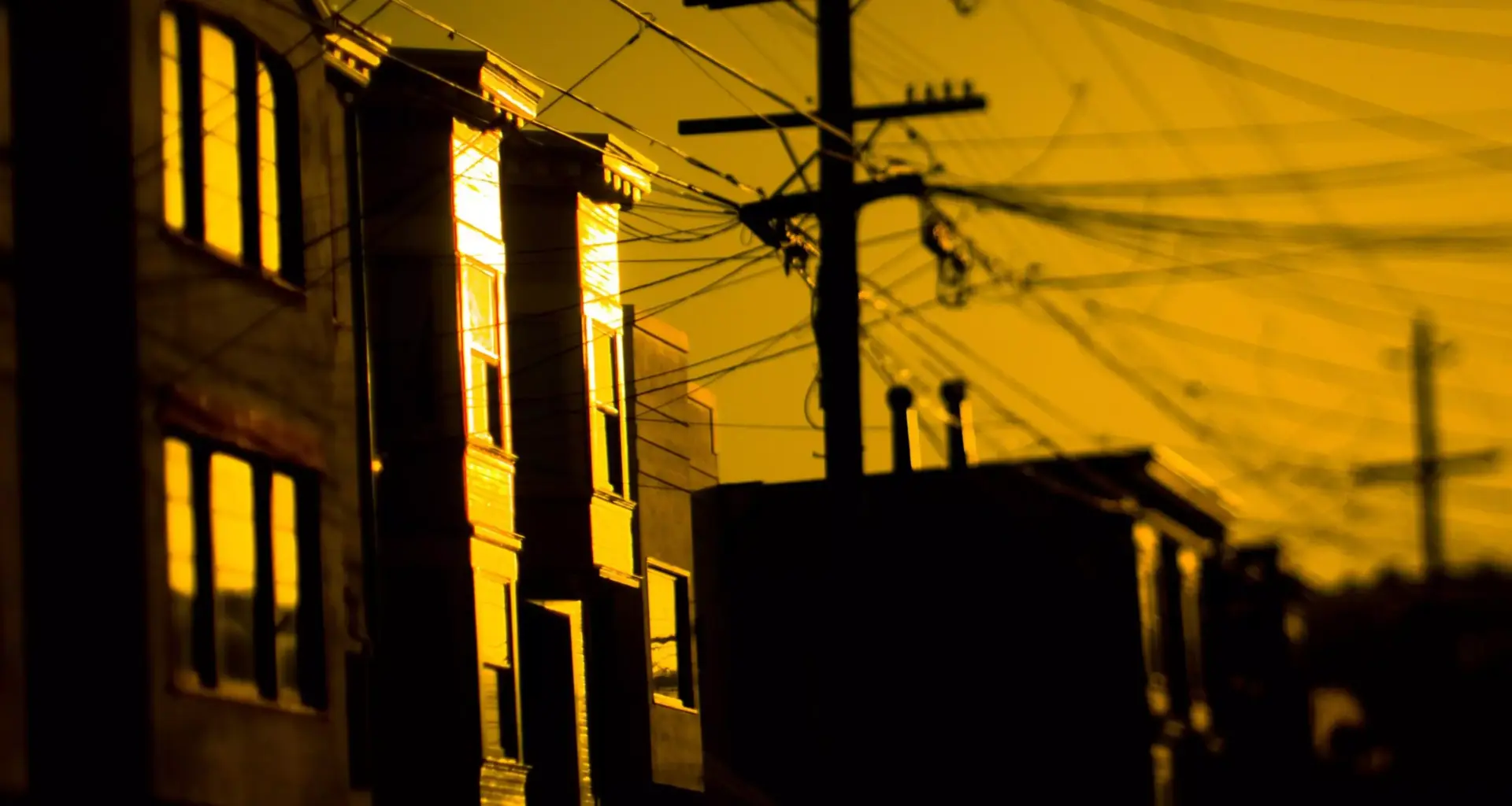
Oh yeah. And glass insulators. You look up at San Francisco overhead wiring, you’ll see wood poles and glass insulators. Like, wow, that is old stuff.
It’s supposed to be the most technologically advanced city in so many ways. We think of it like that — this is the city where we build the future. So it always struck me as a deep irony that we’re building that future on top of this really old system. We’re overtaxing it every day to power that future.
It is an interesting proposition. We are taxing this legacy grid more and more. In order to upgrade it to the speed that we need it to be, we have to think five, 10 years ahead of where our demand will be, what problems we’re going to be facing, and then make the appropriate investments.
When the lights went out in SF, everyone noticed a home here or there that still had power — likely because they had backup batteries and potentially solar generation too. It’s an expensive solution, but it’s one that more PG&E customers have turned to in areas that lose power often. I wonder if more people in the city might consider making that investment now.
There’s a school of thought that feels a resilient, community-centered future grid is a decentralized one made up of local generation and backup batteries — interconnected microgrids, instead of one-off well-off homes.
A microgrid, technically, is a grid that is connected to the larger grid system but can disconnect and power itself separately if needed. So that could be a variety of things — maybe the main power grid just feeds a bunch of batteries, and then if we need to disconnect from the main grid, we’ll operate the microgrid off the battery system for 48 to 72 hours.
But if we have power generation in those microgrids too, there’d be an opportunity to build that robustness, that redundancy. Then if we do need to hold our own with our microgrids, we will have a low-cost generation point. That’s a great opportunity. But that microgrid is interconnected with the major grid. I want to emphasize that — it’s not about disconnecting from the utility. It’s really about, how do we work with the utility now?
I think there are some PG&E customers in San Francisco who are mad enough to try to make a go of it off-grid. But when we’re talking about these kinds of microgrids, they’re just not likely to have the capacity.
That’s right. Rural areas are really innovating in this out of necessity, based on community needs. Every particular place is going to face a different subset of problems.
So when you’re thinking 10 years out, what are the obstacles, and what are the opportunities?
In California particularly, we’ve done a lot of undergrounding power lines [to reduce risk of overhead lines sparking fires]. So there’s an opportunity for continued undergrounding in a way that is prepared for higher loads on the grid. And there’s an opportunity in the microgrids — building in a little bit of community resource generation to have a backup system to be prepared for outages.
What the future really holds for the grid is more localized generation and clean energy, whether that’s solar or wind or hydro, so we don’t have to pass electricity over large regions through large transmission lines. That helps for a lot of different reasons — our voltages can be lower, there’s less risk.
Most important, the constant here is we will always have obstacles. But power is a community resource. If we want to solve it and build robustness, we have to look at it as a community problem.