
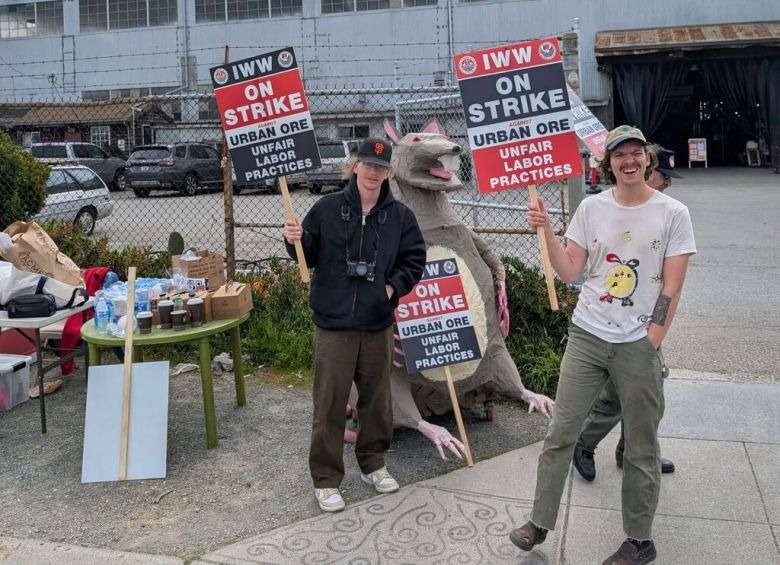
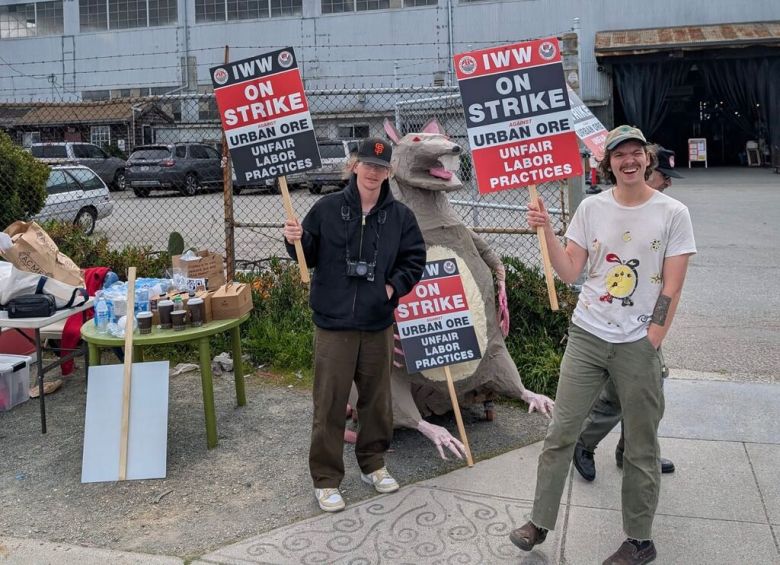
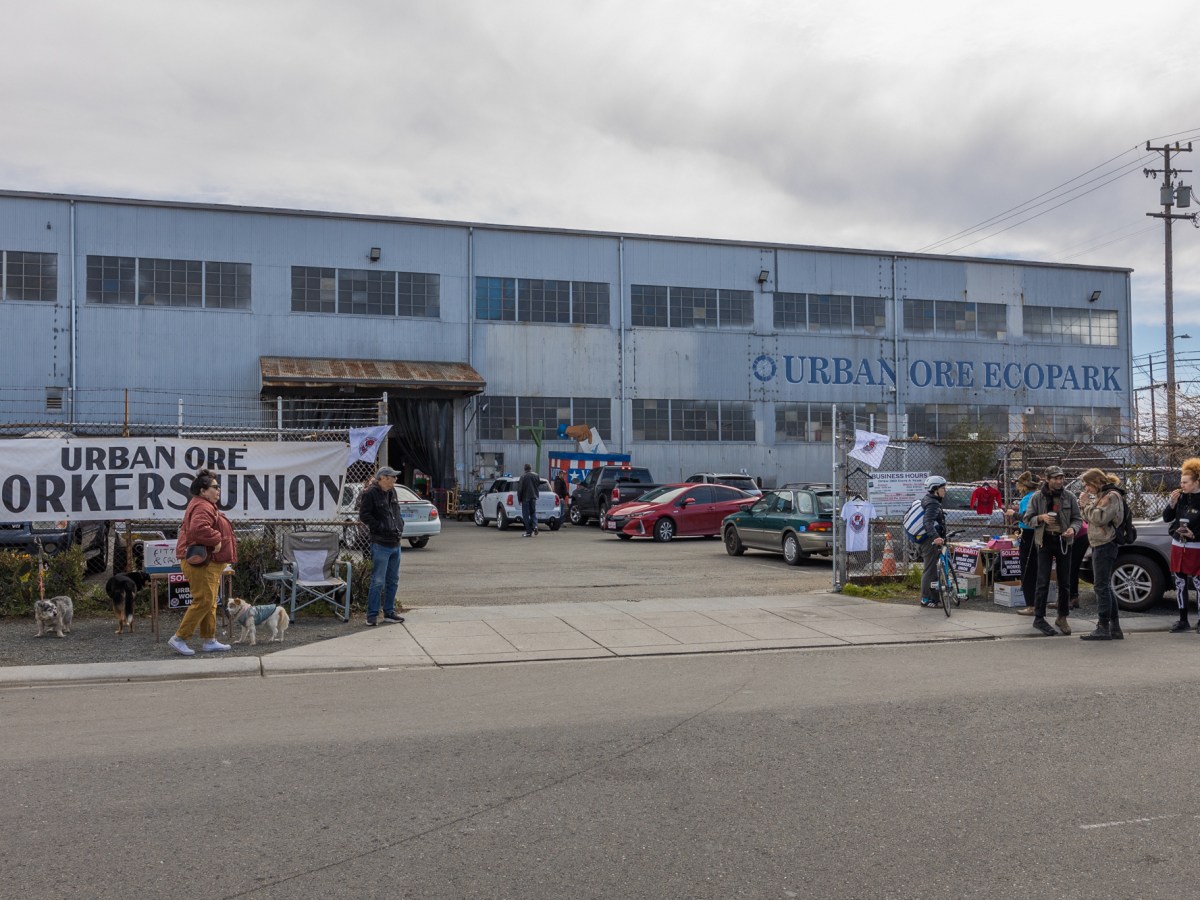
 Workers on strike outside Urban Ore on Saturday, March 22. Credit: Lance Knobel/Berkeleyside
After a nearly three-year battle that pitted workers against owners and each other, employees at Urban Ore, a family-run salvage yard and reuse store in West Berkeley, have ratified their first union contract. The deal, reached last month, ends a protracted battle that led to a month-long strike last year and nearly bankrupted the company.
Under the collective bargaining agreement, still not signed, workers will get an increase of approximately $3 per hour, see higher accruals in paid and unpaid time off along with holiday pay and contractual protections that workers can only be fired for legitimate reasons.
One point of contention that led to the strike was Urban Ore’s unique wage structure that consists of regular base wage pay, monthly revenue sharing and yearly profit sharing. Before the strike, employees received 15% of the store’s revenues, which added around $7 to $9 to their hourly wage rate along with twice a year bonuses. But some employees argued that the unorthodox compensation model resulted in fluctuating income that sometimes meant a smaller paycheck and made it hard to plan. The owners have said that the check differences were insignificant and that a “flexible” payment system created more buy-in and dedication to the company.
Since the strike ended, revenue sharing has been reduced to 5% although profit sharing, in the form of twice a year bonuses, will remain.
“Overall, it’s been a real trial but we came through it and are now looking forward to the next phase,” said co-owner Dan Knapp, who has owned Urban Ore with his wife, Mary Lou Van Deventer, since 1980. Van Deventer was less flattering in her assessment. “It was two years of arm wrestling and blood letting,” she said, referring to the strike and the ongoing negotiations between owners and the union, which aligned with the Industrial Workers of the World. “The union was just ideologically against us because we’re the owners. It was all out class warfare.”
Spencer Jordan, a salvager at Urban Ore who has been with the company since 2021, praised the contract and said that it would not have been possible without a strike. “The capacity we built for self advocacy as a union is what afforded us a seat at the table in terms of the compensation and working conditions,” he said.
Interpersonal scrapes at the scrap yard
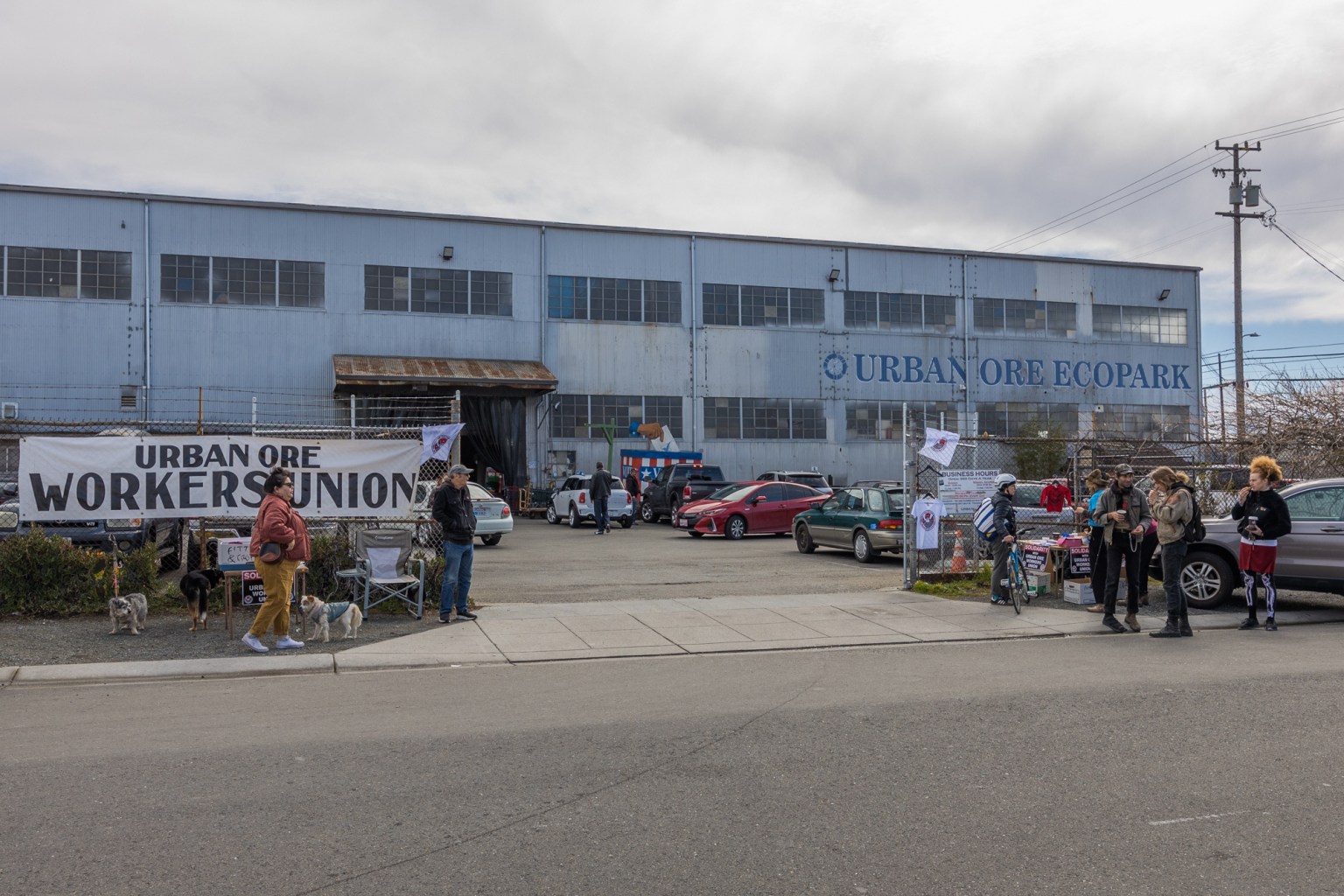 Workers at Urban Ore table outside the store’s parking lot on Feb. 25, 2023. Credit: Marcus Gabbert
Over the years, East Bay residents fell in love with Urban Ore, located off Ashby Avenue where all manner of used treasures could be found – everything from furniture, building materials and lumber to housewares, jewelry, records and books. The business also includes salvage and recycling operations at the city’s solid waste transfer station where workers are dispatched every morning to retrieve items that can be sold at the store. On average, the company removes 3 tons of material from the transfer station every day, reducing the amount of trash and recycling materials the city has to process.
Urban Ore’s existence is a testament to its hippie owners’ “reduce, reuse, recycle” mantra that seeks nothing less than to transform human beings’ relationship to garbage. “Our goal is to end the age of waste,” said Knapp, who has a doctorate in sociology. “We’re almost there as a company and keep 8,000 tons of garbage out of the landfill each year.” Berkeley residents also drop items at Urban Ore and sometimes even sell back unwanted items, reducing waste and generating sales tax for the city and state.
Nick Raymond, an administrative manager at Urban Ore who has been with the company since 2019, said he was happy that an agreement had been reached. But the strike dealt a big blow to the company’s finances that it’s only now starting to dig out from under, he said. “Urban Ore has always been at best a break even operation,” Raymond said. “But the strike majorly damaged the bottom line. The only reason we made payroll last May was because the owners put their life savings into the business.”
Workers at Urban Ore voted 14-7 to form a union in 2023 with the help of Industrial Workers of the World. Knapp told Berkeleyside he thought the election was unfair because it “created a division based on the idea that there are bosses and workers,” but he did not file a formal objection. Employees were evenly divided about the strike. Of the 39 workers employed at Urban Ore in 2023, 18 joined the bargaining unit. When the union called a strike in March 2025, nine employees joined the picket and two did not picket but did not work either.
The union’s biggest concerns centered around wages and disciplinary standards. “We had observed a pattern around firing and discipline that we felt necessitated clear and codified just cause standards,” Jordan said.
Another was a demand that the union would supply all new hires, a non-starter for the owners.
During the strike, picketers blocked the facility’s driveway each day, resulting in a significant drop in customers and putting leverage on the owners to come back to the table. At times, things turned personal. As some workers and their supporters stood on the picket line waving signs, other employees accused them of being ideologues and entitled brats. Picketers, many of whom were not employees but brought in by IWW, yelled “Scrap who? Mary Lou!” and barred potential customers from entering, said Van Deventer.
At one point during the 40-day strike, someone put glue in the combination locks on the company’s gates so that the facility could not be locked. Jordan, the Urban Ore salvager and one of nine employees who went on strike, said that the lock incident “was not a decision that was undertaken by anyone in the union and not an action that we condoned.”
During the strike, six employees, all of whom were on strike, were laid off, prompting the union to accuse the owners of retaliation. Knapp and Van Deventer said that the people selected for layoffs were part-time employees and that the move was necessary because income was reduced and was also a way to help workers receive unemployment benefits.
Urban Ore owners, now in their 80s, turn toward succession planning
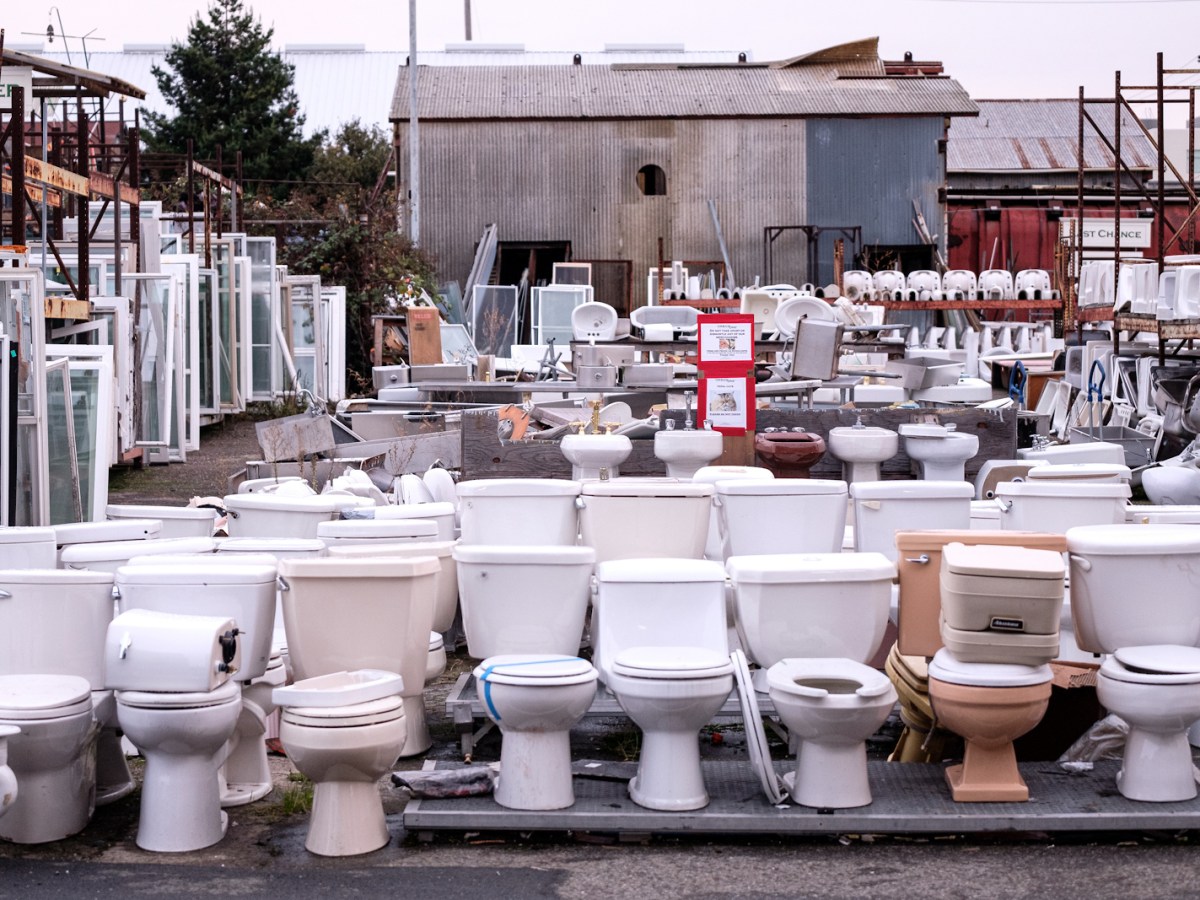
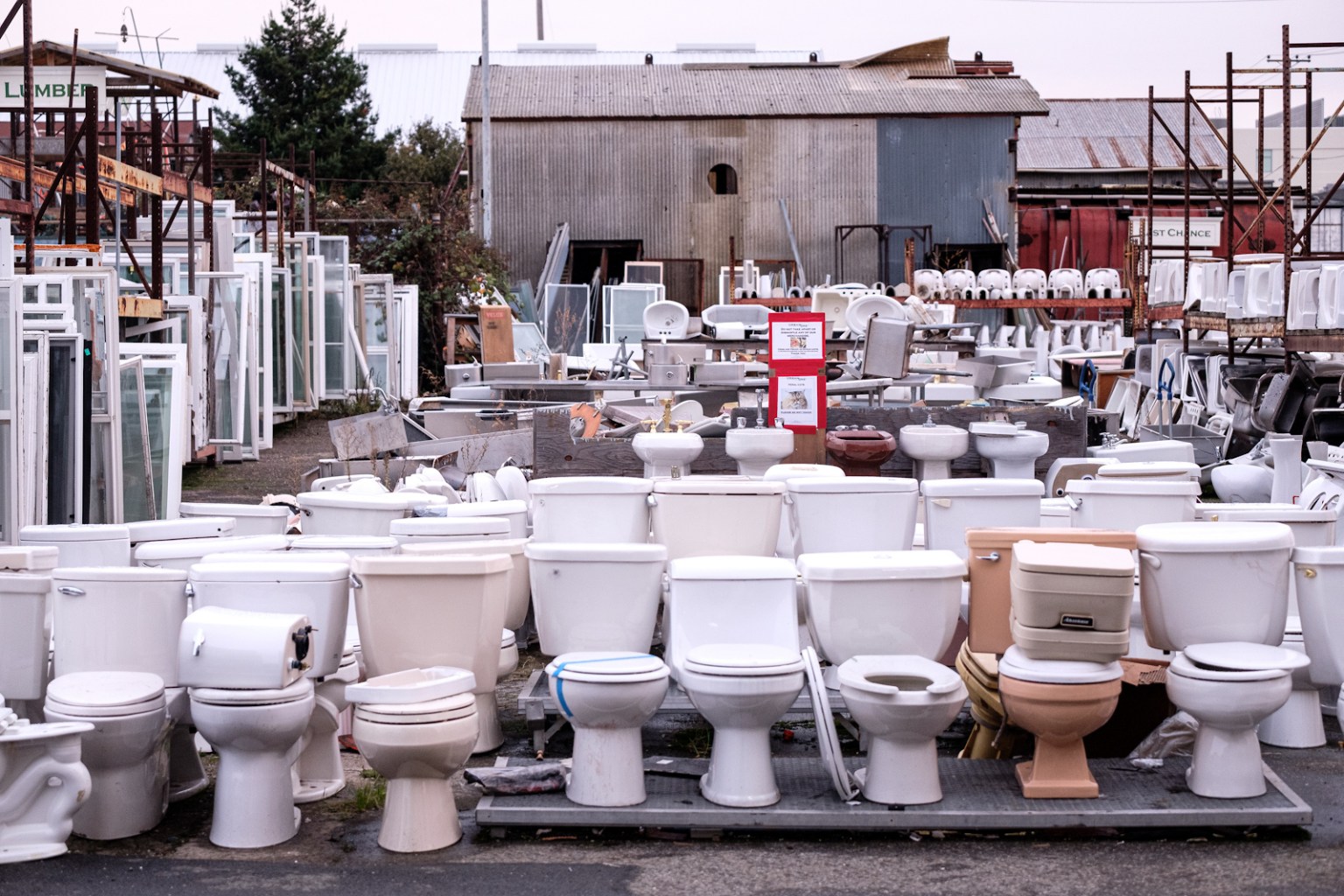 The plumbing section at Urban Ore. File photo: Pete Rosos
As controversial as it was, compensation sharing is also what drew a number of workers to Urban Ore and many dreamed that one day the operation could transition to a worker-owned cooperative. Over the years, Knapp and Van Deventer encouraged the dream in conversations. But when the promises didn’t pan out, some workers began to get frustrated.
Now, with the strike over and contract in place, some say the contentious feelings have subsided. “When workers came back in June from the strike, we thought it would be awkward, but it wasn’t,” Raymond said. “Things mostly went back to normal.”
Knapp and Van Deventer, who are 86 and 81, respectively, said that they’re finally able to focus on the next chapter. That could include a plan to either sell off the business to a buyer’s group made up of current Urban Ore managers and set up an employee ownership trust. An employee ownership trust is a legal structure where a trust holds company shares for employees, who share ownership, profit-sharing, and a say in governance. It’s an ownership structure that is often used as a succession or exit strategy for founders, according to Knapp and Van Deventer.
The owners are still idealists and in their vision, the 2.5-acre property could one day become a hub for similar community-serving businesses where items are restored, resold and find new life. “We want this to be a 100-year operation. We need to get reuse to become more mainstream,” Knapp said. “It’s one of the biggest things you can do for economic development and for the planet.”
Related stories
Urban Ore workers strike ends without a collective bargaining agreement
May 2, 2025May 3, 2025, 7:20 a.m.
Update: Urban Ore union vote certified without challenge from owners
April 19, 2023March 23, 2025, 1:55 p.m.
Workers at Urban Ore, Berkeley’s last salvage store, announce union drive
February 2, 2023June 28, 2023, 11:26 a.m.
“*” indicates required fields