
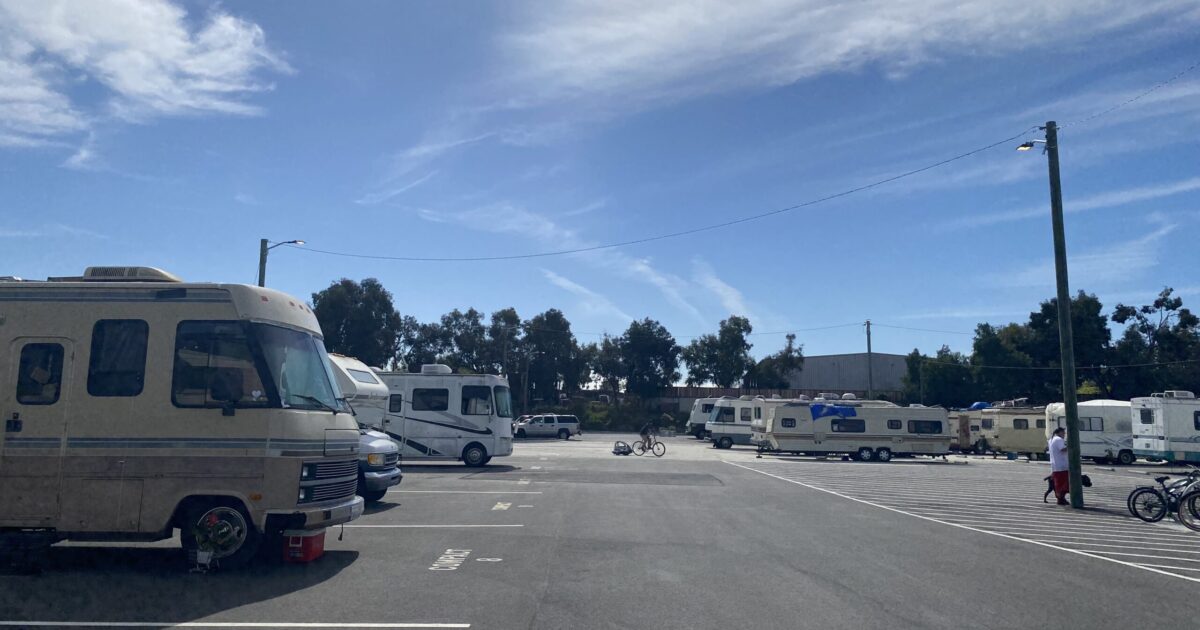
Homeless women face exacerbated safety risks on the streets, and Santa Clara County officials are considering a safe parking site for women who become homeless to escape intimate partner violence.
Santa Clara University researchers raised the idea in a report to county leaders last year. The study found that women and children fleeing domestic violence face systemic service denials because some shelters and other providers prioritize “easier” clients for efficiency and funding metrics.
This year presents a unique opportunity to implement the idea, as county leaders prepare to release a call for new agreements with nonprofits to operate 13 county-contracted safe parking sites, totaling more than 200 parking spaces for people living in their vehicles. The county’s current contracted safe parking site operators are Move Mountain View and Amigos de Guadalupe.
District 2 Supervisor Betty Duong said she supports exploring the concept. Some resources already exist in the county for this homeless population, including CityTeam San Jose’s Heritage House, which provides housing, food and support to any woman in need of shelter who is pregnant and doesn’t have custody of any other children.
“A women-only safe parking site is just one of many tools we have to develop to address the full spectrum of harm caused by gender-based and intimate partner violence,” Duong told San José Spotlight. “That is a broad, complex issue. From housing insecurity to health disparities to the long traumatic impacts of violence coming from people who you trust the most. It’s a multigenerational issue when children are involved.”
There doesn’t appear to be major opposition from county leaders to the idea, but a majority of the Board of Supervisors hasn’t been shy about the view that safe parking sites — as well as interim shelters — are only stopgap Band-Aids to homelessness.
This has brought supervisors into conflict with San Jose Mayor Matt Mahan, who has pushed hard in recent years to redirect money away from permanent housing to temporary shelters.
“Three years ago, you’d be hard-pressed to find the term ‘interim solution’ in any supervisor’s vocabulary, but the results we’ve achieved in San Jose through a combination of safe parking, interim housing and hotel conversions are undeniable,” Mahan told San José Spotlight. “We welcome this effort from the county and will gladly share what we’ve learned from our interim portfolio to help more unhoused neighbors get off the streets and connected to services.”
San Jose opened its first safe parking site at the Santa Teresa VTA light rail station in July 2023 to accommodate 42 RV residents. The city then opened its second safe parking site at 1300 Berryessa Road for up to 86 vehicles. Together, the city has a total of 128 spaces, but there were nearly 900 lived-in RVs and cars across the city as of last year. The Berryessa site had moved 24 people into permanent housing and 11 people into temporary housing as of November, while 15 residents at the Santa Teresa site moved into permanent housing from July 2023 to June 2025.
Jeannette Bumagat is executive director of Front Door Communities, a nonprofit that serves vulnerable women in downtown San Jose. Its Lifted Spirits program provides hot meals and dignified boutique days specifically to women living on the streets.
Bumagat said a women-specific safe parking site should be close to public transportation with areas to keep warm or cool in extreme weather, charging stations for electronics and storage for personal belongings.
“There should be trained overnight staff presence that has experience in deescalation, trauma, gender-based violence, understanding of cultures and a clear protocol for emergencies,” Bumagat told San José Spotlight.
But homeless advocate Shaunn Cartwright said the idea doesn’t help all domestic violence survivors.
“Many unhoused women don’t have their own vehicle they can leave in,” she told San José Spotlight. “Even less if it has to be registered.”
District 4 Supervisor Susan Ellenberg said openness to the safe parking site idea doesn’t mean a lapse in her preference for housing first policies, which prioritize permanent affordable housing development and funding in long-term government strategies. She said temporary shelter settings aren’t the best in situations where women are fleeing their partners with their children.
“Without a doubt, safe parking is better than being on the street,” she told San José Spotlight. “But safe parking is no way for vulnerable and traumatized children to live and I would prioritize getting them into housing.” Santa Clara County has more than 10,700 homeless people, a record high. Families represent 16% of the homeless population, and a majority of families — 84% — live in a shelter or transitional housing. Over the past four years, 2,543 families have obtained permanent housing, representing 8,601 individuals. Despite the county more than doubling shelter capacity for families from 682 beds in 2021 to 1,306 in 2025, the number of homeless families has nearly doubled since 2022 — from nearly 900 people to about 1,680.
“Unfortunately, safe parking lots in the county are full and we do not have an obvious spot for opening a new, separate one,” District 5 Supervisor Margaret Abe-Koga told San José Spotlight. “Nonetheless, it’s an idea that should be part of the conversation … We will definitely add this to the mix for consideration while working on a regional approach to this very challenging situation.”
Contact Brandon Pho at [email protected] or @brandonphooo on X.