
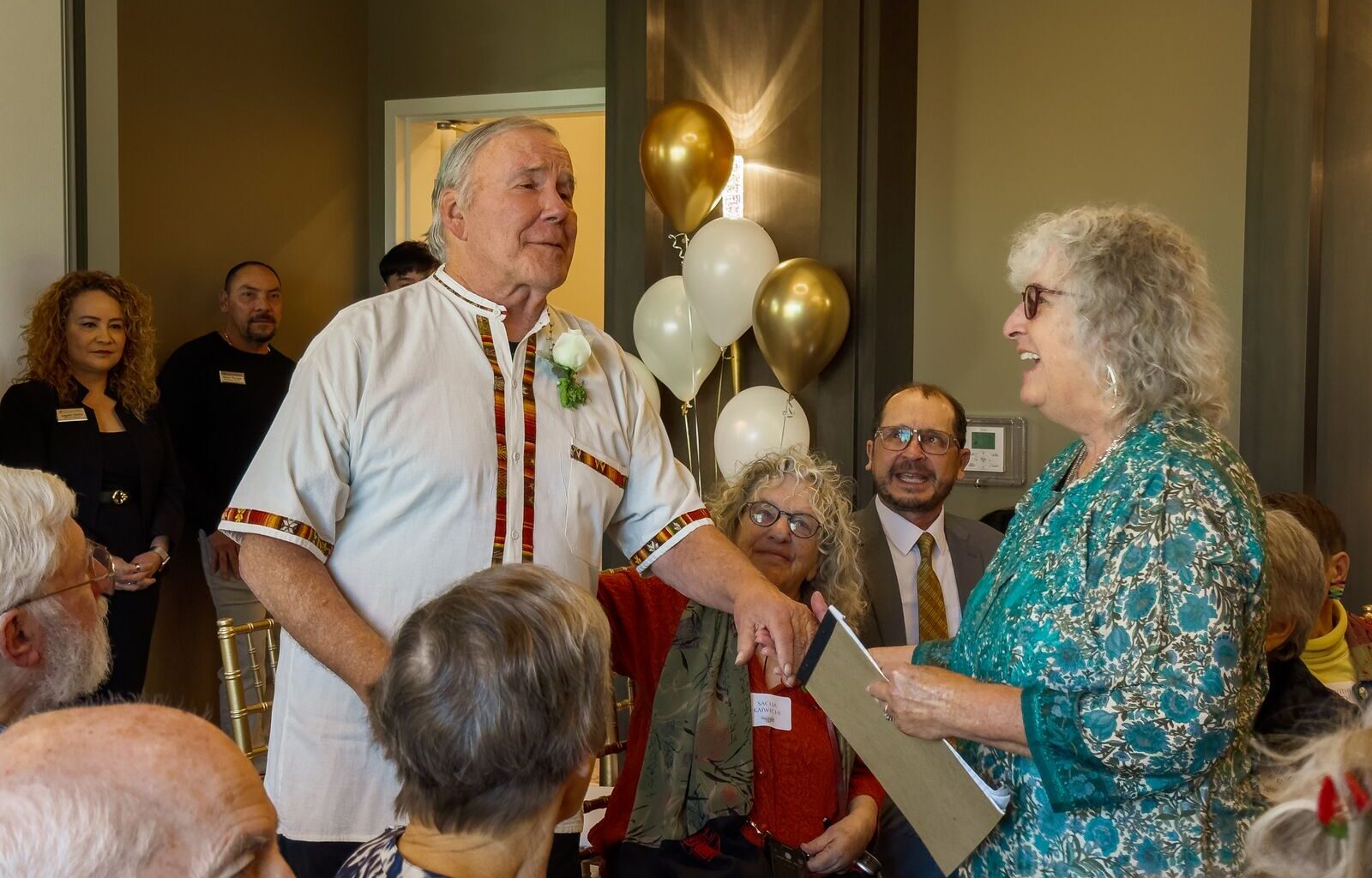
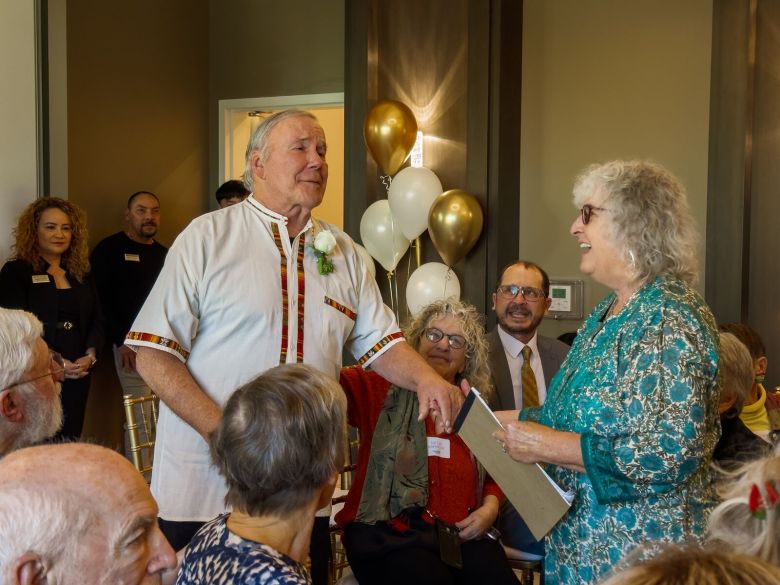
 Linda Feldman helps her husband, Michael O’Reilley, walk down the aisle on Saturday, Jan. 10, during a renewal of vows ceremony at The Ivy, a Berkeley assisted living and memory care residence. Credit: Ximena Natera for Berkeleyside
Four decades ago, her answer was always a no. Oh, it came with a smile, or tender touch of his arm, but it was still invariably a no.
Micheal O’Reilley asked Linda Feldman to marry him many times back in those days when they were both Alameda County public defenders, living together in the Berkeley Hills, with their three kids from previous marriages, a blended family.
He hollered it down canyons in Hawaii. He said he’d hang it from an airplane banner over a Cal football game.
She simply wasn’t ready to remarry, she said. Her mother was ill, among other life complications.
But in 1987, Feldman finally said yes. She was largely spurred, she said, by wanting clarity for the children, O’Reilley’s two daughters and her son. Someone had come to the door asking to borrow jumper cables, and when Feldman said she’d have to ask her husband, daughter Melissa, then about 6, issued a correction: “You’re not married.”
They wed in a small ceremony in their living room.
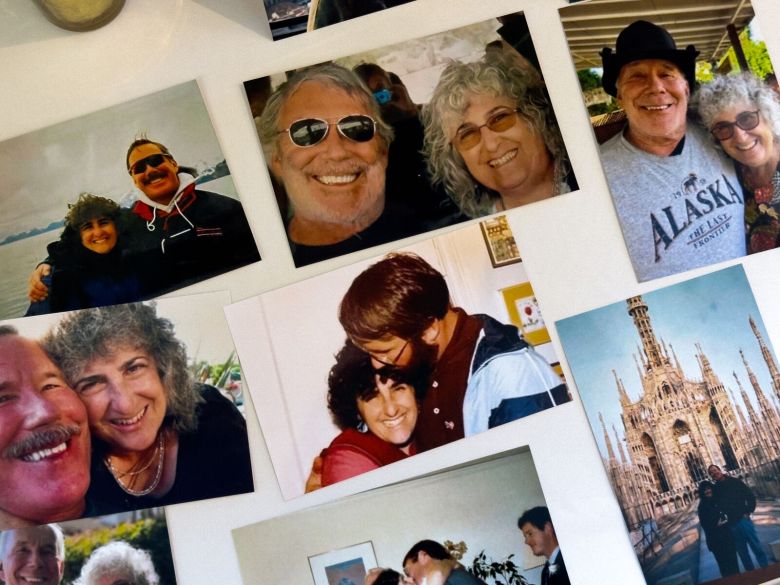 Photos of Feldman and O’Reilley’s life and travels together displayed at the ceremony. Credit: Ximena Natera for Berkeleyside
Then, late last year, Feldman said yes again.
This time, in the memory care unit of a Berkeley assisted living facility, as O’Reilley, 77, who has Alzheimer’s disease, wrapped his arms around Feldman, 78, asking her to be his wife, almost certainly not remembering she already was.
“And I said yes,” she said. In a second.
And last Saturday, in a sun-lit community room of The Ivy, an assisted living and memory care residence on Dwight Way, O’Reilley and Feldman had something like a wedding, or vow renewal ceremony — a version that was unique to the moment and to them. They were joined by a couple dozen friends and family; the room elegantly decked out in white and gold, fresh flowers, balloons, candles.
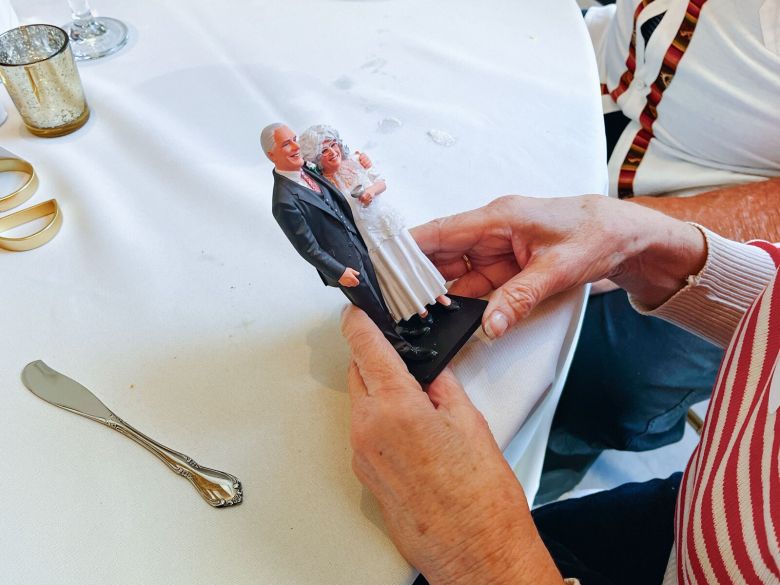 The Ivy ordered a custom cake topper designed to resemble Feldman and Michael O’Reilley in their original wedding outfits. Credit: Ximena Natera for Berkeleyside
To Aaron Cohen, Ivy’s memory care director, it was simple:
“We’re celebrating love,” Cohen said. “Regardless of why you’re here, cognitive impairment or not. It’s about love.”
And this was abundantly clear.
As with many people with Alzheimer’s, O’Reilley’s attention and awareness change moment by moment, and are unpredictable, Feldman said. One minute, he’s repeating a specific word, hooked on its sound or meaning or place in his past. The next minute, it’s a different word or phrase.
“I can be with him … and go to the bathroom, and come out and it’s an entirely different visit,” she said.
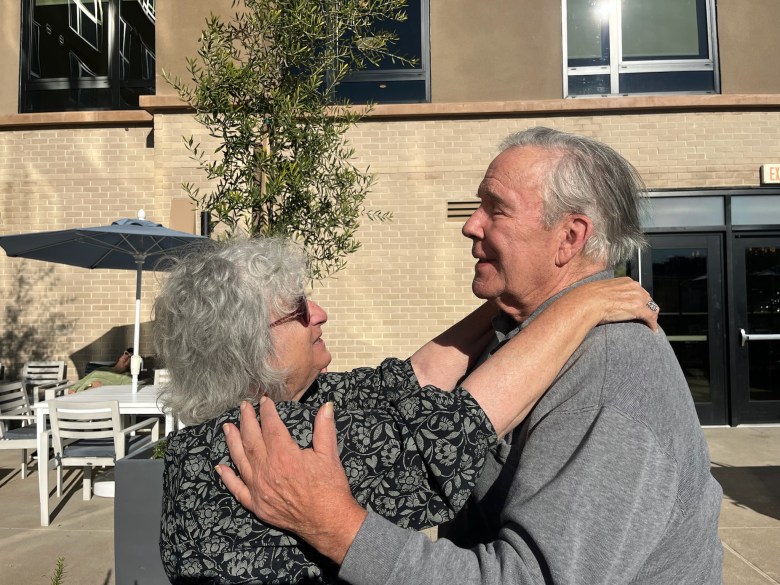 Feldman meets with O’Reilley the day before the ceremony. Credit: Kate Darby Rauch for Berkeleyside
A typically calm, relaxed man, with an ever-ready smile — even as his condition advances, not always the case with Alzheimer’s — O’Reilley’s focus shifts with some internal wavelength, with a sudden laugh, turn of his gaze, non sequitur.
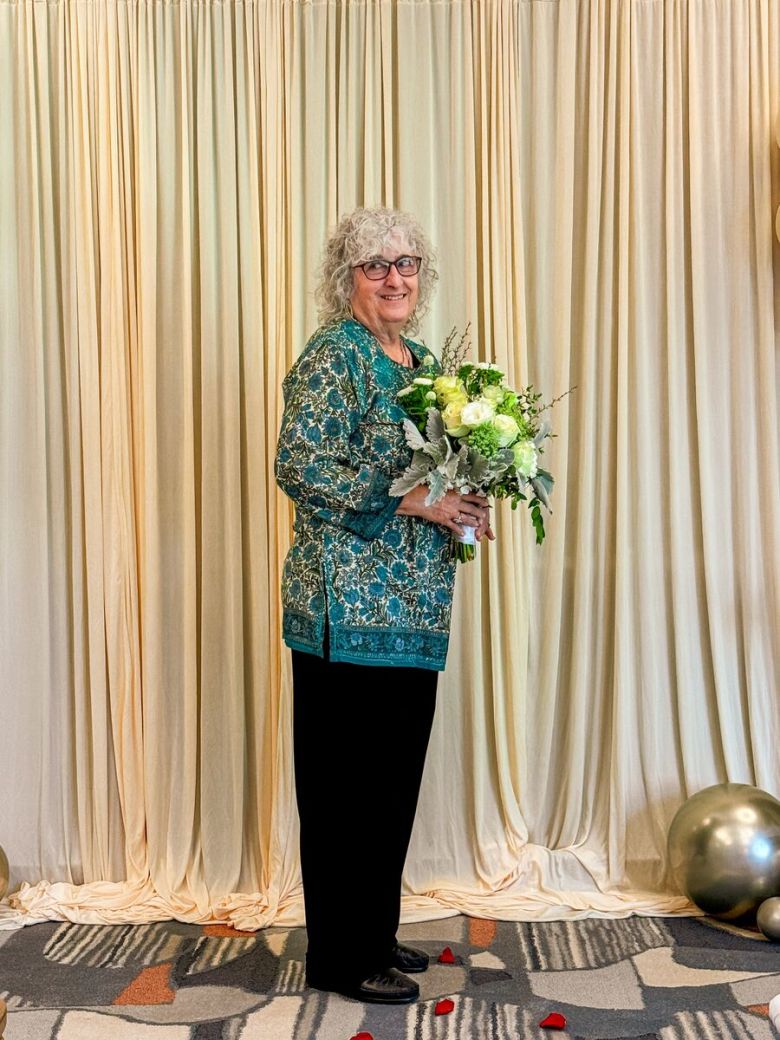 Feldman the day of the ceremony. Credit: Ximena Natera for Berkeleyside
But when he sees Feldman, he immediately lights up, according to her and Ivy staff — at least most of the time. On the day before their ceremony, for example, she approached as O’Reilley sat with others in memory care, doing a musical activity. He looked up, smiled instantly, locking eyes with his wife. When she got close, he reached up for a hug, a kiss on the lips.
“I love you Linda,” he said.
“I love you, too, Michael,” she answered softly. “Very much.”
“You’re so beautiful,” he said quietly, framing her face with his hands.
She reminded him they were going to have a wedding the next day. “Oh no,” he said, laughing a little. “That’s not going to happen.” They hugged for a long time. She explained the plan.
With pleasant curiosity, he took it all in
No one was certain if O’Reilley would want to go down to the first-floor community room Saturday. Or, if he did, how long he’d want to stay.
Whatever would be, would be, Feldman said beforehand. It was all OK.
“I think he’ll enjoy it in the moment, and that’s what Alzheimer’s is,” she said.
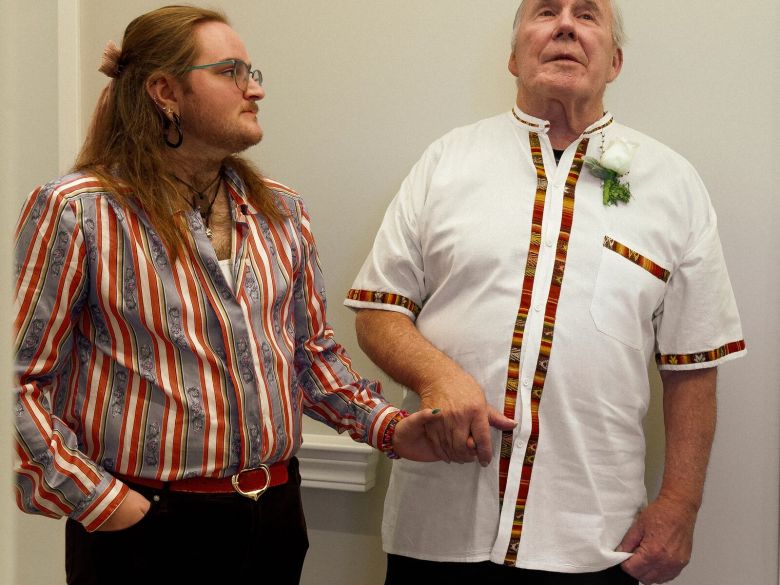 O’Reilley holds hands with Murdock Storm, his principal caretaker at The Ivy, as they wait for the ceremony to start. Credit: Ximena Natera for Berkeleyside
And he did.
“He had seemed pretty confused early Saturday morning so I worried how he would be for the ceremony, but he definitely rallied for the party,” Feldman said the day after.
“It made me happy to see how much he was enjoying himself.”
She too, she said, “loved the wedding. It was fun and over the top in a good way.”
Indeed, on Saturday, O’Reilley appeared pleasantly curious as he made his way slowly into the makeshift wedding chamber, escorted by one of his main caregivers, Murdock Storm. He looked around the room with amusement. At the front, a curtained altar. At the back, elegantly set tables for lunch. Rose petals down the center aisle between chairs.
A harpsichordist played in the corner.
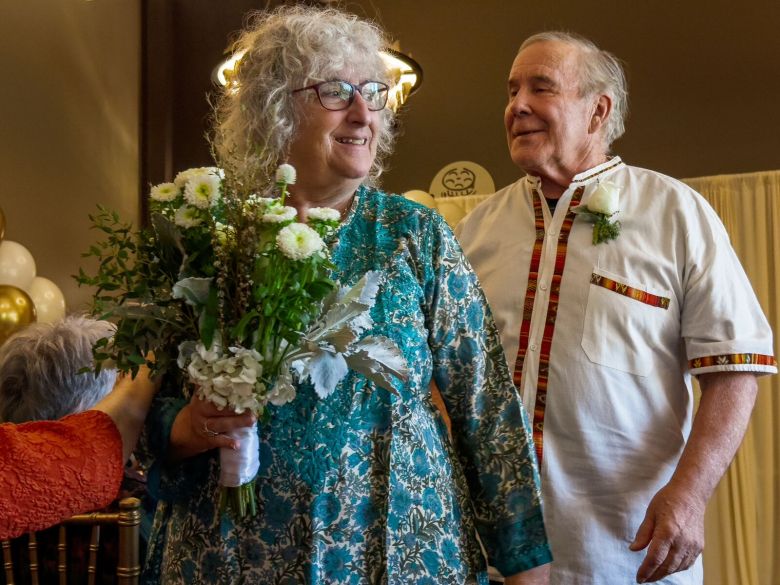
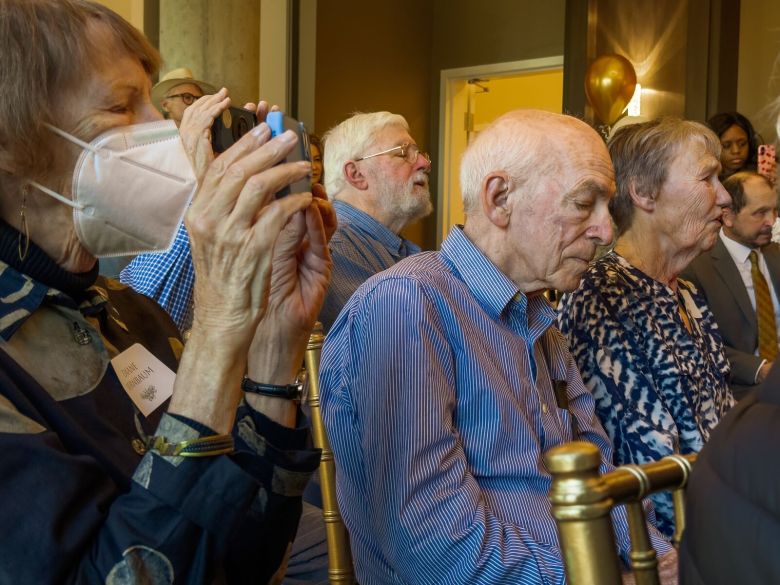 Guests greet the couple as they walk down the aisle. Credit: Ximena Natera for Berkeleyside
Feldman helped O’Reilley sit in the front, saying she was going to talk to him. “Oh, I’d like that,” he said.
Addressing her husband and the room, she thanked caregivers and Ivy staff, talked of how she and O’Reilley met in the public defender’s office, how much they supported each other’s careers, how different they were. She, a “neurotic” and “anxious” “little Jewish girl.” He, an Irish Catholic adventurer who’d played football in high school, wanted to be a priest, was a police officer before deciding on law. (Before Alzheimer’s, he was known as a gifted communicator, an orator who delivered brilliant court arguments.)
She talked at length about their children, their shared devotion to family and kid-raising, including to fun. Of their delight in travel, near and far. How they found their way through challenges. She expressed pride and delight in their kids as adults, each one unique.
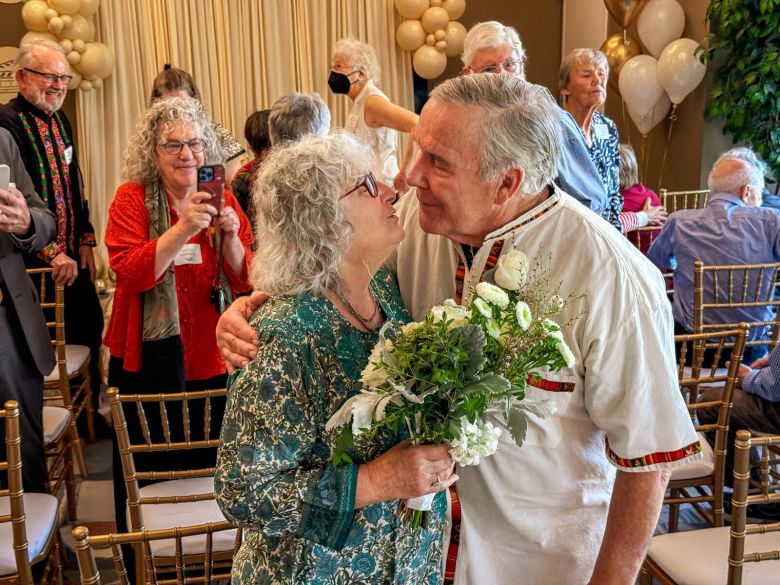 Feldman and O’Reilly kiss. Credit: Ximena Natera for Berkeleyside
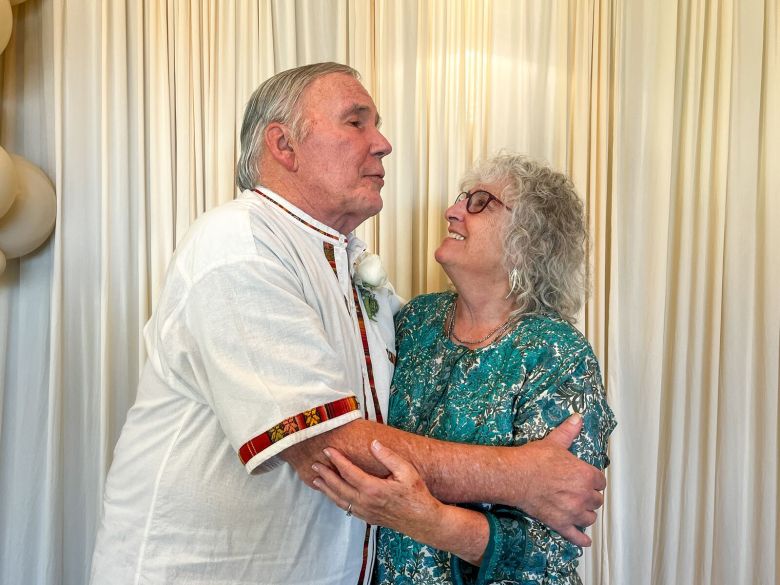 Feldman beams at O’Reilly after the ceremony. Credit: Ximena Natera for Berkeleyside
“We both loved each other a lot, and we made it work with perseverance and a sense of humor,” she said. “We both like to laugh.”
“Yes, pretty much,” O’Reilly said, to a room of laughter.
“You’ve been a wonderful husband,” Feldman said.
“Really?” O’Reilley said from his seat. “Really,” she said, sealing it with a kiss. An embrace.
Then they made their way to the start of the aisle and walked back down, with help from others. Harp melody gave way to a recorded “Sail Away” by the Oak Ridge Boys. A “flower man” scattered red rose petals over white petals already on the path.
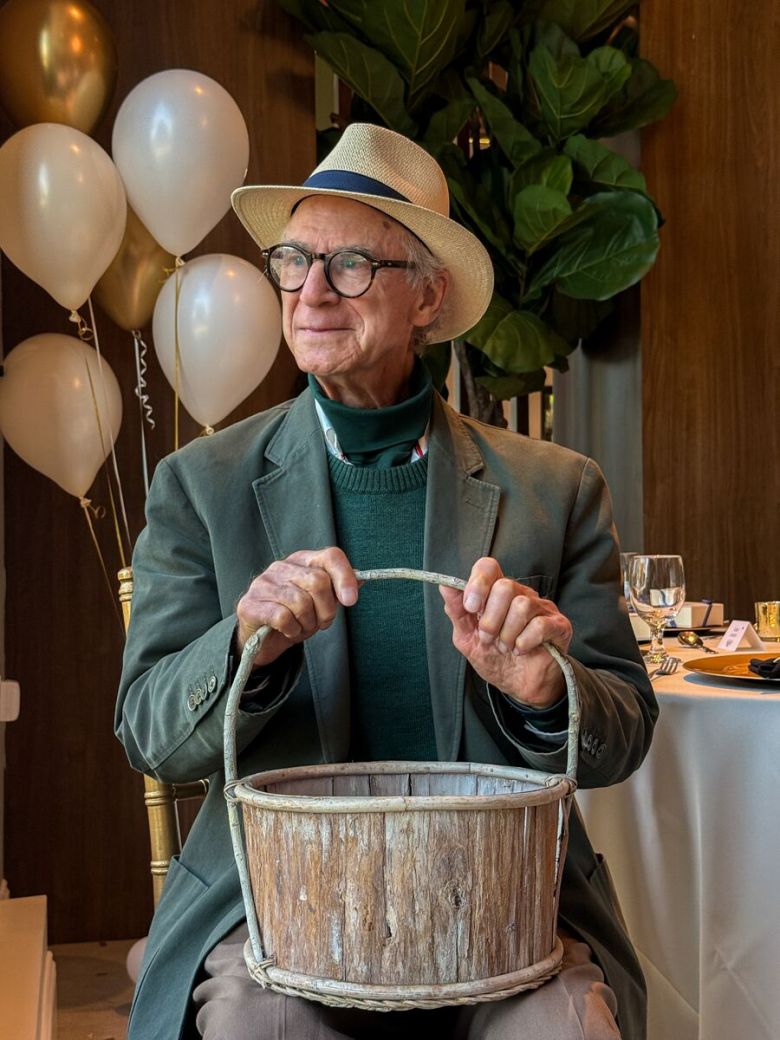 David Feldman, cousin of the bride, served as “flower man.” Credit: Ximena Natera for Berkeleyside
O’Reilley took in the room with his twinkling smile and occasional commentary. “Oh, come on.” “Oh, for God’s sake.” “I love you,” he said to Feldman. “I love you, too. I love you very much,” she answered.
One reason she wanted to have the event, Feldman said the week before, was to share with others that even people with dementia “may be really connected to their partner, to their children. There may be something in there that keeps people attached,” she said.
“I think that’s really special and I think there’s a lot of people who don’t know that could happen.”
Research shows that some people with Alzheimer’s with severe cognitive decline, seem to maintain feelings and empathy, including being calmed or reassured by touch. Though every case is different.
“Aren’t you going to say, ‘I do,’?”, called out someone in the audience, as the couple milled at the altar.
“I do,” said Feldman. “Good job,” O’Reilley replied.
Appreciation in the heartbreak
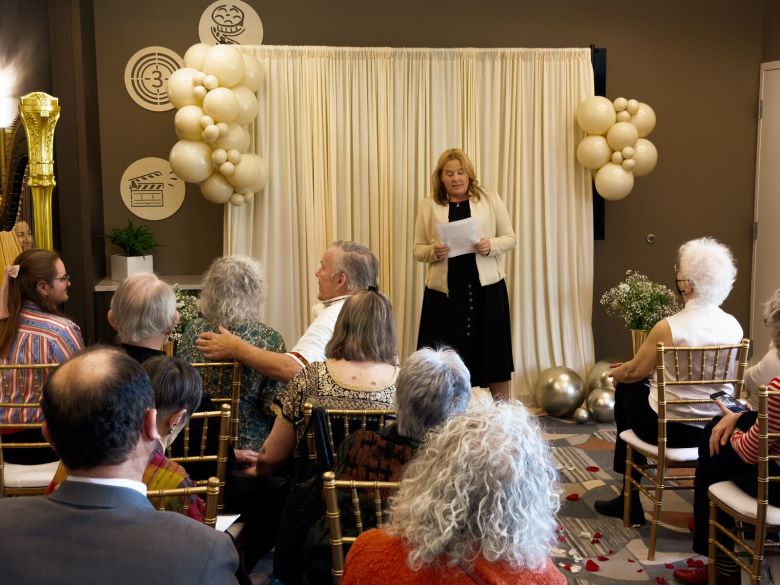 Sharon Frost, O’Reilley’s daughter, officiated the ceremony. Credit: Ximena Natera for Berkeleyside
Sharon Frost, O’Reilley’s youngest child and the ceremony’s officiator, spoke to the group. She highlighted her dad and stepmom’s relationship, their shared sense of exploration and family. Her dad, who loved “living on the edge,” riding motorcycles and climbing mountains, opened the door to new experiences for Feldman, while her calm probably helped keep him alive, Frost said.
“I firmly believe life is about experiences and not material things. These two are a couple of richest people I know,” said Frost, who lives near Sacramento, with her husband and son, both also at the wedding. In fact, her husband walked O’Reilley down the aisle.
Frost talked of the work of marriage. “How can you grow if you don’t have challenges to learn from?” Frost asked.
“How we handle the challenging times is what makes marriage stronger. In my opinion, my dad and Linda have the strongest love for each other because of the hard times.”
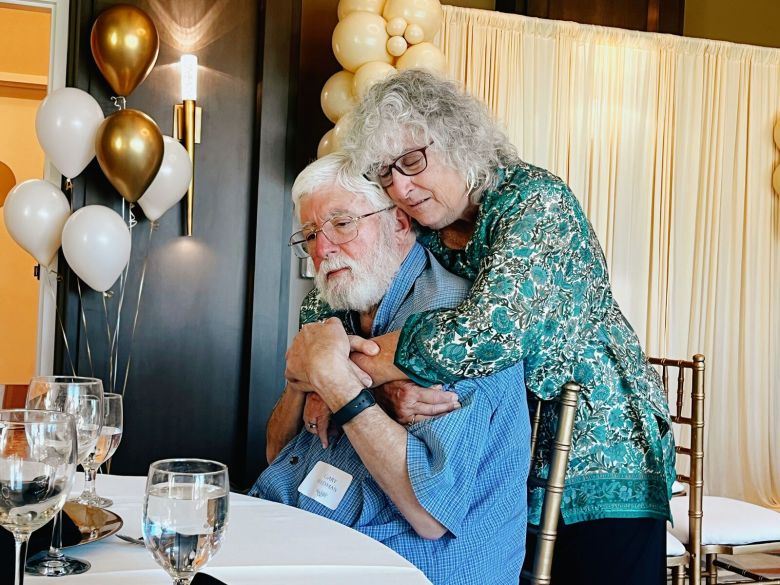 A teary-eyed Linda hugs her brother, Gary Feldman, after Michael is taken back to his room to rest after the ceremony. Credit: Ximena Natera for Berkeleyside
Earlier, in an interview, Frost talked of the profound difficulty of watching her father change, of the disease. O’Reilley, who also worked as a deputy US attorney general, county prosecutor, and taught law, was diagnosed about seven years ago. His brother had Alzheimer’s, as did his aunt.
“My dad’s diagnosis has been extremely challenging,” Frost said, talking of her soul-searching and reflecting to cope. Her dad, she said, had always been her rock.
“Today my dad is not the same person, it’s his body, his smile, his eyes, but it’s not his mind. That’s something I struggle with still.”
She knows, she said, that Alzheimer’s is often harder on family members than the patient. And she appreciates this. “Luckily my dad is not in any pain. He is content. He is happy,” she said. “No one wants to see their hero in pain.”
Feldman, too, takes stock of the positive.
She enjoyed the wedding planning, she said. “There hasn’t been a lot of anticipation with joy. Most of dealing with Alzheimer’s is anticipation with dread.”
And of her husband’s enduring affection:
“It’s a gift in a horrible situation.”
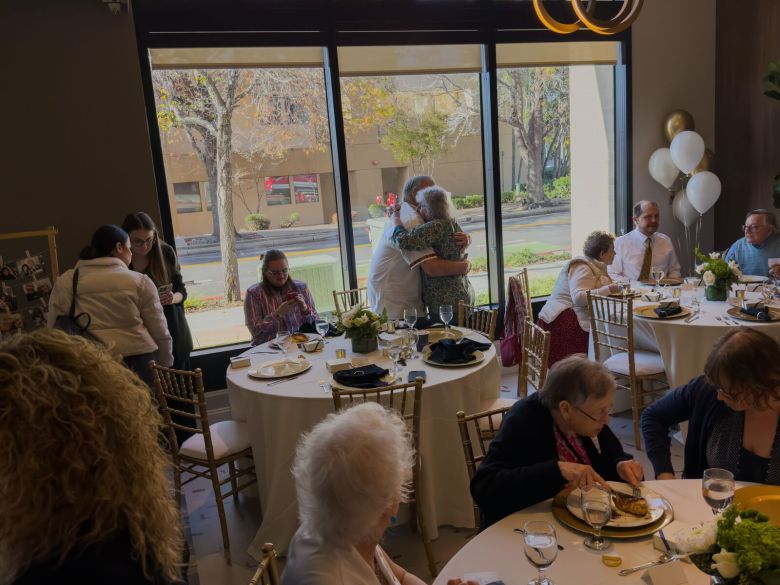 The couple embraces during the meal following the ceremony. Credit: Ximena Natera for Berkeleyside
“*” indicates required fields