
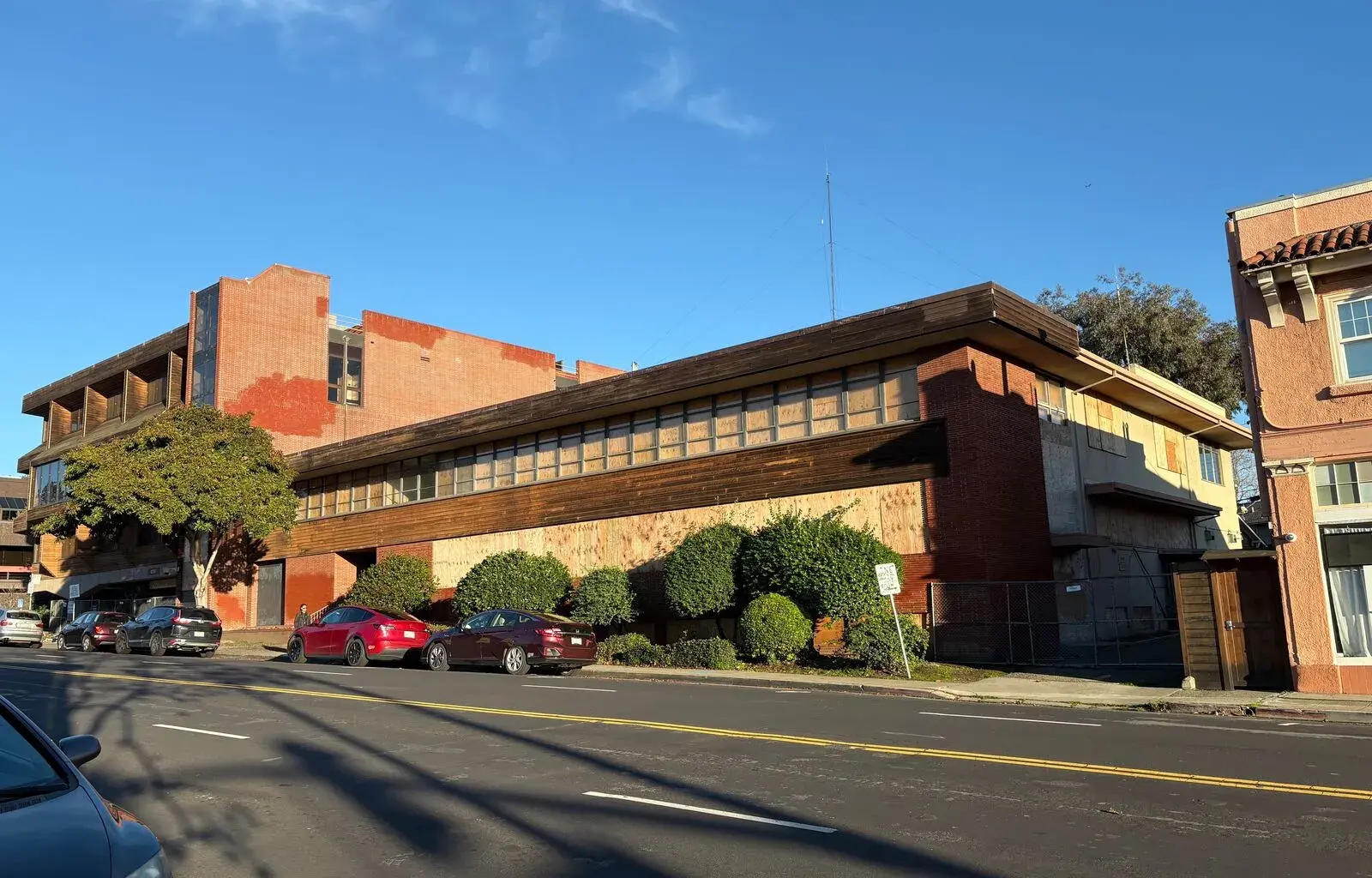
Developers are angling to build a senior housing high-rise at an old Red Cross property in the heart of Rockridge, but some neighbors are pushing back.
Ellis Partners and Spirit Living Group submitted plans in December for the seven-story, 203-unit building on Claremont Avenue, next to the pink property that used to house The Graduate bar. The apartments would be market-rate, including some memory-care and assisted-living units.
“There is very, very, very little senior housing in the East Bay, writ large, especially compared to what the demand is,” said Patrick Flynn, senior vice president with San Francisco-based Ellis Partners.
When the Red Cross relocated its blood donation center and related operations in 2023 and 2024, Ellis Partners jumped at the opportunity to submit a bid for purchase and development. At first, the firm proposed a standard, all-ages market-rate project and was rejected in favor of another developer’s affordable housing proposal, according to Ellis, but that didn’t pan out. Ellis then successfully pitched the senior housing.
A Red Cross spokesperson said the organization has an option agreement with Ellis, but the parties are waiting for the city to review the project before finalizing the sale.
The property — a large, unused parcel directly across from Safeway, around the corner from College Avenue shops, and half a mile from BART — is a rarity in the Bay Area.
“It’s a little over an acre in size, which is not easy to find,” said Flynn. “It’s a very walkable location and seniors generally tend not to drive that much.”
With seven stories plus a mezzanine, most of the proposed building is about 83 feet tall, with two areas reaching about 93 feet. Two architecture firms, Portland-based Jones and San Francisco-based BDE, are designing the project.
Oakland’s zoning code allows a maximum height of 55 feet for buildings in this location. But the developers are invoking California’s density bonus law to request “waivers” in order to build larger and make other tweaks. The law applies to affordable and senior housing, providing incentives to developers — the ability to build denser and taller, and cut back on parking spaces — to encourage types of housing that are sorely needed.
Most likely, the project will go to the Planning Commission for review. If it’s approved, construction could start by the end of the year, and take up to two years to complete, Flynn said.
Neighboring homeowners say the tower is too tall
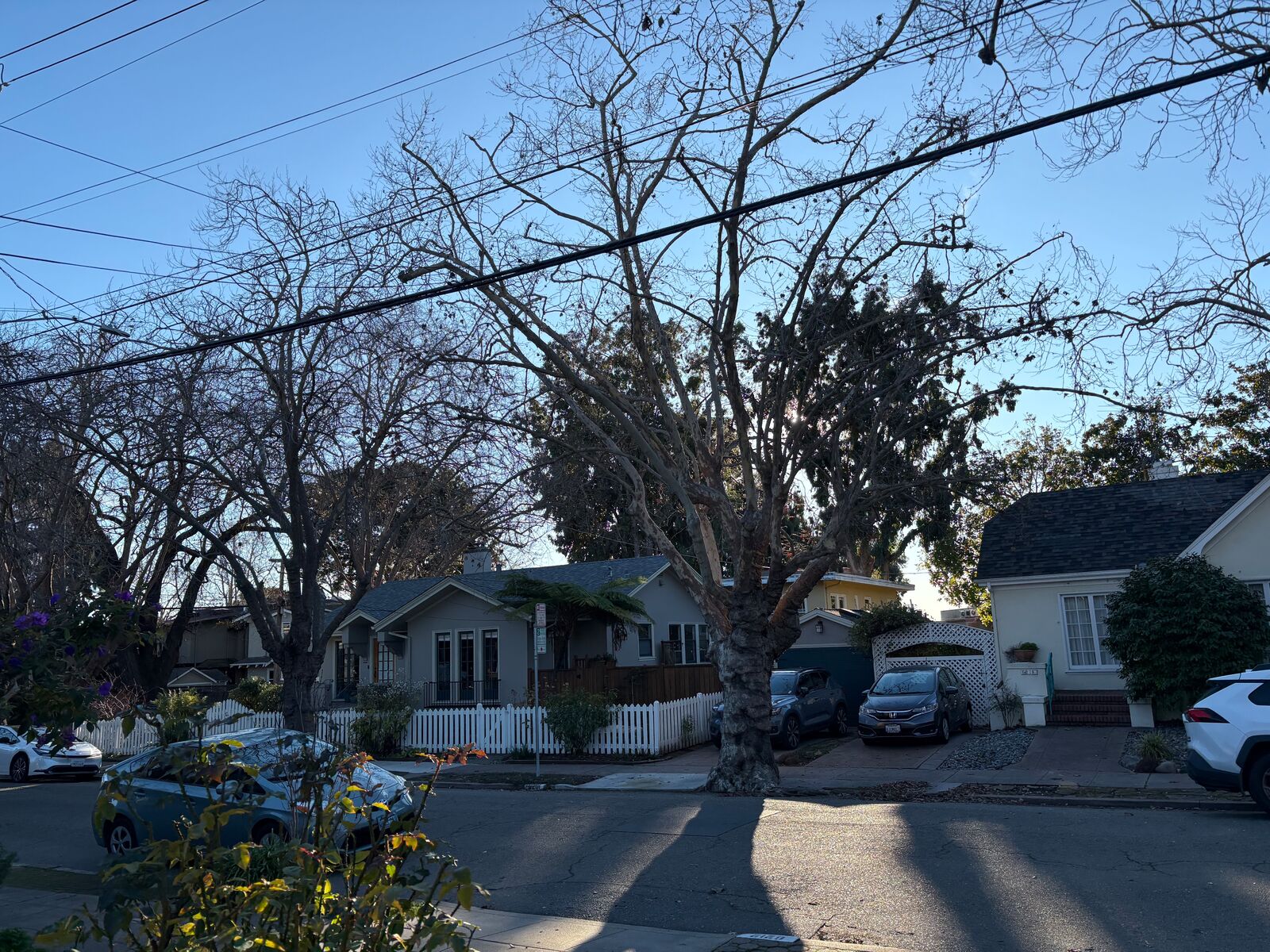 Some residents on Auburn Avenue worry the proposed development would block this afternoon sun. Credit: Natalie Orenstein/The Oaklandside
A group of neighbors is not waiting for the city to weigh in on the plans to build a high-rise near their homes. They met with Ellis Partners and Spirit Living Group at a local church in September, and they had lots of questions.
“I left it feeling like we had a problem,” said Jack Gerson, 29-year Rockridge resident and retired high school math teacher and biostatistician. His house is right behind the Red Cross property.
“I thought the developers, to my surprise, were engaged, and that’s good,” he said. “But there was no give.”
The developers disagree. They say they made a number of changes after hearing from the community, to the design of the project and to its frontage on the residential Florio Street.
“Change is hard, but we want to communicate and have folks be heard, and make adjustments to our development when we can,” said Flynn.
One thing that hasn’t been adjusted is the height, to the chagrin of residents who’ve formed a group called Rockridge Neighbors for Sensible Housing. Their motto: “Build to fit in — not stand out.” Members stress that they actually do want something done with the old Red Cross building, but in compliance with standard city code.
“By all means, build at 55 feet,” said Leila Gough, another Auburn homeowner of 25 years, adding, “and do it affordable.”
Gerson, Gough, and another neighbor, Ken Jong, spoke with The Oaklandside last week and shared a range of concerns about the project, but the towering stature was foremost. They believe the building will block the sun, casting shade on a number of homes — and even had an architect neighbor conduct a study to prove it. During our late-afternoon meeting on their block, the sun shone just above the Red Cross property, where the new building would stand, filtering through trees and into homes.
They’re also concerned about how close the building will be constructed to the edges of the property, and the impact on traffic of the large residential building.
“If significant traffic is diverted onto these streets, especially during construction, that can lead to real hazards and reduced response time for emergency vehicles,” Gerson said.
The group tacked up fliers around the neighborhood, launched a petition — which has 460 signatures and counting — and sent out an email. Gough said that message yielded 80 concerned replies.
Jong, a retired civil engineer and 15-year Rockridge homeowner, sent a lengthy letter to the city aiming to poke technical holes in the developers’ use of the density bonus law and other claims, and lay out what they see as the health and safety hazards of the project.
“We’re doing everything we can to get them to comply with 55 feet,” Gough said.
Fraught history around development in Rockridge
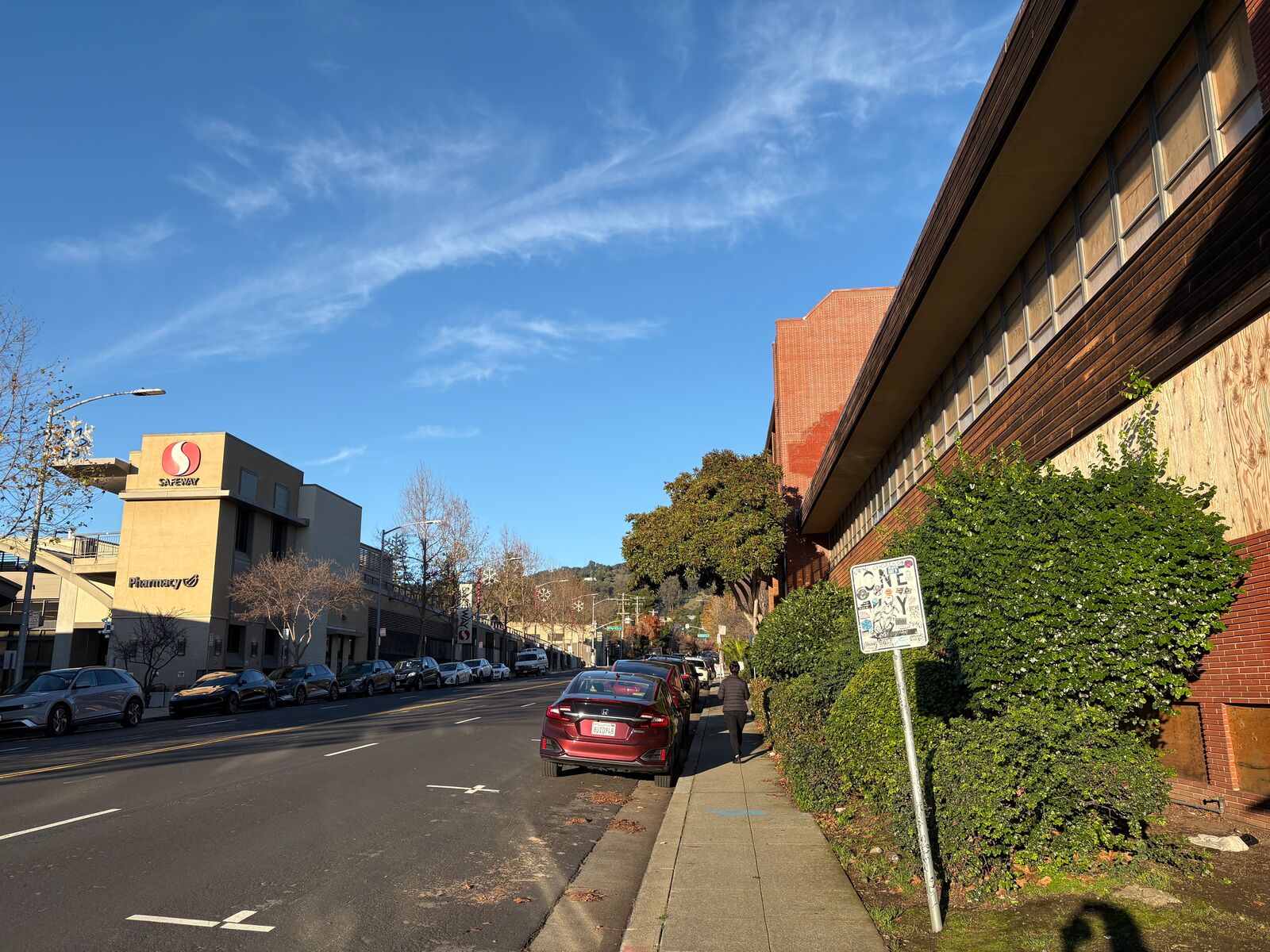 The acre-plus property faces the Safeway on Claremont Avenue. Credit: Natalie Orenstein/The Oaklandside
Ellis Partners and the Red Cross were not particularly surprised by the residents’ reactions.
“We understand that changes in the neighborhood can raise questions, and we remain committed to being a responsible and respectful community partner,” said Red Cross spokesperson Evan Peterson.
“It is not a small building we are proposing,” Flynn acknowledged. “We are proposing a seven-story building in a neighborhood that has largely been resistant to development.”
The largest proposed project in Rockridge, for 448 apartments at the old California College of the Arts campus, also faced fierce pushback when it was first introduced about eight years ago.
Immediate neighbors similarly formed a group to organize against it, called Upper Broadway Advocates. They succeeded in convincing developers to significantly redesign the project from a 19-story tower to shorter buildings. They also argued for more affordable housing in the project, where only a small percentage of units will be priced for low-income residents.
But over those years, the economic landscape shifted nationally and in Oakland, and the CCA developers said they’re no longer certain they can pull together the funds to build on the campus.
Rockridge’s fraught origins have drawn attention in recent years, as Oakland’s housing crisis and disparities have expanded. Press and researchers unearthed advertisements from the early 1900s that banned Black or Asian people from buying property in the Rock Ridge Park tract.
Today, it is still one of Oakland’s most affluent and white neighborhoods, filled primarily with single-family houses that are out of reach to many.
The lack of affordability, paired with strong transit and commerce in Rockridge, prompted the state in 2022 to tell Oakland to plan for more housing construction in the neighborhood.
Building large and tall, said the developers with Ellis, is what will enable them to finance the project. There’s also a strong demand for senior housing, making it even more feasible.
“The density of the project is driven by the economics of what it takes to develop,” said Flynn. “I mean, there are not a lot of cranes in the Bay Area in general, and that’s because it’s really difficult to develop right now, especially with insurance rates the way they are and construction costs where they are.”
“That’s why the state’s been issuing new legislation in order to make housing feasible,” added Jim Ellis, cofounder of Ellis Partners. “And this just happens to be one of those sites where it seems to check all of the boxes.”
The developers said their hope is to enable local seniors to downsize while staying in the neighborhood, freeing up their single-family homes for younger people and families.
There are signs that the appetite for development is expanding in Rockridge. Recent elections for open seats on the board of the nonprofit Rockridge Community Planning Council were dominated by a slate of candidates who called themselves “pro-housing.”
Board member Mark Aaronson said the views of the neighborhood leaders do diverge, but perhaps not as starkly as outsiders might think.
RCPC has a committee to monitor the proposal for the Red Cross site, and will take an official stance after gathering more information and hearing from more neighbors, Aaronson told The Oaklandside.
Previously, when RCPC heard the property was on the market, the board sent a letter to city leaders advocating for 100% affordable housing there.
“Our general approach is to look at these things individually,” Aaronson said. “There is a crisis in housing, so what can you do in a neighborhood like Rockridge, which is more upper-class these days? It’s a legit concern, but some projects are going to be too big and not fitting with the neighborhood.”
“*” indicates required fields