
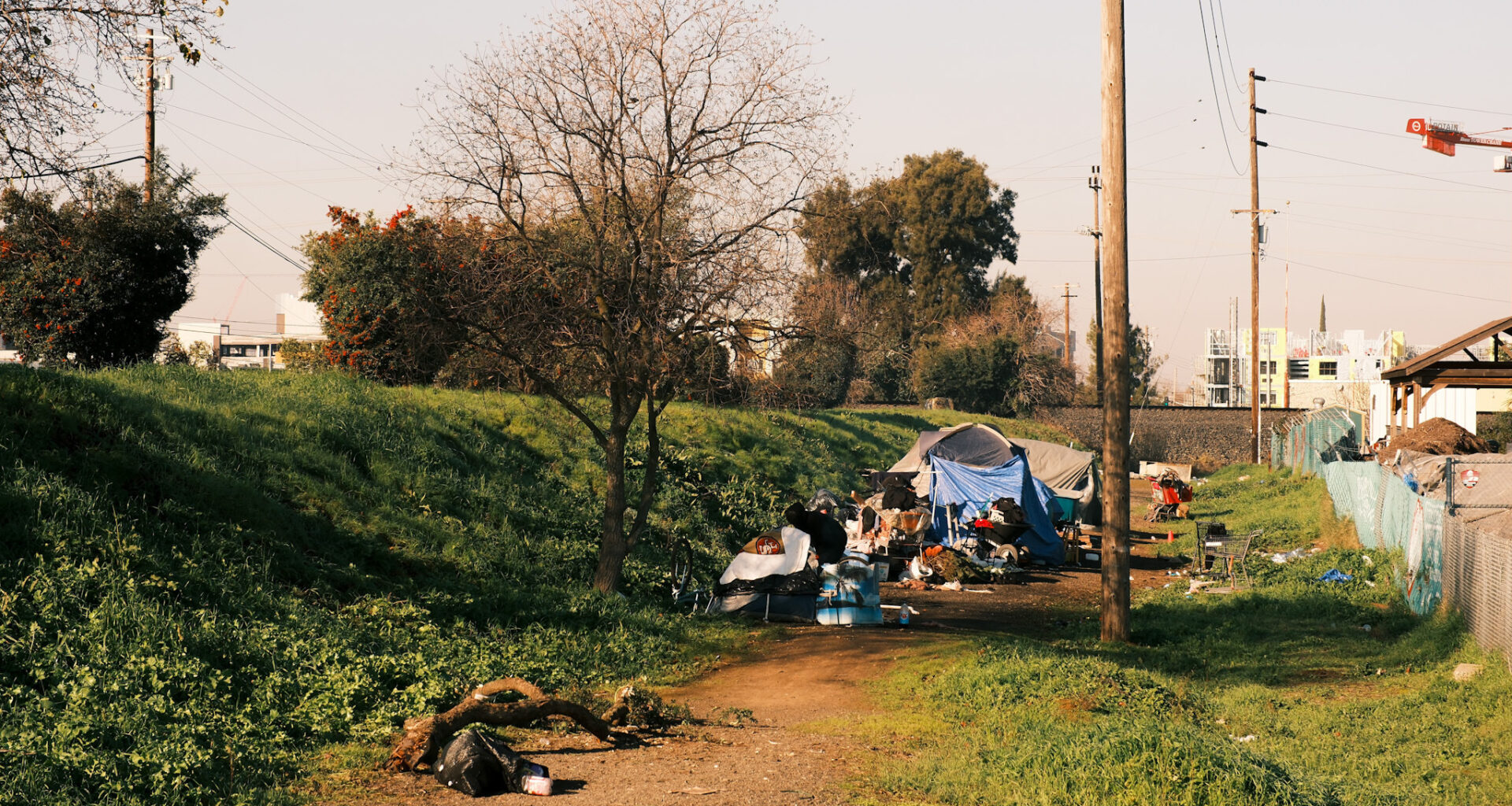
The Sacramento County Board of Supervisors on Tuesday passed an expansion of the county’s camping ban to include private property. The change, county supervisors say, is meant to deal with encampments on vacant lots and business properties.
The ordinance gives the Sacramento County Sheriff’s Office expanded authority to clear encampments on private property when the owner is not there, unreachable or unwilling to act. Until this change, deputies needed a property owner’s request or permission to treat someone as a trespasser.
Critics are warning that this infringes on property owners’ rights and deepens the criminalization of homelessness.
District 4 Supervisor Rosario Rodriguez, who introduced the ordinance, says the change is needed after enforcement on public land increased, resulting in many encampments moving onto private land in the region.
“If you make it uncomfortable for them, I’m hopeful that that decision will drive them to accept the services that are offered to them,” Rodriguez said.
Despite how wide-reaching the change is, the ordinance was approved on the Board’s consent calendar. Items placed on consent are typically reserved for routine matters and passed together without individual discussion unless a supervisor requests otherwise. Consent items are usually reserved for noncontroversial or technical matters, and this item was approved without public debate by the supervisors.
Under the new rules, camping on private property is illegal, except in a few specific cases. People can still camp on their own land or with a property owner’s express written permission. A person may camp for no more than 72 consecutive hours, and no more than three times per calendar year. It also requires that people camping have access to toilets and trash collection, and they avoid creating fire hazards.
With this change, deputies will be able to issue verbal or written warnings or refer individuals to homeless services if those conditions are not met. The new ordinance takes effect in 30 days.
Once it becomes enforceable, law enforcement will be able to remove camping structures and equipment, but personal belongings must be stored for at least 90 days. Refusing to leave or interfering with cleanup can result in a misdemeanor citation or arrest.
Civil rights attorney Mark E. Merin criticized the ordinance, saying the county already has the authority to address unsafe conditions on private property without creating a new camping ban.
“It’s just an absolutely unenforceable attempt to intimidate people about the use of their own property,” Merin said. “It’s ridiculous. I can’t believe that our elected officials are bothering themselves and us with this kind of nonsense.”
Merin, who has represented unhoused people in Sacramento for decades and has previously allowed unhoused residents to stay on his own private properties, said the ordinance will punish people for being homeless and not protect their health and safety.
“You cite somebody for violating one of these ordinances, you give them a fine. They don’t show up, they can’t pay the fine… then they’re criminalized further… and then they can’t apply for housing,” Merin said.
Some residents told supervisors the change is long overdue.
Holly Tolbert, a member of Advocates for Arden Arcade, was the solo public commenter at Tuesday’s meeting. She described ongoing problems at vacant properties in her neighborhood.
“When we call the sheriff, they tell us that they do not have the authority to make the report,” Tolbert said during public comment. “So this is now how we live with huge fenced areas around our buildings to keep the mischief away.”
Tolbert described a vacant building near an elementary school.
“The building has had smashed windows, doors, graffiti everywhere, piles of trash and shopping carts all over the street,” she said. “We have had people passed out from fentanyl on the front steps of our building, a block from our local elementary school.”
She urged supervisors to approve the ordinance.
“We need to stop enabling this behavior that has such a negative impact on our community,” Tolbert said.
Opposition also came from Sacramento Area Congregations Together, known as SacACT, which sent in written comments to the Board ahead of the decision. Mike Jaske of SacACT says the camping exceptions will become so narrow that most unhoused people could not avoid violating them.
“We felt that those exceptions, although they appear on the surface to allow a degree of camping on private property, are so tight as to be virtually a brick wall,” said Jaske.
He said the county, relying on enforcement, ignores the basic reality that there are more unhoused people than available shelter or housing.
“It is very common for when a sweep happens for people to be given information about services that are reportedly available,” Jaske said. “But when a homeless person follows through, a very large proportion are essentially told, ‘Okay, we’ll put you on a waiting list.’ And people are on a waiting list indefinitely.”
According to Jaske, shelter and housing capacity in Sacramento County already falls short of the demand.
Rodriguez said deputies and outreach teams will continue to offer services before taking enforcement action, including shelter referrals, mental health support, and substance use treatment.
“I don’t want to make it harder for people to be homeless,” Rodriguez said. “But I want to make it so that people are feeling the pressure to take some of the help that is offered.”
Rodriguez argues that the ordinance provides clearer authority to intervene when encampments generate complaints from neighbors and businesses.
If someone refuses services or cannot access them, the ordinance allows the county to remove their encampment and ultimately charge them with a misdemeanor.
Housing advocates like Merin say that this is an attempt to move the homeless from the public eye and disregard their safety.
“The people who are moved move somewhere else at great inconvenience to themselves… and then they go right back to where they were moved. So it’s just a continuous effort by law enforcement to do what they’ve been mandated to do, and that is to get homeless people out of the view of the public,” Merin said.
Follow us for more stories like this
CapRadio provides a trusted source of news because of you. As a nonprofit organization, donations from people like you sustain the journalism that allows us to discover stories that are important to our audience. If you believe in what we do and support our mission, please donate today.