
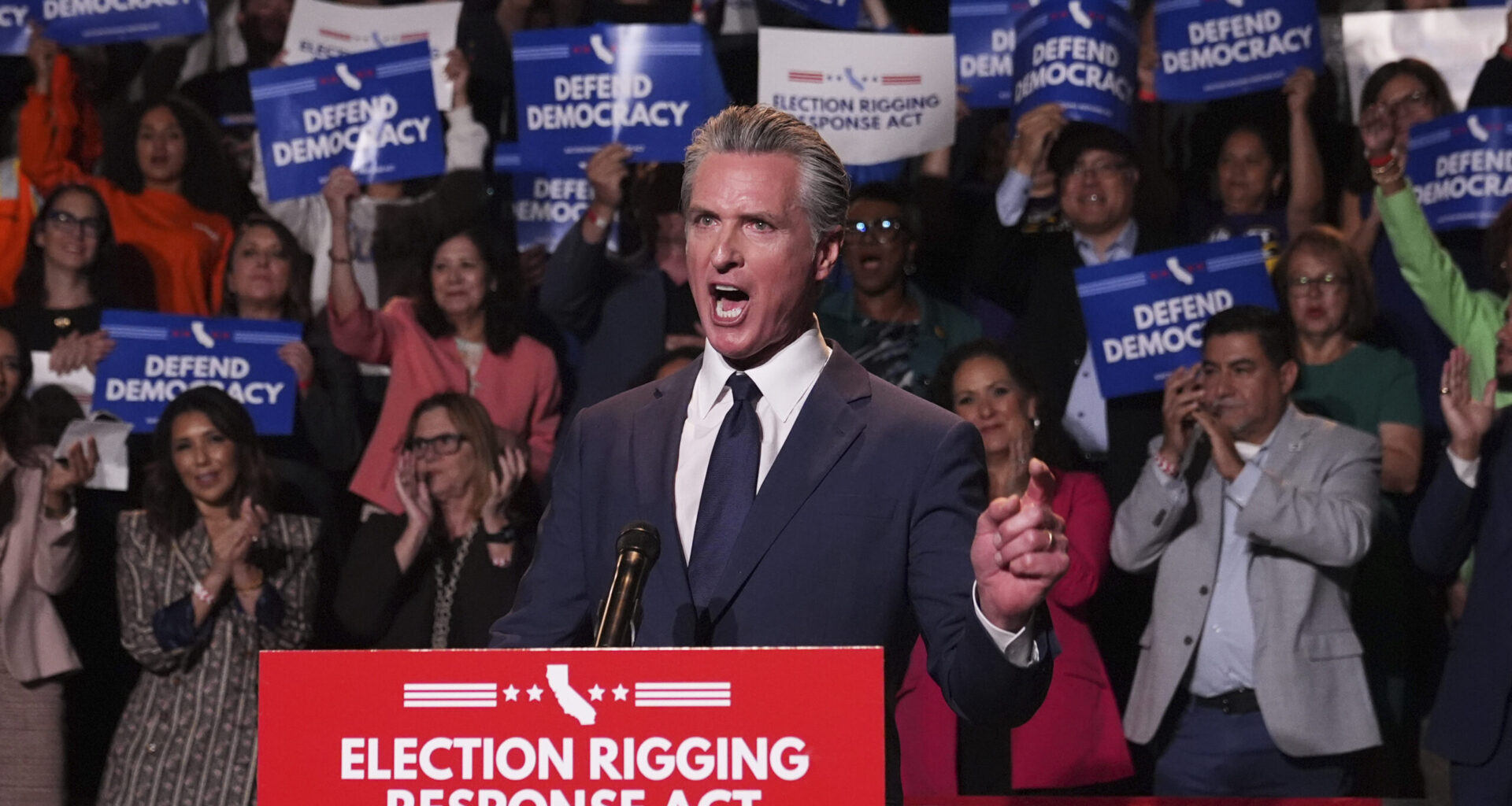
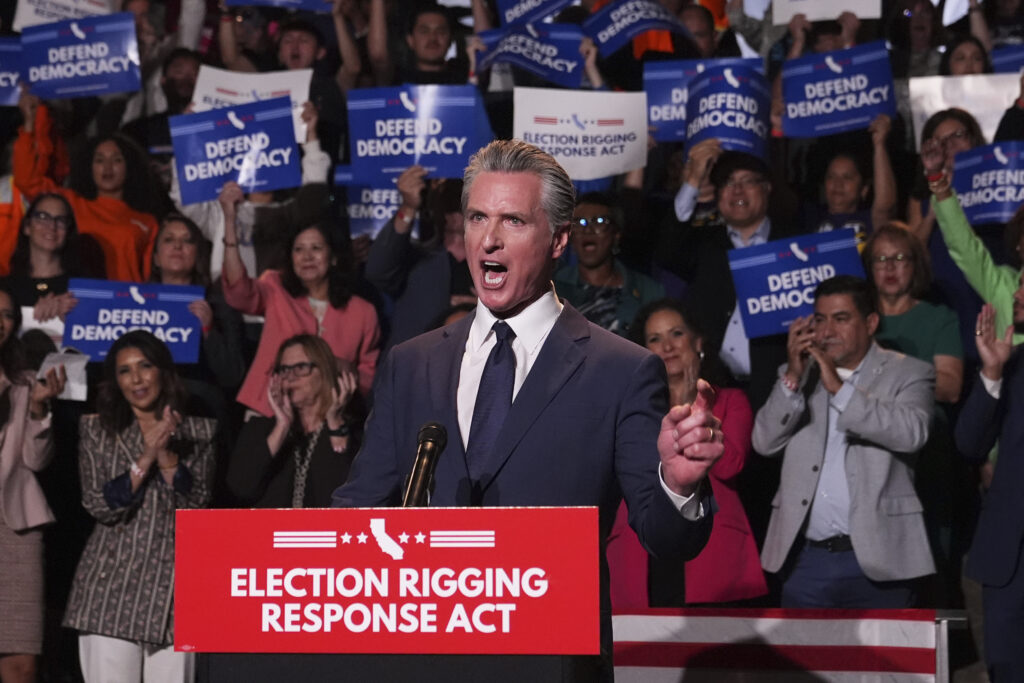
 California Gov. Gavin Newsom speaks during a news conference Thursday, Aug. 14, 2025, in Los Angeles. (AP Photo/Marcio Jose Sanchez)
A federal court Wednesday ruled against a Republican challenge to California’s redistricting plan, rejecting the GOP claim that the state had engaged in illegal racial gerrymandering when drawing up its new congressional map.
The three-judge panel denied the GOP’s motion to block the map, finding there was no basis for a preliminary injunction.
“Republicans’ weak attempt to silence voters failed,” California Gov. Gavin Newsom (D) said in a social media post. “California voters overwhelmingly supported Prop 50 — to respond to Trump’s rigging in Texas — and that is exactly what this court concluded.”
Republicans will likely appeal the ruling to the U.S. Supreme Court. But three GOP-appointed justices already opined in a December decision on Texas redistricting that the California map was motivated by partisanship.
California Democrats redrew their congressional map last year in response to President Donald Trump’s push for Republican-controlled states to conduct unprecedented mid-decade redistricting in favor of the GOP. Golden State voters overwhelmingly voted for the Proposition 50 plan, which aimed to create five more Democratic congressional seats to balance out Trump’s efforts to pick up five seats in Texas.
But Republicans quickly challenged it, asking a federal court to block the California map because it was allegedly drawn “to favor Hispanic voters” in violation of the Fourteenth and Fifteenth Amendments. They argued that Paul Mitchell, the California mapmaker, said his work on the legislature’s plan was guided by racial considerations and that the “number one thing that [he] first started thinking about” was “drawing a replacement Latino majority/minority district in the middle of Los Angeles.”
In the ruling, the court noted that Republicans didn’t express racial gerrymandering concerns during the legislative debate on the map.
“No one on either side of that debate characterized the map as a racial gerrymander,” the court wrote, adding that Republicans repeatedly described it as a political power grab.
In fact, the court wrote, California Assembly member David Tangipa – a Republican plaintiff in the case – himself described Proposition 50 as “partisan gerrymandering” and a “power grab” that “eliminate(d) five Republican districts and strengthen(ed) Democrat held seats.”
Since the U.S. Supreme Court greenlit partisan gerrymandering in 2019, Republicans “abandoned the argument they made to the voters” and called it a racial gerrymander instead, the court concluded.
The court also noted that voters’ intent mattered, too – and supporters of the measure were motivated by partisanship, not race.
The majority opinion was written by Judge Josephine L. Staton – appointed by former President Barack Obama – joined by Judge Wesley L. Hsu, appointed by former President Joe Biden. Judge Kenneth K. Lee, appointed by Trump, wrote a dissenting opinion.
The court held a three-day preliminary injunction hearing in December.
The lawsuit was filed by the Dhillon Law Group, a firm founded by Harmeet Dhillon, who now leads the U.S. Department of Justice (DOJ)’s civil rights division. In August, the firm made two attempts to block California’s redistricting effort. The California Supreme Court denied both petitions.
The DOJ also intervened in the California redistricting case, seeking to block the map. Dhillon recused herself.
The Democratic Congressional Campaign Committee (DCCC) intervened* to assist with defending the map.
Unlike in the Texas redistricting legal battle, which featured two days of testimony from GOP mapmaker Adam Kincaid, Mitchell did not testify at the California hearing, despite being called as a witness by the GOP.
Mitchell reportedly was not required to testify because he was served in Sacramento, outside of a 100-mile radius of the court hearing in Los Angeles. He sat for a deposition, but the DOJ filed a motion blasting Mitchell’s legal team for repeatedly blocking questions during the deposition, claiming his counsel “asserted legislative privilege approximately 122 times.”
During Kincaid’s testimony in Texas, attorneys defending the gerrymander also repeatedly blocked questions, claiming the answers were privileged information.
In his dissent in the California case, Judge Lee argued Mitchell “publicly boasted” that the new map would boost Latino voting power – and criticized the mapmaker for not testifying.
“Mitchell refused to appear before our court to explain how he drew the map and invoked legislative privilege for staying silent,” Lee wrote.
*The Democratic Congressional Campaign Committee is represented in the lawsuit by the Elias Law Group (ELG). ELG Chair Marc Elias is the founder of Democracy Docket.