
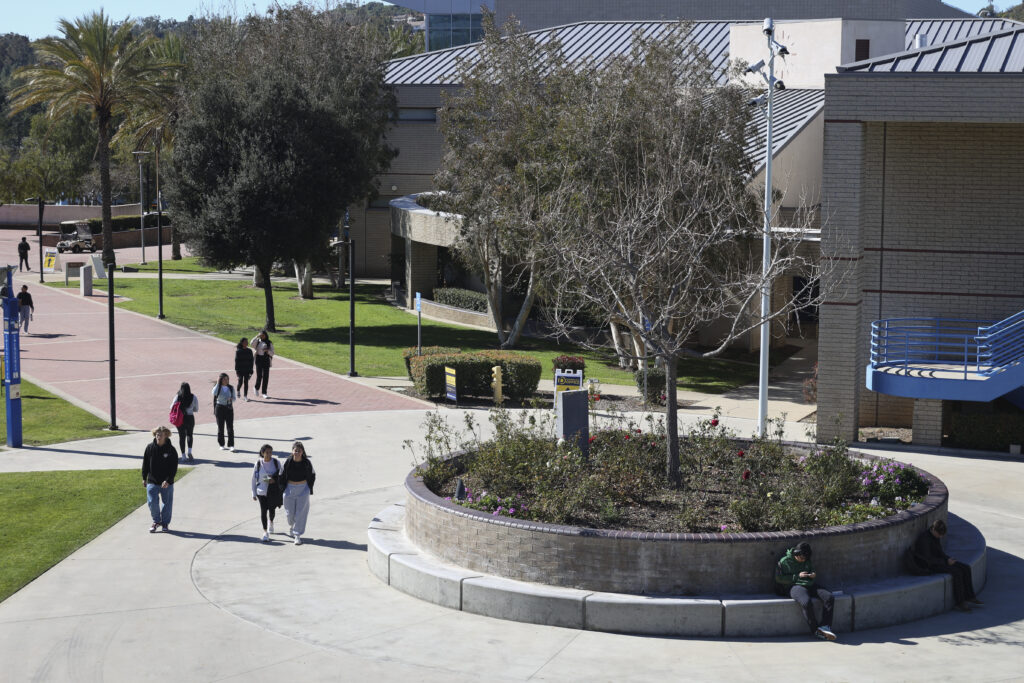
Santiago Canyon College in Orange is one of seven community colleges in the state that have yet to get final approval for bachelor’s degrees they proposed in 2023.
Courtesy of Santiago Canyon College
Top Takeaways
Members of the board of governors for California’s community colleges said they support approving bachelor’s degrees that face objections from California State University, though they did not take action.
Sixteen degrees are currently blocked, including seven that were initially proposed in 2023. Local community college leaders and students have grown frustrated by the delays.
Community college officials maintain that the proposed degrees don’t duplicate what’s offered at CSU campuses, though CSU sees it differently.
California community college officials on Tuesday urged approval of proposed bachelor’s degree programs that have been blocked, in some cases for years, by California State University.
The degrees were discussed at length during a meeting of the California Community Colleges system’s 17-member Board of Governors in Sacramento. State law allows community colleges to create bachelor’s degrees as long as the programs don’t duplicate what’s offered by the state’s four-year universities.
Fifty-four bachelor’s degrees are currently offered or will be soon at community colleges across the state. Most were approved in 2022 or later.
Sixteen other proposed degrees that have been approved locally are still awaiting final sign-off from the state because of objections from CSU campuses. Many local community college leaders and students have grown frustrated by the delays. Seven of those degrees were initially proposed in 2023.
No action was taken on Tuesday, but several board members said they support approving the degrees. That sentiment was echoed by many students, faculty and local college officials during a long public comment period. The state community college system’s chancellor’s office staff also emphasized that the degrees were crafted to be distinct from what’s offered at CSU.
They were perhaps emboldened by a recent analysis from the nonprofit organization WestEd, suggesting that many of the blocked degrees are not necessarily duplicative and would serve students currently not reached by CSU. The state community college system’s chancellor’s office contracted WestEd to conduct the analysis and help resolve the disputes with CSU.
“It just seems like the bureaucracy that’s inhibiting this is unjustified and that we should be very aggressive in moving ahead,” said Tom Epstein, the longest-tenured member of the board and former president.
Final decisions on the degrees are up to the president of the board of governors, who can approve them at the recommendation of the chancellor. The current president is Hildegarde Aguinaldo, senior director assistant general counsel for the healthcare company DaVita Inc. It’s not clear when Aguinaldo and Chancellor Sonya Christian will decide on the pending degrees, but some campuses expect approvals as soon as this month.
CSU did not return a request for comment on Tuesday. In the past, CSU campuses have cited curriculum overlaps between the proposed degrees and their own.
The blocked degrees include cybersecurity technology at Cerro Coso Community College, field ironworker supervision at Cerritos College, cybersecurity and network operations at Moorpark College, cloud computing at Santa Monica College, and building trades management at Foothill College, among others.
Foothill College President Kristina Whalen asked the board to approve the building trades management program, which has been blocked since 2024 because of objections from Chico State and Sacramento State. Both campuses offer degrees in construction management.
Whalen said the program would be distinct and noted that “not a single student” from Foothill College has transferred to Chico State or Sacramento State for construction management. “There’s not an enrollment opportunity for the CSUs, but there is three years of lost opportunity for students, for our local construction industry and for a state that needs skilled leaders in the trades,” Whalen added.
James Todd, the community college system’s vice chancellor of academic affairs, said during a presentation to the board that the 16 blocked degrees have gone through a “rigorous process” to ensure that they aren’t duplicative.
He acknowledged some course overlap with CSU degrees but said the programs themselves are unique and prepare students to fill unmet workforce needs.
“There are students out there that would benefit from these programs, and yet our campuses have not been able to offer them even though we’ve done the work,” Todd said. He added that “it’s time that they get their decision.”
A spokesperson later said Todd wasn’t suggesting the degrees be immediately approved and that the approval process is ongoing.
Tyler Bird, a student pursuing an associate degree in field ironwork at Cerritos College, said he hopes to get his bachelor’s degree at the college in field ironworker supervision — if it’s approved. For him, the degree would mean a promotion and better pay.
“It would give dedicated workers like me a fair shot to advance and support our families while strengthening California’s work,” he said during the public comment period. “We just need the green light.”
That degree faces objections from two CSU campuses: Chico State and Cal Poly San Luis Obispo. Cal Poly is located about 208 miles from Cerritos College, and Chico State is about 450 miles away — distances that could give the community college system’s board enough reason to approve the Cerritos College degree.
The recent analysis by WestEd suggested that the location of a community college is relevant and that proposed degrees should not necessarily be considered duplicative if the objecting CSU campuses aren’t geographically accessible to students. The report noted that the intent of the law was to meet local community needs and serve community college students who are place-bound, meaning they can’t leave their home region to attend college.
“I think it’s really important that the local communities are having a voice in what they feel like they need, versus some other community saying, ‘Hey, you can’t have this program,’” said board member Joseph Williams during Tuesday’s meeting. “So I’m in full support of this effort.”
Another board member, Adrienne Brown, a counselor at Los Angeles Harbor College, said she is also in “full support” of the degrees but added that she hopes the community colleges can work with CSU to address their “pain points.”
Brown noted that some CSU campuses are struggling with enrollment, which may explain their objection to bachelor’s degrees at community colleges, and suggested the community colleges could look for ways to send more students to those campuses.
“And then maybe over time, once that’s flowing, there will be less resistance” to the bachelor’s degrees, Brown said. “I just see it as looking for more win-win partnership opportunities.”