
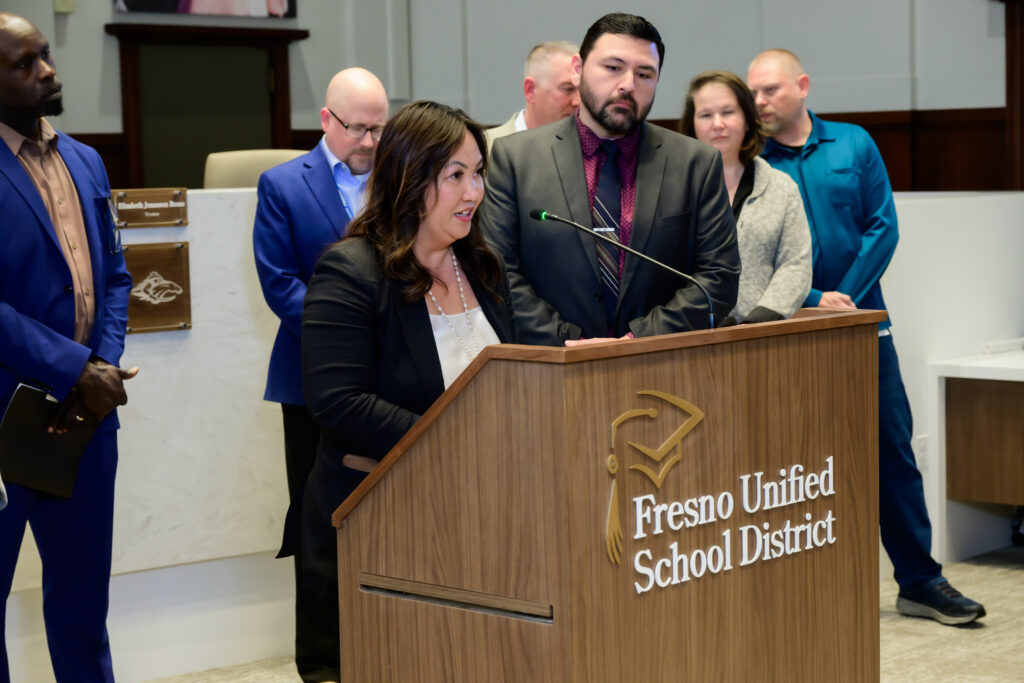
Credit: Fresno Unified / Flickr
Top Takeaways
Health care coverage for Fresno Unified retired educators with Community Medical Centers was disrupted due to a contract dispute between the provider group and the insurer Aetna.
Until a Wednesday announcement of a Feb. 20 contract extension, Community Medical had not allowed retirees to access care.
Retirees still have lifetime benefits, but not as promised or as legally protected, they say.
Fresno Unified School District’s health board, created to manage and maintain health benefits for employees and retirees, is meeting Thursday to discuss how to ensure that retired educators continue to receive health care.
At issue is a crisis that began Jan. 1, when many district retirees lost access to health care provided by Community Medical Centers, the area’s largest health care provider, which is in contract negotiations with the insurer Aetna.
More than 6,200 retirees and their spouses or eligible dependents are enrolled in the Aetna program. Of them, more than 1,500 received primary or specialized medical care through the Community Health System within the past year, according to Fresno Unified.
Throughout the state, school districts are struggling with rising health care costs for employees and retirees. Fresno Unified is among 7% of school districts statewide that offer lifetime health benefits.
Community Medical Centers agreed on Wednesday to extend patient care access for office visits and prescription refills through Feb. 20 while contract negotiations continue between the health system and Aetna.
Even though retirees over age 65 still have coverage through Medicare, their district-provided Aetna Medicare Advantage plan is severely limited without access to the Community Medical Centers network.
Jesus “Jesse” Alcaraz, whose wife, Dolores Alcaraz, retired from Fresno Unified in 2021 after working 44 years as a library aide in the district, started his cancer treatment with a team of Community Medical Center physicians last year following an October diagnosis.
When the medical system and Aetna failed to reach an agreement by the Dec. 31 deadline, patients like Jesus lost access. Some sought services but were denied; others had to pay out of pocket, delaying much-needed care.
“We have tried to talk to the doctors, to go talk to Aetna,” Dolores Alcaraz said during public comments at a Wednesday Fresno Unified board meeting. “He is not being seen by a doctor, and with his diagnosis, it is critical.”
The causes of the upheaval are hotly debated in the community.
From 1976 to 2023, Fresno Unified funded supplemental insurance to cover retirees’ health care after their Medicare coverage. In the self-funded model, the district directly contracted with individual providers for the remaining costs rather than set network providers.
In 2023, Fresno Unified switched from the self-funded retirement plan to offering retirees the choice of an Aetna plan with a nationwide network of providers, including Community Medical Centers, and a Kaiser insurance Medicare Advantage plan that had always been available.
That switch jeopardized retirees’ access to care and the district’s promise of lifetime benefits, said retired high school English teacher Emily Brandt.
“We have lifetime benefits; Medicare Advantage was not what we retired under,” said Brandt, who was diagnosed in 2022 with a rare type of lymphoma. “It’s a plan that sounds great because you have zero co-pays, zero deductibles, zero premiums. The real problem is that most people don’t realize that those are all good things if you are well. But if you are ill, the system breaks down for our care. They authorize very few things; frequently, you are denied.”
Because the district changed the retirement health plan option from the district’s supplemental insurance to an Advantage plan, which arguably has a narrower network of providers, the district cut the value of benefits, according to Alan Warhaftig, a retired Los Angeles Unified School District teacher who has studied retiree benefit protections.
The last health care plan changes for Fresno retirees dated back to 2006, when the district started charging them premiums, contrary to the premium-free, district-provided lifetime benefits promised. Retired educators sued the district. A 2010 court decision found that the district can only negotiate changes in an employee’s health benefits package “before they have retired and not after.”
“The other way that you can mess with things is by cutting the value of the benefits, narrowing the network of the providers,” Warhaftig said.
The health board is voting Thursday on whether to restore the self-funded model as an option for retired educators, a process that can take up to a year to become active due to federal requirements.
If approved, retirees will have the choice of the district’s supplemental insurance plan similar to what ran until 2023, the Aetna Medicare Advantage Plan that currently contracts with Community Medical and others nationwide as well as the Kaiser plan during open enrollment.
“We really need to try to run both plans as long as it is financially feasible,” Patrick Jensen, the district’s chief financial officer, said about retirees being satisfied with the Aetna plan.