
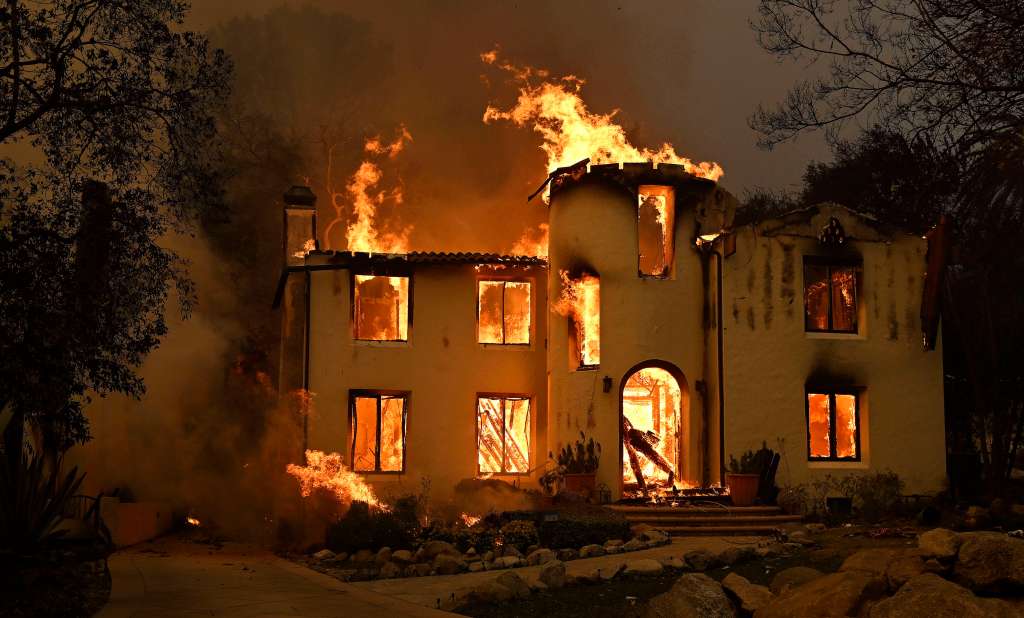
A year ago, Los Angeles was hit by two of the most destructive wildfires in California history—the Palisades Fire in Pacific Palisades and the Eaton Fire in Altadena, which forced me to evacuate my family’s home. The fires killed 31 people, destroyed more than 15,000 structures, and were made worse by institutional and policy failures. Sadly, one year later, these issues persist, leaving Los Angeles and other California communities vulnerable to future disasters.
The areas affected by the wildfires are located in the wildland-urban interface (WUI), areas where human development and wildlands intersect, leading to increased wildfire risk because of excessive vegetation. When California was being built up, single-family zoning restrictions prevented the development of multifamily housing in the state’s urban cores, where wildfire risk is lower. This created a “drive until you qualify” market that ultimately pushed urban sprawl into WUIs.
Insurance regulations in California, specifically Proposition 103, have also distorted organic incentives to live in safer areas. This proposition limits insurers’ ability to raise their rates freely, even in light of inflation and increasing wildfire risk. As a result, California has insurance rates that underprice risk.
Research by the International Center for Law & Economics reveals that the state has the worst “regulatory rate suppression” in the nation. In other words, people in high wildfire risk areas often don’t pay premiums that reflect the true risk of their location. Without insurance price controls or zoning restrictions by government, a functional market would emerge and encourage people to live in safer areas with lower insurance costs, away from wildfire risks.
Given the inherent risks of WUIs in Los Angeles and other parts of California, it is vital to prioritize wildfire prevention. In such environments, one spark can ignite a devastating wildfire. Unfortunately, the circumstances surrounding the Palisades Fire and the Eaton Fire reveal that wildfire prevention has been neglected.
The Palisades Fire is thought to have been started by a rekindling of the earlier Lachman fire, which was started six days prior and was allegedly the result of malicious arson. Texts from firefighters reveal that the Los Angeles Fire Department (LAFD) failed to sufficiently monitor the Lachman Fire burn scar and that firefighters were ordered to leave despite “visible signs of smoldering terrain.” Meanwhile, the leading hypothesis for the Eaton Fire is that abandoned utility equipment owned by Southern California Edison re-energized and sparked the blaze. The transmission tower at the center of the controversy sat abandoned and unused for over fifty years.
If those allegations are proven true, it means that both tragedies were preventable. In the future, LAFD should use thermal imaging to confirm that fires are completely extinguished before leaving a burn site. Utility companies should minimize the risk associated with transmission lines. At the very least, public safety power shutoffs should be implemented during Red Flag Warnings (which was not the case throughout LA County a year ago), and companies should adopt “fast trip” technology, which can deenergize lines faster than they can fall and spark a fire.
Moreover, in 2020, the State of California and the U.S. Forest Service signed a memorandum of understanding that both parties would “treat” 500,000 acres of public land per year through controlled burns and mechanical thinning to mitigate wildfire risk. Neither party has fulfilled its pledge. In the 2024–25 fiscal year, for example, Cal Fire treated only about 180,000 acres. In the year prior, the U.S. Forest Service treated 325,000 acres. Both parties should honor their commitment, which could involve easing air and species regulations that often block urgently needed thinning projects.
We must take decisive action. In order for the Golden State to become more resilient against wildfires, among other things, zoning must be abolished, Proposition 103 must be repealed, and all relevant parties, both public and private, must make wildfire prevention a top priority.
Kristian Fors is director of the California Golden Fleece® Awards at the Oakland-based Independent Institute and author of “The 2025 Los Angeles Wildfires: Lessons and Key Recommendations.”