

The quiet grounds of two church congregations in Santa Ana seemed poised to provide a rare opportunity for affordable homeownership before city staff foreclosed on their future.
Habitat for Humanity of Orange County in 2024 submitted a proposal to build up to 40 townhouses on the West Alton Avenue church site, acquired by property owner and housing advocate Bill Taormina.
Santa Ana, a leader in developing affordable housing in O.C., awarded the bid and signaled an intention to secure $9.8 million from a federal block grant to plug the project’s funding gap.
But in September, city staff reversed course, withdrawing the bid award and noting the project would not be recommended for City Council approval. A letter sent to Michael Valentine, Habitat OC’s chief executive, by Housing Manager Judson Brown did not specify a reason for the change in direction — only that the city was within its right to do so.
“It was heartbreaking,” said Valentine from Habitat OC’s Santa Ana office. “We saw 40 families that were going to get a homeownership opportunity, and then it just went away. I didn’t understand it.”
A city spokesperson did not respond to a TimesOC request for comment.
In recent years, developers have turned to church sites for housing opportunities in O.C. cities where developable land is scarce. The Diocese of Orange is building market-rate apartments behind its church in La Habra, while Garden Grove approved plans for market-rate townhomes to replace Grace Baptist Church and its dwindling congregation.
Amid a housing crisis, state law allows religious institutions and nonprofit colleges to override local zoning restrictions to build affordable housing on land they own.
Habitat OC’s project, which would require rezoning and an amendment to the city’s general plan, was unique in proposing 40 townhouses for affordable ownership, with 30 three-bedroom units marked for low-income homebuyers and 10 units allocated for moderate income earners.
“The number of homes that are all-affordable is extraordinary,” Valentine said of the project. “We were really excited about this and the beautiful neighborhood we were going to be able to build.”
Valentine described the initial working relationship with Santa Ana as positive, as Habitat OC staff met with members of the City Council and planned community outreach efforts.
In May, the nonprofit hosted an open house at the project site attended by more than 100 people. Councilmember Phil Bacerra, Brown and other city officials were also present. Traffic and parking arose as concerns from residents about the proposed development, especially as it would be across the street from MacArthur Fundamental Intermediate School.
An online petition opposing the project launched the following day and gathered hundreds of signatures.
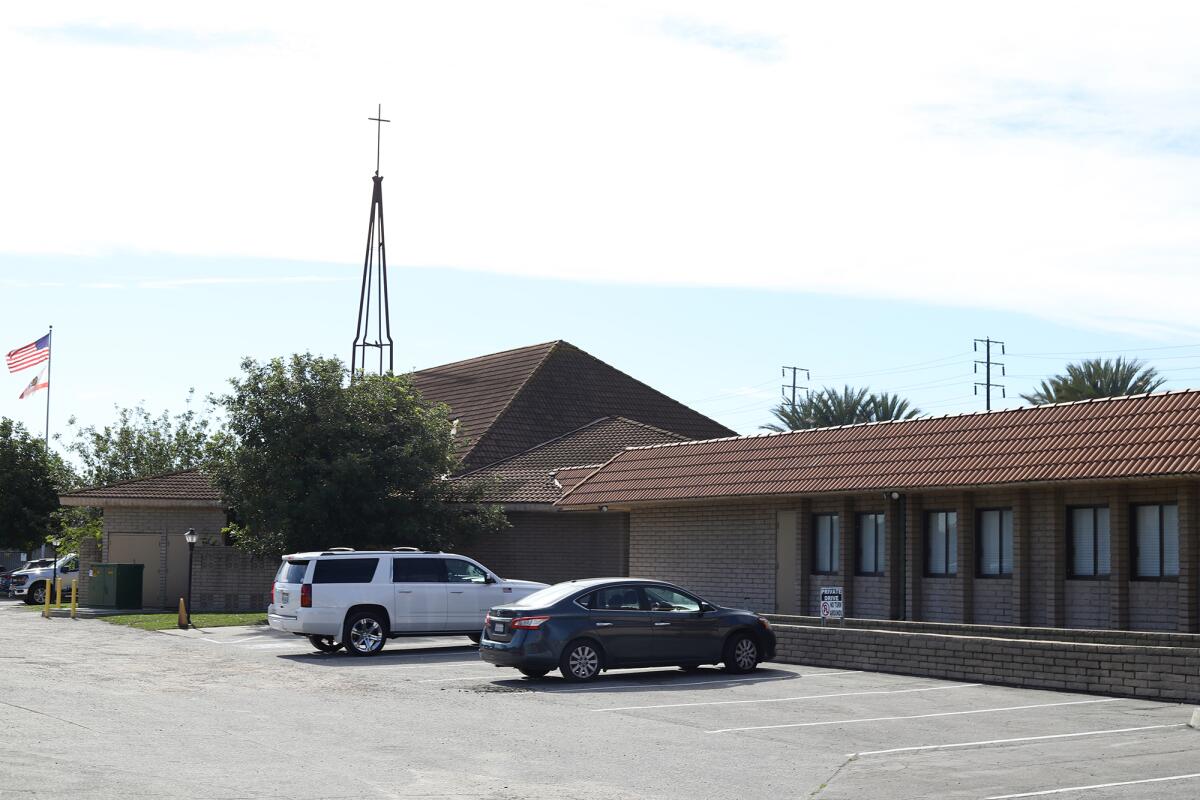
The grounds of Turning Point Fellowship, on West Alton Avenue in Santa Ana, were eyed for an all-affordable townhouse development.
(James Carbone)
Being responsive to complaints about parking, Habitat OC pledged improvements.
Velma de la Rosa, Habitat OC’s vice president of housing and community development, emailed Bacerra and Asst. City Manager Minh Thai after the open house.
“While concerns about neighborhood parking and traffic were clearly voiced, they were framed more as long-standing infrastructure issues than objections to new affordable housing,” she wrote.
De la Rosa expressed optimism about moving the project forward and participating in a June council meeting.
Bacerra asked City Manager Alvaro Nuñez why Habitat OC would make such a statement.
Thai warned De la Rosa that including city staff and elected officials “in ongoing strategic and planning communications may have the unintended consequence of affecting or appearing to effect the city’s neutrality” ahead of any public hearings.
But the project never made it to City Council.
Days after the open house, Matt Cody, an attorney specializing in real estate litigation, sent Brown and Asst. City Atty. Andrea Garcia-Miller an email confirming a meeting at which the status of Habitat OC’s negotiations and negative feedback from community members about the project had been discussed.
He included a risk assessment Brown had requested in communications released by the city in response to a TimesOC public records request.
Cody noted Habitat OC followed the proposal process in doing public outreach in anticipation of receiving a pre-commitment loan letter from the city, which it spent $88,000 negotiating.
“The practical reality is that Habitat was required to engage in the process and undertook a significant commitment, which the city was completely aware of during the entire process,” Cody wrote.
He further advised that Santa Ana’s bid award did not absolve it from a potential claim and warned the city manager’s office and community development agency should have a clear understanding of affordable housing fund policies, as deviating from them creates the risk of appearing to have “changed the rules.”
Cody suggested it wouldn’t be in Habitat OC’s “long-term interests” to sue the city and noted the risk of the claim could be low.
In September, months after the open house, Santa Ana withdrew Habitat OC’s bid award.
“I’ve never seen a project get killed that was enthusiastically and unanimously approved by each of the commissions,” Taormina said, “and then vaporized in front of us without having a formal chance to go to the Planning Commission, to go to City Council and a formal hearing process.”
The leases for Turning Point Fellowship and the Faith Community Church of Santa, Taormina’s two on-site tenants, expire at the end of the year, but Taormina has pledged to renew them until he understands what is going to happen — or not happen — at the property site with regard to housing.
Instead of voting on the Alton project, council members debated a policy change on affordable housing funds in November to prevent the city from issuing pre-loan commitment letters if a project does not align with the its general plan and zoning code.
Affordable housing advocates from the Kennedy Commission, Habitat OC and People for Housing opposed the revision and claimed it would hinder future projects.
Most council members also opposed the change.
“This is a solution looking for a problem,” said Councilmember Thai Viet Phan. “If there’s a project that requires a general plan amendment, it comes back before this council.”
Bacerra argued that the policy change was necessary in the interest of impartiality.
“It’s not bureaucratic, it’s fairness,” he said.
Councilmembers voted 6-1 to reject the policy change.
Even with existing policy remaining intact, the debate deflated Valentine’s hopes that the West Alton Avenue project could get back on track in Santa Ana.
“If the city manager had not said this was a dead-on-arrival project, we would probably be pursuing some conversations about undoing the rescission,” he said.
Instead, Valentine is mulling ways to close the funding gap without collaborating with the city, a move that would likely delay the townhouse project by a few years.
“I love this project so much that I’m trying to figure out how we can do it without the city’s money,” he said. “I can’t think of a time when we’ve been awarded funding and then had it removed. Why is this not a good project? To this day, I still don’t know.”