
For The Union-Tribune
What kind of yard does a wildlife biologist create for herself and her family? For Shea O’Keefe, the 2025 WaterSmart Landscape Contest winner for San Dieguito Water District, it’s a yard that has a thoughtful connection to nature.
O’Keefe, a wildlife biologist who does restoration on working lands (think farmland, rangeland and forest land whose owners want to do something for wildlife) for the U.S. Department of Agriculture, has gradually created her own miniature version of a wildlife preserve in the suburbs of Encinitas.
The critters who drop in or call the space home range from monarch butterflies, ladybugs and lizards to hummingbirds and bushtits, skunks, opossums and even the occasional mountain lion. Given that O’Keefe, her husband Ian and teenage sons Aidan and Tristan have two cats, a dog and chickens, everyone needs to be secure in their home — and the chickens in their coop — before nightfall.
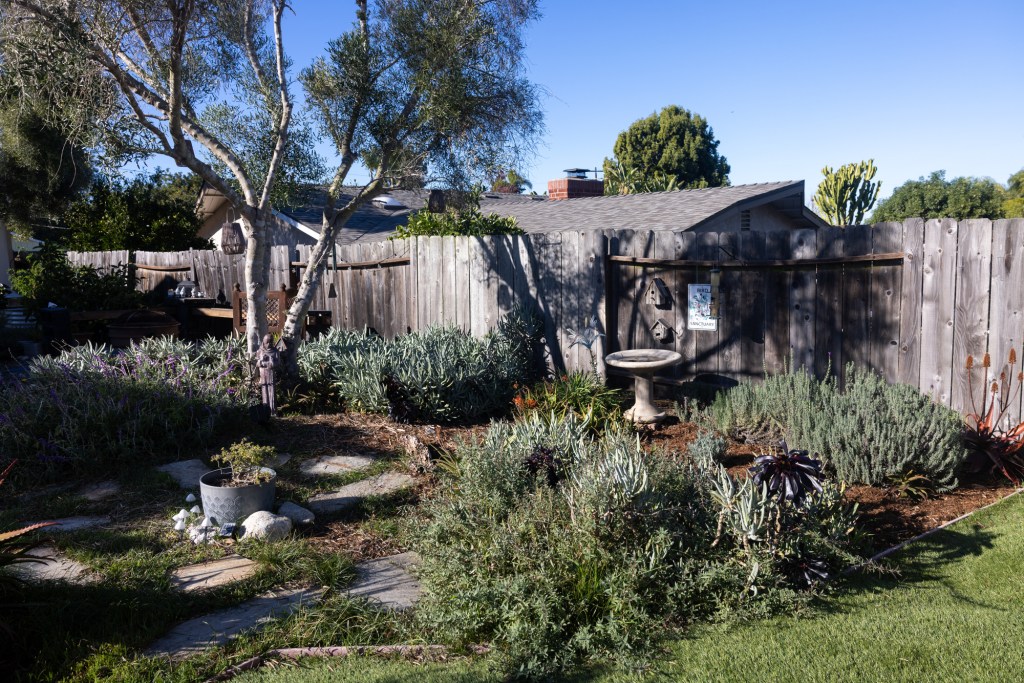
 “My overall theme has always been, ‘It needs to serve a purpose for wildlife,’ ” said homeowner Shea O’Keefe, a wildlife biologist, whose yard does so year-round. (Ana Ramirez / The San Diego Union-Tribune)
The O’Keefes moved into their late ’60s home in 1999. She had divided her work on the front and backyards into three phases, as well as divided the property into different functional areas based on available light and how they wanted to use the space.
The front yard has a bit of a slope and was designed to be a lovely waterwise welcome to the home. It’s filled with lots of succulents and native species. The large back has a swimming pool that cuts across the yard, a lounging area in the back right and a small play area dating to when her sons were young, with artificial turf bordered by two giant birds of paradise. There’s a small structure that functions as a home office for her husband, a fire pit her son Aidan built, some raised beds for growing vegetables, an office building for herself, and the chicken coop. Directly in front of the home’s back entrance is a dining area under a new pergola and a barbecue. The rest of the yard has beds for the native plants and succulents she’s been growing to bring in all those critters — and other plants, like a guava tree, olive trees, a trumpet tree, roses and oaks that she planted long ago.
About 10 years ago, O’Keefe was ready to start reimagining the yards back and front, starting with removing the lawns, for which she received a $2,500 rebate.
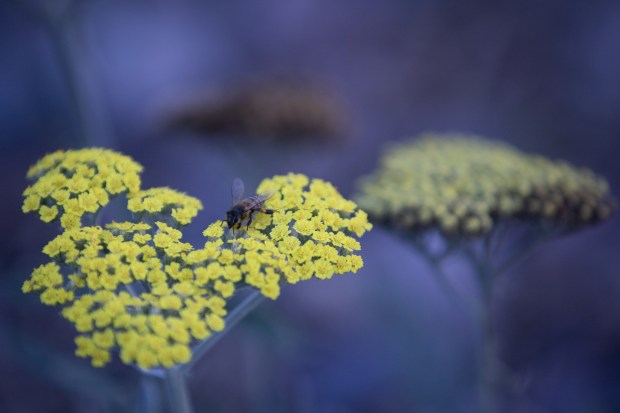 A bee visits a golden yarrow bloom. O’Keefe added a pollinator plot several years ago, mostly for the bees, she acknowledged. “I study bees so I watch what comes and goes,” she said. (Ana Ramirez / The San Diego Union-Tribune)
“At that time, we planted the olive trees, and a lot of natives with the succulent component,” she recalled. “We tried to do a native grass area but it didn’t sustain, so we added more artificial turf about 12 or 15 years ago. Four or five years ago we added vegetable boxes and a pollinator plot, mostly for the bees. I study bees so I watch what comes and goes. Our third phase came after we had new stucco put on the house and the workers destroyed the landscaping.”
O’Keefe learned about the WaterSmart Landscape Contest from a neighbor who works for the water district.
“She walks up and down the street and I’d be outside, and she’d say, ‘You need to apply to this contest,’” O’Keefe said. “I remember on May 8 and we were having a big birthday party for my son on May 9. She told me I had to get the application in by May 9 and I’m like, sure, no. I’m not going to do it. But she handed my son the application and told him to make sure I applied. It was due May 9 at midnight, and I literally did it at 11 o’clock. When I learned I’d won, I was like, ‘Oh my gosh! I’ve never won anything in my life! That feels pretty good.”
O’Keefe got a $250 gift card for The Home Depot, which she spent on a new barbecue for the family.
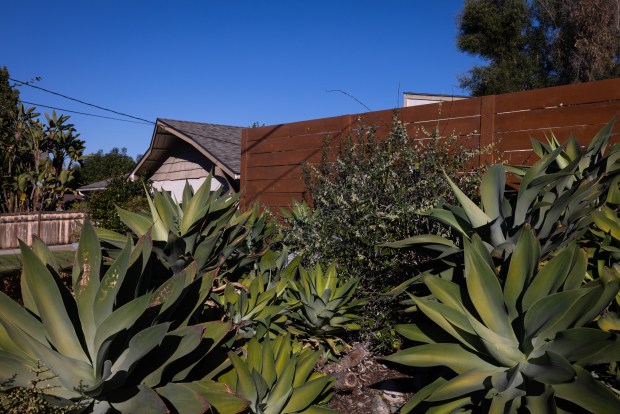 Foxtail agaves and other succulents soak up the sun in the front yard. (Ana Ramirez / The San Diego Union-Tribune)
The inspiration
What O’Keefe wanted above all was a space for wildlife.
“My overall theme has always been, ‘It needs to serve a purpose for wildlife,’ ” O’Keefe emphasized. “I wanted lizards. If I want lizards, I’m going to have to have some sort of rock element. I wanted insects. So I wanted downed wood. And then I wanted bloom periods that were year-round for pollinators.
“So many birds come into this yard in the morning. I have bush poppies loaded with bushtits in the morning. And the hummingbirds are just dive-bombing me every day. I get these possums that come through, so I have water dishes for the possums and skunks and whatever else is foraging around here at night.
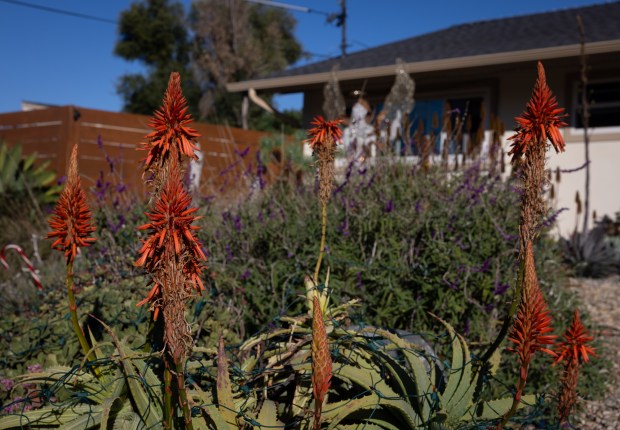 Orange flowering stalks of the aptly named candelabra aloe tower above the plants below. (Ana Ramirez / The San Diego Union-Tribune)
“I just wanted to provide a little spot for wildlife to get food resources and water. And if they can stay for a while, like my ladybugs, great. If not, then they can move on.”
To figure out how to achieve this, O’Keefe visited the San Diego Botanic Garden in Encinitas, an organization she works with professionally.
“It was nice walking around and noticing that sometimes they don’t just have plants, they also have art integrated with the landscape,” she said. “So, I thought we could do some little statues. Some lights. Water features.”
Another priority was to create little refuges for herself. “I’ve got three boys in there, so it’s always nice to have some refuge places where I can go sit and hide.”
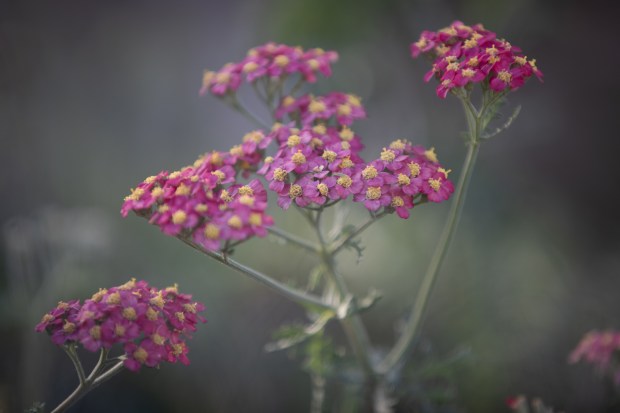 Flowers provide bloom periods throughout the year. (Ana Ramirez / The San Diego Union-Tribune)
The details
A few years ago, the O’Keefes had to do some upgrading to the house. Plumbing, electrical, a new roof, solar panels and new stucco.
“After two weeks of demo, the guys just trampled everything, especially in the front,” she recalled. “The front was gone.”
So, phase three of landscaping kicked in. O’Keefe reached out to her friend Steve McDearmon of Garden Rhythms for help. He’d stepped in about 15 years earlier to put some plants in. Now he helped again with a plan.
“He said, ‘OK, let’s do this irrigation system, which is automated. Let’s really think about where your plants are and where the sun is, and how much moisture you have against the house versus out here.”
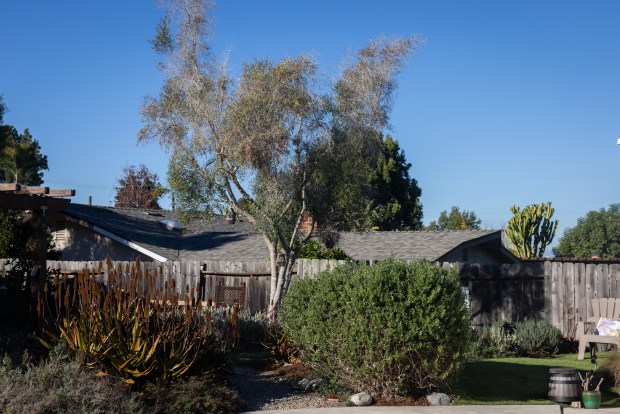 The Encinitas yard has lounge space for O’Keefe and her family, but also small havens for insects, rocks for lizards to sun themselves, and places for birds, possums and more to find resources as they pass through. (Ana Ramirez / The San Diego Union-Tribune)
The friends collaborated. O’Keefe made pencil drawings of what she had in mind for the layout. McDearmon would take a look and suggest mounding some of it for a little elevation. He’d bring over plant samples for O’Keefe to select or, given her background as a wildlife biologist, she’d give him names of native plants she wanted for him to source.
Irrigation was one of her priorities. Along with drip irrigation in the back, she got a rain barrel for one side of the house to water from. There’s a rain chain on the other that sends water to a spot where McDearmon created special drainage in the back; that collection area leads to the front of the house, where he designed a creekbed that routes the water to saturate front-yard plants instead of sending it into the street. In the front, she also installed sprinklers because she has salvias and a manzanita that love overhead watering.
Planting was done based on sun exposure. The front yard faces west; the back, east. There’s a stand of candelabra aloes sporting brilliant orange stalks of flowers in the front. Nearby are California bush sunflowers and a large grouping of foxtail agaves, which produce pups that O’Keefe often prunes and places on the curb for neighbors. Below are California brittlebush and elephant bush. Smaller plants and bushes are by the street, larger ones are closer to the house.
In the back by the dining area and the firepit, O’Keefe has created a haven for insects. There are salvias, yarrow, buckwheat, deergrass and California wild rye in spaces that get a lot of sun, while leopard plants with daisylike yellow flowers get some shade and moisture by being close to the house.
“My ladybugs overwinter in the grasses,” O’Keefe said. “So I’ll get a big group of them in the spring. They eat aphids that get on the milkweed that are keeping the monarch caterpillars from getting enough. So it kind of works out.”
In the areas with plants, there’s plenty of mulch, which O’Keefe bought from Grangetto’s Farm and Garden Supply in Encinitas.
O’Keefe’s new landscaping was completed quickly by McDearmon’s team by the end of August 2023. Since then, she’s been delighted that she can create little wildflower bouquets to put in the house or give to friends. And she gets lots of “how to” questions from neighbors walking by, which she also delights in.
“I know all these parents because my kids go to the schools here, and one parent asked me to come to her house to redo a little area,” she said. “I’ve had people bring me to their yard to help. And, you know, I’m pleased to be able to bring natives to people.”
Costs
Over the years, O’Keefe has spent about $9,000, minus the $2,500 rebate she received for removing the original lawn. The latest phase, phase 3, cost about $5,000.
A closer look: Shea O’Keefe
Plants used: monkeyflower (Erythranthe cardinalis), California fuchsia (Epilobium canum), red buckwheat (Eriogonum grande var. rubescens), bush poppy (Dendromecon rigida), deergrass (Muhlenbergia rigens), giant wildrye (Leymus condensatus), seaside daisy (Erigeron glaucus), leopard plant (Farfugium japonicum), giant white bird of paradise (Strelitzia nicolai), yarrow (Eriophyllum confertiflorum), California brittlebush (Encelia californica), coast live oak (Quercus agrifolia), Mexican bush sage (Salvia leucantha), narrowleaf milkweed (Asclepias fascicularis), English lavender (Lavandula angustifolia), French lavender (Lavandula stoechas) and a variety of aloes and other succulents
Where they were sourced: Moosa Creek Nursery, Waterwise Botanicals in Bonsall and Barrels & Branches Nursery in Encinitas. She also bought boulders and gravel from RCP Block and Brick and much (and some natives) at Grangettos Farm and Garden Supply in Encinitas.
Estimated costs and any rebates you got: About 10 years ago, in an earlier iteration of the yard, O’Keefe got a $2,500 rebate for lawn removal. This third phase cost about $5,000. Earlier phases cost $1,000 and then $3,000.
Who did the work: O’Keefe did most of the work but brought in her friend Steve McDearmon, CEO and founder of Garden Rhythms, to help with the design and initial implementation.
How long it took: For this third and latest phase, O’Keefe and McDearmon spent one month, July 2023, planning. It took another two weeks after that prepping the area and one week to install, finishing in August 2023.
Water savings: Approximately $200 a month but with water rate changes, she said it’s hard to really know.
Advice:
• Be patient with the install. Do it in phases so you can see how things grow and transform.
• Don’t be afraid to prune natives.
• Incorporate little spaces for creativity.
• Think about year-round bloom periods.
• Add those edible plants for you and your wildlife.
• Incorporate potted plants that can be changed up to add variety.
• Incorporate downed wood, rocks, ponded water and cavities for wildlife.
About the series
This is the sixth this year in an occasional series on 2025 winners of the annual WaterSmart Landscape Contest, conducted in partnership with the San Diego County Water Authority. To learn about entering the next contest, visit landscapecontest.com.
For details on classes and resources through the WaterSmart Landscape Makeover Program, visit watersmartsd.org. Landscape rebates are available through the Socal WaterSmart Turf Replacement Program at socalwatersmart.com.