
LOS ANGELES, CA — Gus Van Sant’s “Dead Man’s Wire” is a tale of profound desperation — a powder‑keg chamber piece about a man crushed by the promises of the American Dream. It’s a story of aspirations curdling into volatility and crashing against the institutional forces of a Midwest worn thin by economic strain. What emerges is a psychological descent devoid of logic, control and even the faintest grip on reality.
That unraveling situates Van Sant’s latest crime thriller firmly within the thematic terrain he’s returned to throughout his career. From the drifting outsiders of “My Own Private Idaho” to the quiet ruptures of “Elephant,” and the intimate character work of “Milk” and “Good Will Hunting,” he has spent four decades tracing lives marked by marginalization, volatility, and quiet implosion.
“Dead Man’s Wire,” his first feature in six years, pushes that continuum forward with a renewed, sharpened fervor, edging into the live‑wire moment when one man’s moral clarity frays into raw outrage and deepening disillusionment.
At the center of the story is Bill Skarsgård as Tony Kiritsis, emotionally bruised in the throes of financial woes. A jittery, hollow‑eyed mortgage borrower trapped in a bureaucratic maze, he teeters on the brink of a meltdown — tense, frantic, unhinged.
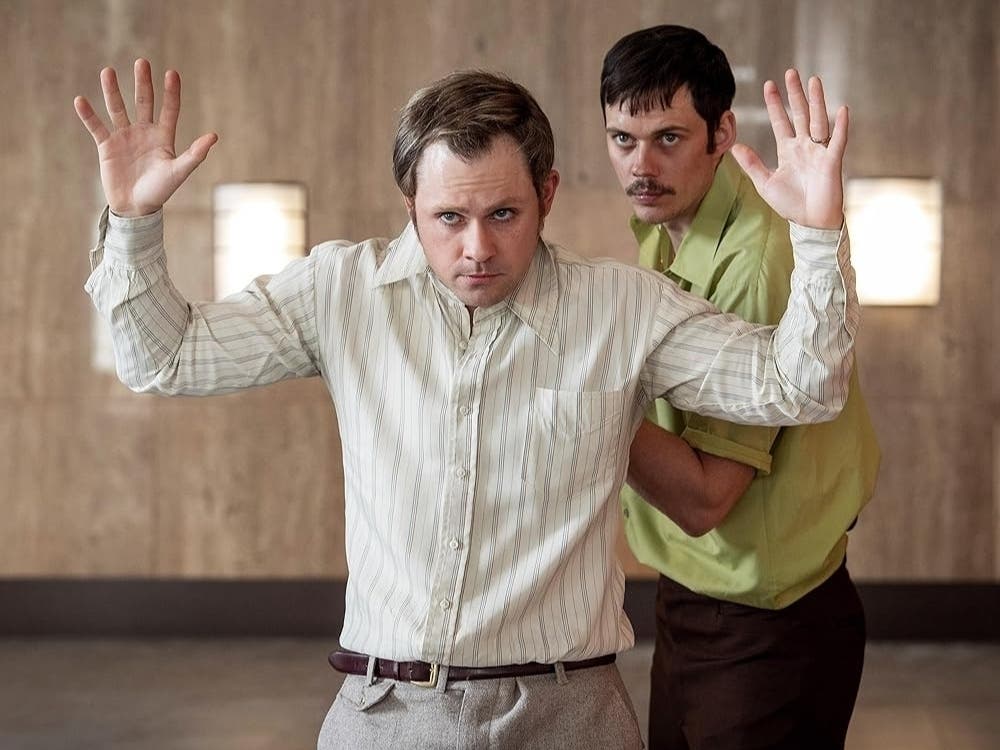
Loosely rooted in the 1977 Indianapolis hostage standoff, the film follows the moment Tony finally breaks — storming into his lender’s office on a frigid winter morning, only to find the company’s founder, M.L. Hall (Al Pacino), absent, leaving his son Richard (Dacre Montgomery) as the unintended hostage.
In the chaos, Tony rigs what he calls a “dead man’s wire,” a makeshift tether he loops around Richard before fastening the other end to the shotgun he keeps trained on him. The setup is crude but effective, binding the two together so tightly that if Tony is rushed, jolted, or taken down, the tension on that line threatens to turn the situation catastrophic.
What begins as seething fury now morphs into a public siege, echoing the combustibility of Sidney Lumet’s “Dog Day Afternoon.” The streets erupt into pandemonium as Tony drags Richard outside. Police swarm. Cameras ignite. Reporters surge. Crowds gather. Sirens wail. Everything tilts into a 63‑hour standoff broadcast live across prime‑time TV.
With Austin Kolodney’s well‑crafted screenplay as the film’s spine, Van Sant stages the chaos with crisp, unfussy precision, dropping the audience straight into Tony’s unraveling. The result is a piercing, contemporary‑feeling drama of indignation and inequality rather than a straightforward 1970s period piece. The film never absolves Tony, yet it remains tethered to the grievances that fuel his desperate acts. That perspective sharpens further once the film narrows in on Skarsgård’s performance.
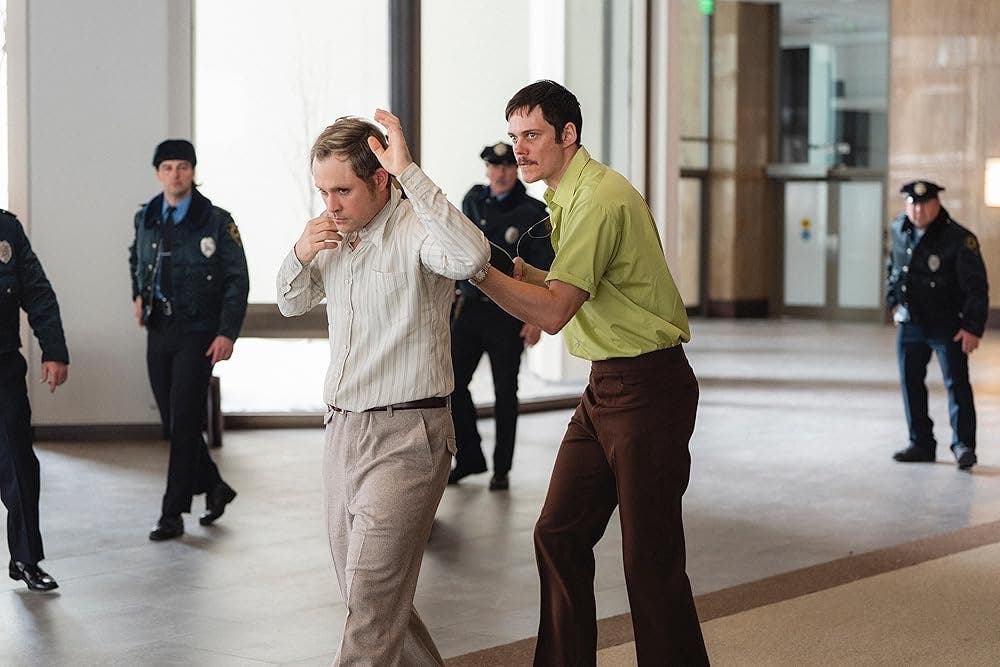 Bill Skarsgård and Dacre Montgomery in “Dead Man’s Wire.” (Stefania Rosini / Row K Entertainment)
Skarsgård delivers his finest turn yet. He plays Tony with taut, neurotic desperation, unleashing a wounded pride that feels unmistakably real. His eyes flicker between agitation, resolve, and paranoia, his voice raw and lived‑in, giving “Dead Man’s Wire” an immediacy that feels electric.
Around him, the supporting cast sharpens the film’s emotional edges. Pacino gives M.L. Hall a worn, guarded authority. Montgomery brings a quiet, unsettled intensity to Richard, a son living in the fallout of choices he never made.
Among the film’s invented characters, Colman Domingo is razor‑sharp as an Indianapolis radio host branding himself the “voice of the people,” while Myha’la stands out as an ambitious journalist eager to turn the hostage crisis into a career step.
Notably, the film’s rhythm wavers at times, slipping in and out of urgency, but that fluctuation feels less like a misstep than a reflection of Tony’s unraveling. The tension surges, stalls and fractures in ways that mirror a man fading in and out of control. It becomes part of the film’s texture — a structural echo of a psyche on the verge of snapping.
Ultimately, “Dead Man’s Wire” lands with a force that feels both intimate and unnervingly current, attuned to the anxieties of now. Skarsgård’s raw, blistering performance gives the film its pulse, while Van Sant’s unflinching gaze deftly captures the emotional charge of a society strained by economic pressure and institutional neglect.