
Want more ways to catch up on the latest in Bay Area sports? Sign up for the Section 415 email newsletter here and subscribe to the Section 415 podcast wherever you listen.
The 49ers were already playing on the road in one of the NFL’s most hostile environments. They were already up against the only team to win 14 regular-season games and the opponent that held them to a season-low three points in a deflating Week 18 loss. They were already without superstars Nick Bosa, Fred Warner, and George Kittle.
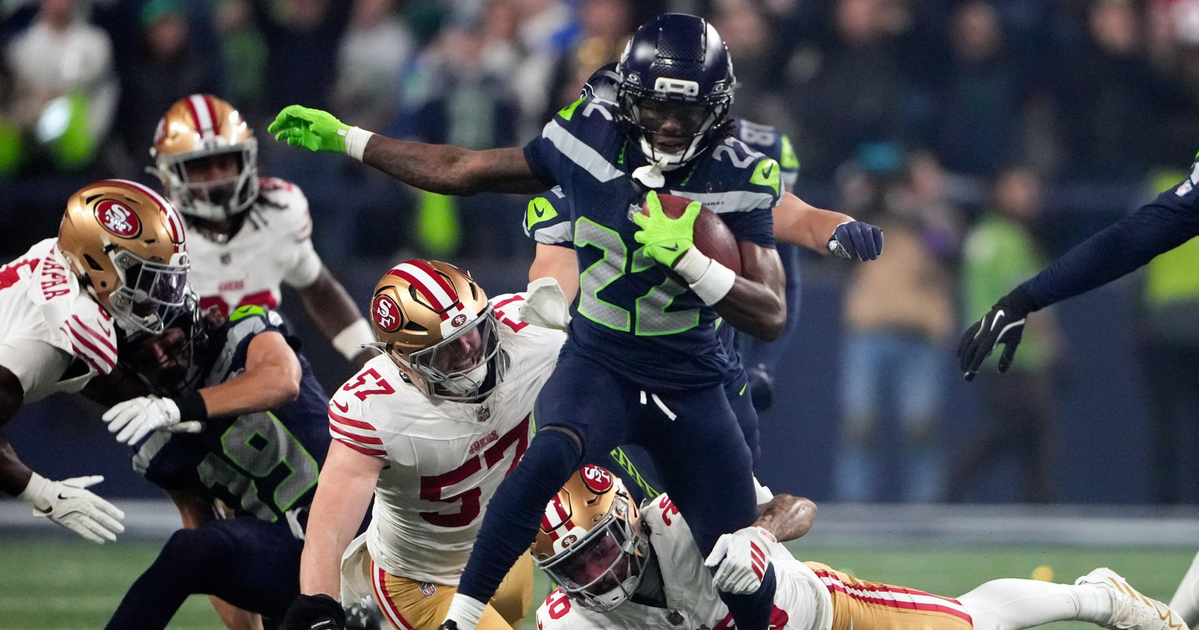
Then they watched Seahawks returner Rashid Shaheed take the opening kickoff of Saturday’s game 95 yards for a touchdown.
Lumen Stadium was rocking, and the 49ers’ season was over.
San Francisco technically had 59 minutes and 47 seconds to mount a comeback in Seattle, but Kyle Shanahan’s team continued imploding in a 41-6 defeat that was uglier than anyone anticipated.
A series of self-inflicted mistakes put the 49ers in their deepest halftime hole of the season, and when it came time to dig out, star running back Christian McCaffrey was injured and unable to take the field. Six days after stunning the reigning champs in Philadelphia to advance to the NFC divisional round, the 49ers’ hopes of completing an unlikely run to a home Super Bowl in Santa Clara were dashed by an NFC West rival.
Why did the 49ers collapse, and how did it all happen so quickly? Shaheed’s electrifying kick return was simply a preview of a series of unfortunate events for San Francisco.
The 49ers committed three turnovers, failed to convert on an early fourth down, and couldn’t stop Seahawks running back Kenneth Walker III, who ran for 116 yards and scored three touchdowns.
By the end of the first quarter, the 49ers faced a 17-point deficit and were staring down the reality that they only had three quarters left to change their fate.
The Seahawks made sure that didn’t happen.
1 day ago

4 days ago

5 days ago

Eddy Piñeiro kicked a pair of second-quarter field goals, but Walker cut across the field and scampered in for a seven-yard touchdown to cap a 10-play, 80-yard drive that sent the Seahawks into the half with a 24-6 lead.
McCaffrey stayed on the sideline after being diagnosed with a stinger for the 49ers’ first series of the second half, but returned for the next series, which ended abruptly on an errant Purdy throw that landed in the hands of linebacker Ernest Jones IV.
The Seahawks expressed mild concerns about quarterback Sam Darnold’s availability after the quarterback dealt with an oblique injury at practice this week and was listed as questionable to play on Saturday. Darnold didn’t finish the game as Seattle’s quarterback, but that’s because the Seahawks built up a five-score lead that enabled backup Drew Lock to enter the game and preserve Darnold’s health.
After Purdy fumbled the ball away in the fourth quarter, Shanahan also removed his starter in favor of Mac Jones.
Saturday’s game served as a reality check for the 49ers, who had too many key players dealing with injuries and an offense that failed to score a touchdown in Week 18 and in the divisional round of the playoffs against the league’s best defense. Seattle, the well-rested No. 1 seed in the NFC playoff field, should be a contender for years to come under head coach Mike Macdonald, who is one of the game’s brightest defensive minds.
With Sean McVay’s Rams competing for the other spot in the NFC title game on Sunday, a 49ers team that went 12-5 must make a serious push to upgrade its roster at key positions to compete in the NFL’s most top-heavy division.
An instant collapse
It didn’t take a single snap to figure out that this wouldn’t be the 49ers’ night. Shaheed housed the opening kickoff for a touchdown, and Seattle never looked back.
Did the 49ers have some chances to make this a competitive game and accomplish their goal of dragging Darnold into deep water? Sure, but that would’ve required them to continue balancing along the narrowest of tightropes — and they simply couldn’t hold their balance any longer.
The 49ers blew their first opportunity when Shanahan inexplicably called a college-style option run on fourth-and-1 against Seattle’s historically good run defense. It went predictably poorly. Later, tight end Jake Tonges fumbled away a quality Purdy completion and cornerback Renardo Green busted a coverage that bailed the Seahawks out of a second-and-long situation.
Shanahan briefly benched Green after his miscue, and while he was barking at the cornerback on the sideline, Seattle receiver Jaxon Smith-Njigba beat his replacement — Darrell Luter Jr. — for a touchdown.
Later in the half, after Purdy led a couple of tough, 10-play field goal drives to bring the 49ers within 11 points, a defensive holding penalty on San Francisco defensive tackle Jordan Elliott nullified a three-and-out — and the Seahawks continued cruising.
When the Seattle avalanche started, the 49ers’ weaponry looked like this:
The final result, then, is predictable. This type of loss happens when a depleted team faces an elite opponent — the Seahawks have some of the highest-rated defensive and special teams units of all-time — and has greasy plays go against it. Things unravel.
This isn’t the first time it has happened in 49ers’ franchise history. In the 1986 playoffs, a team featuring Joe Montana and Jerry Rice lost 49-3 to the eventual Super Bowl champion New York Giants.
Were the 49ers doomed for years?
No. They returned in 1987 with arguably the NFL’s best team and earned the NFC’s No. 1 seed. And although the 49ers suffered a massive upset loss in that season’s playoffs to the Minnesota Vikings, they rebounded with back-to-back Super Bowl trophies in 1988 and 1989.
These 49ers remain in a similarly favorable spot. They’ll now have a chance to heal and replenish their tattered roster. And they have the most important piece in place: Purdy. The quarterback again played well in Seattle.
Moving forward, it’s up to the 49ers to restock his supporting cast. They’ll have money to spend and draft picks to make this offseason.