
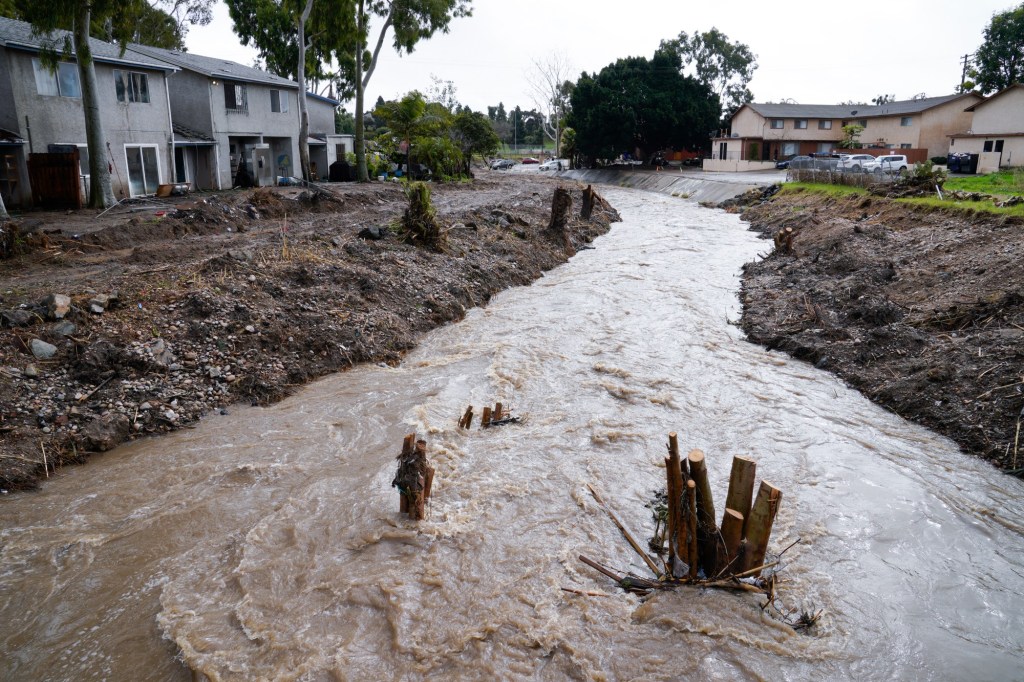
Early on New Year’s Day, people in neighborhoods along Chollas Creek awoke to flooding in their streets.
Cars were submerged up to their axles. Residents in rain boots trudged through ankle-deep water. In some areas, water flowed into homes. Some families evacuated.
“It’s only going to get worse,” one woman said to her family in a video, as they raced to their car in Shelltown.
Residents across the southeastern San Diego neighborhoods quickly reached out to their community networks for support — a familiar step at this point.
“The fear and the trauma and the flashbacks are coming back when you see all this water racing up,” said Beba Zarate, a Shelltown resident, the next day.
It’s been nearly two years since catastrophic flooding devastated San Diego communities, largely in working-class neighborhoods in the Chollas Creek watershed. Thousands of residents were displaced. Many are still recovering. And close to 2,000 are suing the city in more than 50 lawsuits, saying the city’s failure to maintain its storm channels is to blame.
Since the Jan. 22, 2024, flooding, the city’s Stormwater Department has made progress clearing its storm channels, including performing repeated maintenance on channels in Southcrest and Mountainview that were overwhelmed in 2024.
But the city is restricted by a general lack of funding for stormwater maintenance. Nearly half of its channel segments and infrastructure — including in the Los Penaquitos watershed, San Diego River watershed and Tijuana River watershed — haven’t been maintained in at least 15 years, according to recent city records.
The city cleared some sections of its storm channels this month, including in the Jamacha and Rolando neighborhoods, and cleared a few other areas in November.
But it last performed maintenance on channels in Southcrest and Mountainview back in August and October. The city says this is due to setbacks from this season’s heavy rains that began in October.
“Channel conditions must be dry and stable enough for crews and equipment to safely operate within the channels,” department spokesperson Ramon Galindo said in a statement. “San Diego has received well above average rainfall since October 2025, which delayed planned channel maintenance for multiple days in November and December.”
On Dec. 31, Galindo says, city crews were sent out on storm patrols, inspecting and cleaning drain inlets and picking up downed vegetation, including in places such as Oak Park, Grant Hill and Southcrest.
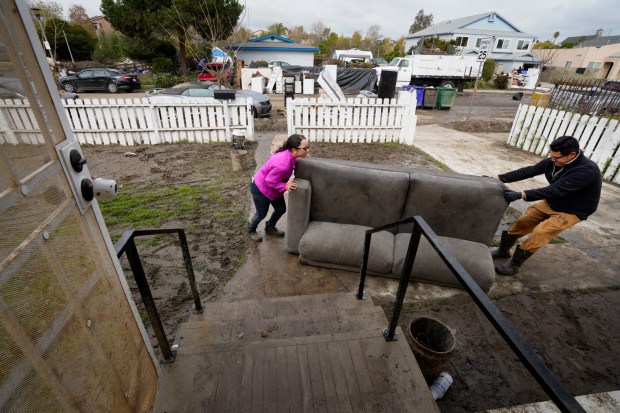 Jose and his wife Martha Navarro move wet furniture out of their home after historic floods devastated the house on Beta Street in Southcrest in January 2024. (Nelvin C. Cepeda / The San Diego Union-Tribune)
Neighborhoods like these were some of the hardest hit two years ago, but other areas were also impacted, including National City and Spring Valley.
“We’re two years here, and this is still something that is fresh,” said Lisa Sheffield, a Spring Valley resident whose home was damaged in the 2024 floods. She’s about 80% done rebuilding. “That PTSD is still there.”
And for newer residents like Ernest Smith, who moved to Oak Park six months ago, the recent flooding was a wake-up call. His aunt, who owns his apartment, warned him that the area floods during heavy rains.
“She told me not to keep anything important on the ground,” said Smith, who woke up at 6 a.m. on Jan. 1 to ankle-deep water in the home. He used heavy blankets as makeshift sandbags to try to stop the water from getting in.
Following the 2024 floods, the city’s stormwater department says it reassigned staff to help crews keep up with maintaining the roughly 18 miles of channels that it cleared — including 12 miles of channels in the Chollas Creek watershed.
In the fiscal year that ended in June, the department cleared 18,000 tons of sediment and vegetation from the city’s stormwater system, according to the city’s annual waterways maintenance report.
Still, more than 2,300 stormwater maintenance requests were filed with the city’s Get It Done app in the last year, ranging from concerns around damaged storm drain screens and corrugated metal storm drain pipes to vegetation overgrowth.
Keeping up with channel maintenance — and addressing the decades of backlogged maintenance — is a fiscal challenge for the city, with a funding shortfall of more than $6.5 billion for infrastructure needs over the next five years as of early last year. The largest chunk of that deficit by far is for stormwater needs, at nearly $4 billion.
The city’s stormwater department has an annual budget of nearly $65 million for the current fiscal year. That’s up from about $63 million the year prior but down from nearly $71 million in fiscal 2024.
The department has ambitious plans for several stormwater capital improvement projects, including 26 ongoing and future projects in the Chollas Creek Watershed. But several projects are unfunded, including a citywide flood resilience infrastructure project and another one to restore Chollas Creek at 54th Street and Euclid Avenue in Oak Park.
“The city continues to pursue long-term funding strategies for major stormwater and flood resilience projects,” the Mayor’s Office said. It added that those initiatives rely on multi-year planning and funding, such as from federal and state grants, not one-time contingency funding.
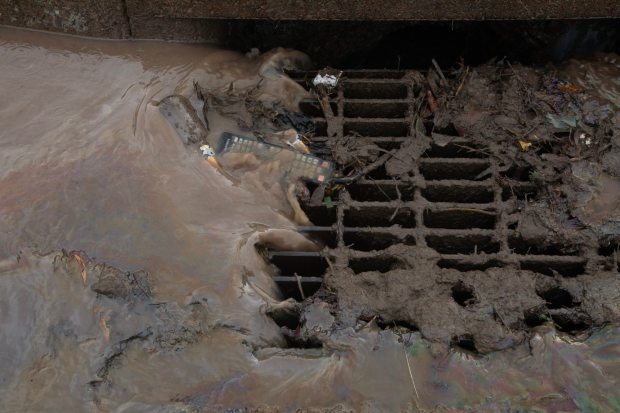 A storm drain after heavy rains caused flooding near Birch and Una Streets in Southcrest on Jan. 23, 2024, in San Diego. (Ana Ramirez / The San Diego Union-Tribune)
One project — which would improve the Beta Street Channel, the Beta Alley and Southcrest Trails Park with an estimated cost of over $100 million — is slated to get more than $1 million in federal funding, part of more than $4 million allocated for the city of San Diego this fiscal year to support four critical stormwater capital projects.
Another funding source for the department comes from a $733 million federal loan, for which the city has to match funds.
One funding source that isn’t available to the city is a dedicated tax. In 2024, city leaders explored a parcel tax to fund stormwater infrastructure but later dropped the effort, citing difficulty getting the two-thirds support it would need to pass.
In the meantime, the city has focused on clearing and maintaining critical channel sections, including those that flooded in 2024 — but 45 of its 110 waterway segments and infrastructure haven’t been maintained since before 2011.
In the past year, it has made some progress. According to city performance metrics, 79% of stormwater channels can now carry stormwater flows as originally designed, up from 71% last year. All storm drain inlets have been inspected, up from 85% the previous year.
And the number of days during the wet season, which runs from October through April, on which stormwater pump stations were fully functional rose slightly, from 86% to 90%.
Galindo says his department’s budget doesn’t allow for 100% maintenance each year, but metrics like these “reflect the priority and focus” the city has placed on storm channel maintenance over the last two years.
He adds that channel maintenance requires significant funding, including securing environmental permits and mitigation land in cases when maintenance activity impacts wetland areas. Then there’s disposal of material dredged from channels, along with equipment rental and traffic control.
The department has been pushing for its own funding to replace corrugated metal pipes, Galindo said. The city’s goal is to replace 5 miles of pipes each year, but it only replaced 1.5 miles in fiscal 2025.
Residents are eager for these infrastructure updates and more support from the city before new storms hit.
The city distributes unfilled sandbags at 11 locations, but residents say they wish the bags came filled. The city sent out 7,000 mailers in December, including with information on how to prepare for heavy rains, but residents say it would be more helpful to have tangible resources to prepare, such as an evacuation center and mental health support.
“We obviously wanted everyone to prepare. But what exactly are we preparing with?” questioned Jessica Calix, a displaced Southcrest resident. “It’s not really like practical, hands-on things.”
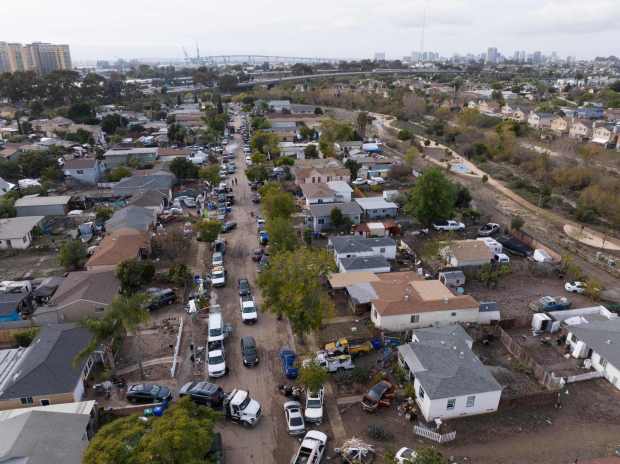 On Wednesday, Jan. 24, 2024, in San Diego, residents of Beta Street begin the cleanup from flooding. (Nelvin C. Cepeda / The San Diego Union-Tribune)
In the days and months following the 2024 flooding, the city quickly secured a disaster declaration that paved the way for federal relief. Officials helped sign up thousands of victims for federal aid, opened two relief centers and waived permit fees to help applicants rebuild.
The city and county sent about $7 million to the San Diego Housing Commission for flood recovery, including financial relief and housing aid — some of which went to the Harvey Family Foundation’s work rebuilding homes.
By the time the nonprofit’s program wrapped up last fall, it had completed construction on nearly 80 homes, according to Clariza Marin, the foundation’s chief financial officer who helped organize flood recovery efforts.
But for many people, the financial and emotional struggle continues.
Around 1,900 are suing the city — along with other public entities — for what they say is a failure to maintain the storm channels that led to the catastrophic flooding. And the city has filed more than 20 cross-complaints, including against at least two flood victims, maintaining that they bear responsibility.
A trial is set for early October. Evan Walker, one of the plaintiffs’ lawyers, expects to start seeking witnesses for deposition in March.
Some plaintiffs have said they hope to use any money they win to move to another neighborhood less prone to flooding.
“We all need to be able to move on with our lives,” Calix said.