
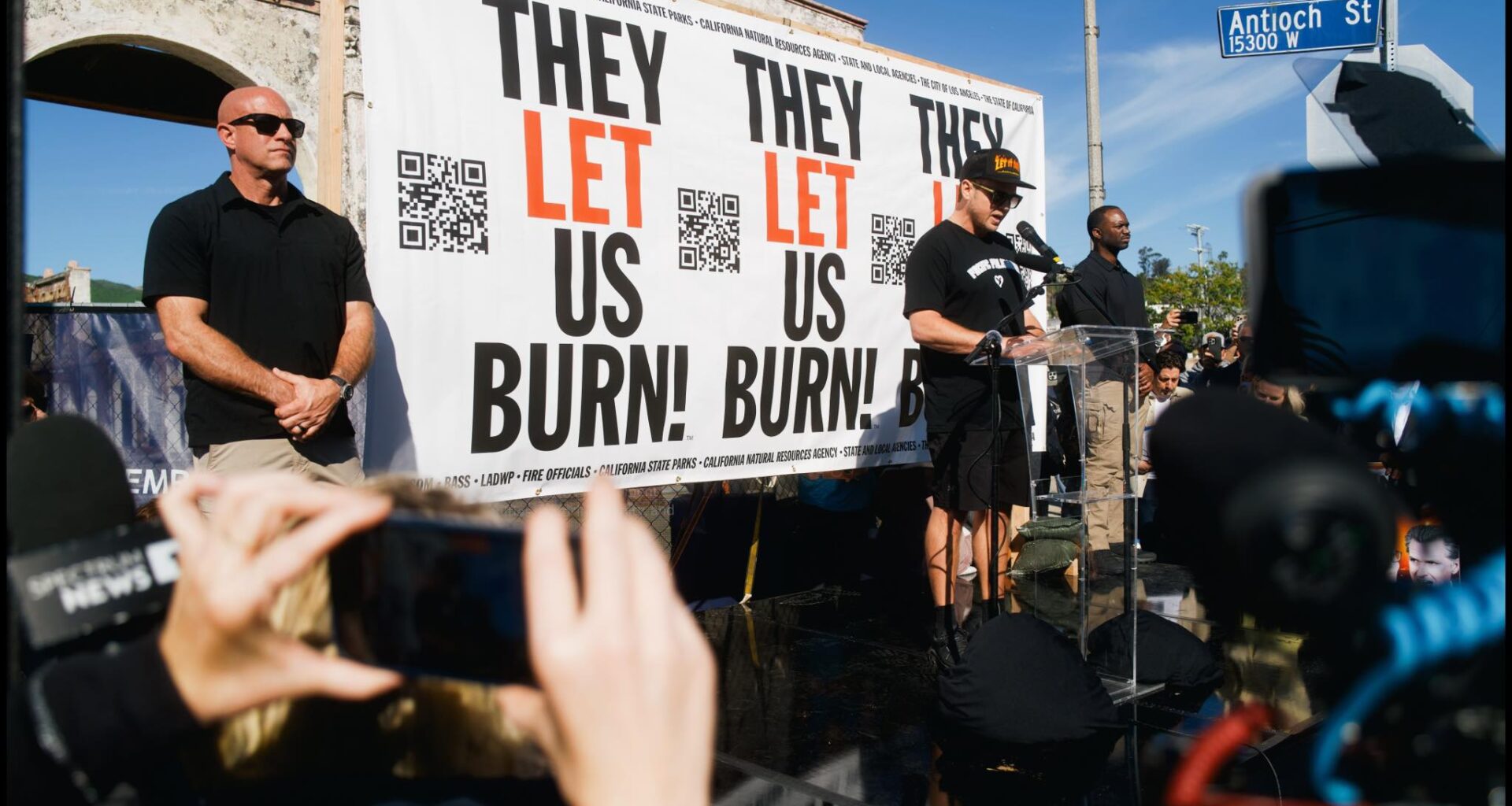
 Longtime Pacific Palisades resident and media personality Spencer Pratt speaks at the “They Let Us Burn” rally, where he announced his candidacy for mayor of Los Angeles on the one-year anniversary of the Palisades Fire, citing the disaster and its aftermath as the impetus for his campaign. Photo shared by Spencer Pratt social media.
As the community marks the anniversary of one of California’s most devastating wildfires, recovery continues and resident Spencer Pratt enters the Los Angeles mayoral race
One year after the Palisades Fire tore through the Santa Monica Mountains and forever altered the lives of thousands, the scars of one of the most destructive wildfires in California history remain deeply visible — in the landscape, in ongoing recovery efforts, and now, in the city’s political arena.
On Jan. 7, residents gathered in Pacific Palisades to mark the anniversary of the fire that ignited a week earlier and exploded under hurricane-force Santa Ana winds, ultimately killing 12 people, destroying more than 6,800 structures, and scorching more than 23,000 acres in a “They Let Us Burn” rally.
Among the speakers at the rally was longtime Palisades resident and media personality Spencer Pratt, who announced his candidacy for mayor of Los Angeles, directly linking his campaign to the fire and its aftermath.
“I chose Jan. 7 because there is a somber poetry in launching a new chapter on the anniversary of the worst day of my life — the day my town and everything my family owned burned to the ground,” Pratt said in a statement released after the rally. Pratt, 42, whose home was destroyed in the fire, framed his bid as a challenge to what he described as entrenched political leadership and systemic failures exposed by the disaster.
Pratt and his wife, Heidi Montag — both known for their appearances on the MTV reality series The Hills — documented the fire in real time, sharing videos of flames advancing toward their neighborhood and later showing the devastation left behind. Over the past year, Pratt has been a vocal critic of local and state leadership, including Los Angeles Mayor Karen Bass and Gov. Gavin Newsom, accusing officials of failing to adequately prepare for and respond to the blaze.
“Business as usual is a death sentence for Los Angeles,” Pratt told the crowd. “This isn’t just a campaign — it’s a mission.”
The Palisades Fire began in the early hours of Jan. 1, 2025, as a small brush fire near the Skull Rock Trailhead in Topanga Canyon. Initially dubbed the Lachman Fire, it burned less than half an acre and was declared suppressed. Investigators later determined that embers smoldered undetected for six days, buried deep in dry soil and root systems. On Jan. 7, powerful Santa Ana winds — forecast days in advance — reignited the fire, driving it rapidly through Pacific Palisades and into Malibu.
By the time the fire was fully contained on Jan. 31, entire neighborhoods had been reduced to ash, more than 100,000 residents were displaced, and economic losses were estimated to be the highest of any wildfire in California history.
In October, federal authorities arrested 29-year-old Jonathan Rinderknecht in Florida, charging him with arson in connection with the fire’s origin. According to federal affidavits, Rinderknecht allegedly ignited the initial blaze intentionally on New Year’s Day. Surveillance footage, cellphone data, and fire pattern analysis placed him at the ignition point shortly after midnight. Prosecutors allege his actions were reckless and malicious, and he now faces federal charges that could carry decades in prison if convicted.
The arrest brought a measure of closure for many residents, but it also reignited scrutiny of how the fire was handled in its earliest stages. On the same day as the arrest, the Los Angeles Fire Department released a 70-page After-Action Review Report examining the first 36 hours of the response. The report acknowledged that while firefighters performed heroic evacuations — saving tens of thousands of lives — procedural and systemic failures allowed the fire to resurface and grow unchecked.
According to the report, crews relied largely on visual inspections and manual checks to confirm extinguishment, rather than using thermal imaging technology that might have detected lingering heat underground. Staffing shortages, limited resources, and competing red-flag incidents across the region also contributed to the decision not to conduct extended monitoring of the initial fire area.
Interim Fire Chief Ronnie Villanueva described the incident as a “perfect storm” of human error, extreme weather, and environmental conditions worsened by prolonged drought. “While bravery and dedication were on full display, we must learn from what went wrong,” Villanueva said.
The findings have fueled ongoing lawsuits filed by fire victims against public agencies and utilities, alongside claims against the accused arsonist. Legal experts say responsibility could ultimately be shared, though arson remains the central cause under California law.
For residents, the anniversary was both a moment of remembrance and an expression of frustration. Malibu Mayor Marianne Riggins said the revelation that the fire may have been intentionally set added “another layer of pain” to a community already struggling to rebuild. “Our focus remains on getting families home and making sure this never happens again,” she said.
Against that backdrop, Pratt’s mayoral announcement underscored how deeply the fire has reshaped public trust and political discourse in Los Angeles. He joins a crowded mayoral field that includes incumbent Mayor Karen Bass, former LAUSD Superintendent Austin Beutner, and more than a dozen other candidates. The primary election is scheduled for June 2, with candidate filing set to open in early February.
Whether Pratt’s campaign gains traction remains to be seen. But one year after the Palisades Fire, the disaster continues to reverberate — as a symbol of loss, a test of government accountability, and now, a catalyst for political change in a city still grappling with how to protect its communities in an era of increasingly catastrophic wildfires.
Like this:
Like Loading…
Related