
It’s 2026, and you can play Doom II on a small computer you keep in your pocket that’s far, far more powerful than the mainframes that directed Apollo 11 to the moon and back. But in cities across the nation, do-gooders and professionals are preparing for that ritual known as the homeless point-in-time count, where they will venture out to tally homeless people by wandering around city streets with clipboards, manually counting anyone who, say, looks like Jack Dorsey.
San Francisco’s next count is coming on Jan. 29. It is a ritual with some purpose, in that it is necessary to do this to receive federal funds. But the tally is done using methods that would’ve been standard operating procedure during the crafting of the Domesday Book. Adding to the anachronistic nature of it all, this is done every other year.
That’s a hell of a way to run a railroad. But worry not: The city has announced that it will this year refine the methodology behind the homeless point-in-time count. Instead of holding the count between 8 p.m. and midnight, the small army of clipboard-toting counters will now head out between 5 a.m. and 10 a.m.
This will clear up a lot of the ambiguity about who’s homeless and who’s just out and about. Another new policy is that, this year, counters will talk to the people they’re tallying. That’s a big deal: Without a conversation, you might indeed count Jack Dorsey (net worth: $3.9 billion) as homeless.
With the benefit of conversation, counters should do better at discerning between a homeless person in the Tenderloin and a formerly homeless person in the Tenderloin who lives in an SRO and likes to go outside for a walk sometimes.
But, truth be told, these shifts in the city’s point-in-time count methodology are a bit like the Ford Motor Company rolling out a better horse and buggy at the 2026 Detroit Auto Show. The city’s count protocol displays both a deeply antiquated way of thinking about who is homeless and an even more deeply antiquated way of tabulating that number.
Other cities held their counts at more suitable hours years ago. San Francisco, however, took its time doing the same because it was thought to be methodologically desirable to keep making the same mistakes for consistency’s sake. It’s perverse, but when you get better at counting, you can no longer confidently compare your numbers from this year to the ones two years ago and the ones two years before that.
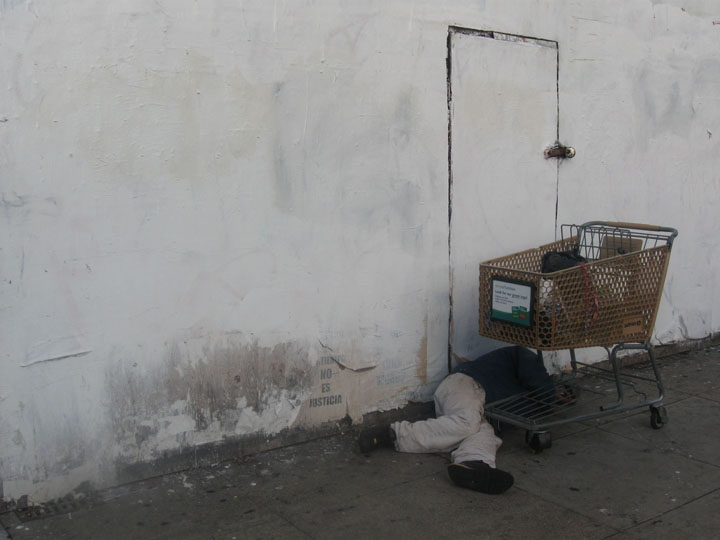 Near 26th and Mission streets, September 2011
Here’s some halfway decent news: This isn’t the only means of tracking homelessness. City government is already measuring that in more sophisticated ways.
San Francisco, like every city, compiles scads of data and sends it to the feds. We know how many people are accessing shelter and services. Unless they’re ninjas who make it very hard to be seen, we know who they are.
That is partly why nobody in homeless services in San Francisco takes the point-in-time count all that seriously as a management tool. Truth be told, the real number of people who were homeless in San Francisco is far, far higher than the 8,323 people counted during the point-in-time count on the single night of Jan. 30 2024.
The number of people who experience homelessness at some point during the year and seek shelter or services is consistently about three times whatever the point-in-time tally is. That’s the real number.
But many officials in San Francisco — and quite a few media outlets — remain hung up on the count. Homelessness is a messy and complicated issue, but a single, overarching number is not complicated.
For a government official, if number goes up, you’ve failed. If number goes down, you’ve succeeded. If number goes up by less than counts in other major cities, you’ve kinda-sorta succeeded; losing by less is the new winning.
For the media, Number go up or Number go down is an easy story and an easy headline. Ignoring distinctions between people on the street or in shelter, people in vehicles, individuals and families and children and simply coming up with an ur-homeless number, in the end, is leaving people less informed, not more.
In 2019, your humble narrator wrote a column about the homeless point-in-time count titled “In San Francisco, we obsess over contrived homeless stats — and neglect the ones we really ought to know.” A lot has changed since then, but the central conceit of that column remains. There are, believe it or not, beneficial uses for the biennial homeless point-in-time count — in addition to being a requirement to receive federal funding, which it is.
The point-in-time count isn’t useful for determining overarching homeless numbers. But it is useful for ferreting out patterns in distinct communities. You can spot cars and RVs and tents a lot easier than someone (a ninja?) hiding in the dark. You can discern and begin to quantify trends, like the explosion in RVs. This year, the point-in-time count will all but certainly record a sharp reduction in tents.
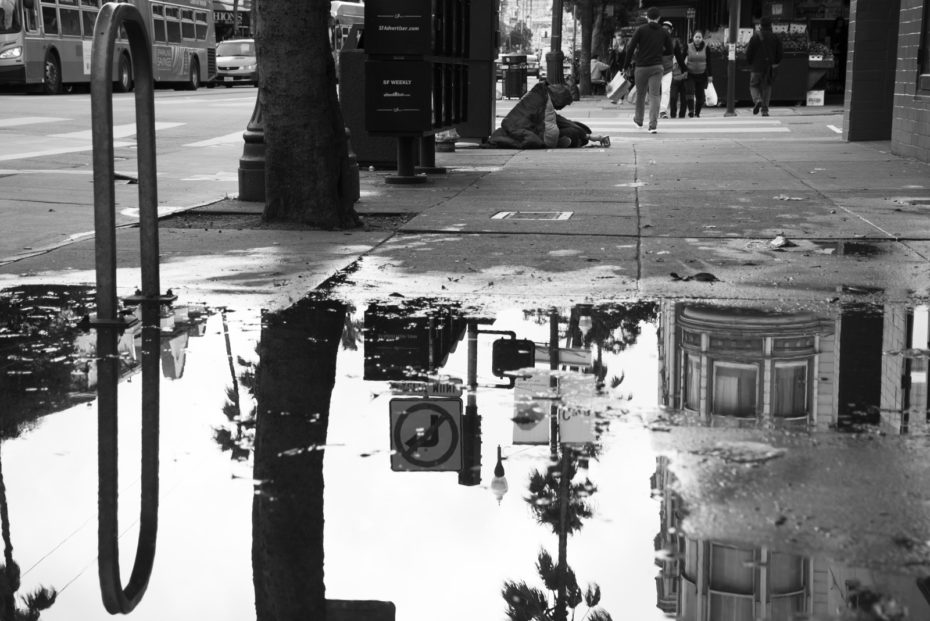 Mission and 23rd, January 2017. Photo by Lola M. Chavez
Are there more homeless people in recent years or is San Francisco just getting better at counting? The answer is “yes.” While the city resisted intuitive changes in counting methodology, like operating at more sensible hours and actually talking to people, in recent years the city did become much more thorough in counting people in jails, shelters and even hard-to-reach places like the federal Golden Gate National Recreation Area or land owned by Caltrans.
It is unambiguously good to have accurate tallies of homeless people in shelters and jails — especially if you can begin connecting them to services before release instead of just expelling them into street homelessness. San Francisco, in recent years, even tallied homeless people who, by federal definition, would not be homeless: That’s incarcerated people, but also people in treatment facilities or hospitals.This, again, is a good thing to do if you’re actually interested in identifying and helping vulnerable people.
But, predictably, this resulted in larger tallies of homeless people, which were compared, apples-to-oranges, to earlier homeless counts that did not include these people, and loud headlines about spiking homelessness.
Alas. No good deed goes unpunished. Count on it.