
Budget analysts for San Diego say city officials should demand big changes at the cash-strapped County Water Authority, including a thorough re-thinking of its entire operations and urgent action on out-of-state water sales.
The recommendations come with the city facing cumulative water rate hikes of 90% over six years, and the water authority predicting it will need to increase the rates it charges the city and other local agencies 100% to 150% by 2035.
Those hefty rate hikes could possibly shrink substantially if the water authority limits large capital projects, reduces operating expenses and finds a way to “right size” its water supply, according to the city’s independent budget analyst.
The fundamental problem facing the water authority is that it’s contractually obligated to buy more water than its member agencies typically need, forcing it to raise rates to cover its built-in costs.
Those increases essentially get passed on to local water agencies, including the city of San Diego, which must increase their rates accordingly.
The water authority is contractually obligated to buy 325,700 acre feet of water per year, primarily from the Colorado River and the Carlsbad Desalination Plant. Local water sales by the authority, which dropped to 323,781 acre feet last year, have continued to steadily dwindle.
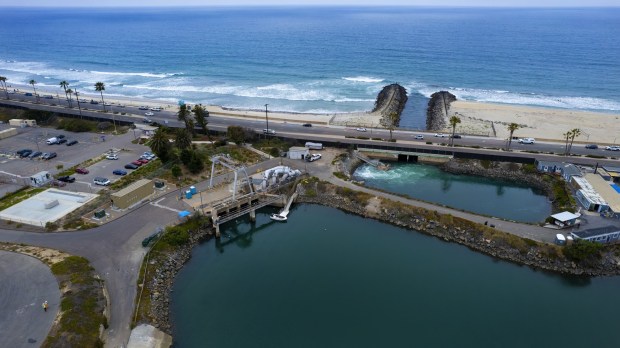 The Carlsbad Desalination Plant on Tuesday, June 7, 2022 in Carlsbad, CA. (Nelvin C. Cepeda / UT file)
While the mayor and City Council often complain publicly about the water authority and urge its leaders to make changes, the new set of recommendations from the IBA suggests a more direct route.
The city controls 10 of the 34 seats on the water authority’s board, allowing the city to play a key role in its management decisions.
The recommendations, which were written by the IBA’s Jordan More, are characterized as marching orders for the “city 10” when the water authority launches its 2026 legislative calendar this Thursday.
One key recommendation is that the city 10 demand the water authority create a new business plan within one year.
Such a fundamental move would “critically evaluate CWA operations and provide options to help guide the organization towards a path to sustainability given declining regional demand,” More said.
The new business plan should evaluate a proposed new operations site, the future of the Twin Oaks Treatment Plant, future reservoir projects and other initiatives, More said.
More stressed that San Diego water officials have already postponed major infrastructure projects three years to save money and shrink rate hikes, contending it wouldn’t be too much to ask the water authority to follow suit.
More noted that the Metropolitan Water District, which faces some of the same challenges as the water authority, recently began updating its business plan.
Another key recommendation for the city 10 is demanding that the water authority negotiate deals to sell excess water to agencies outside the region – most likely out of state – within one year.
More said timing is crucial on such deals, which CWA officials have already agreed to solicit.
“This next year will be vital in securing a deal to offload water supplies as each of the region’s water recycling projects is projected to start producing water in the next 18 months,” said More, referring to sewage recycling projects in Oceanside, East County and San Diego.
More said the water authority deserves credit for making some notable budget cuts and reaching a legal settlement with the Metropolitan Water District that allows out-of-state sales.
But he said bigger moves are needed.
“Although progress has begun, more rapid and holistic changes are needed quickly to have a lasting and dramatic impact on rates,” More said.
More said one reason for optimism is that the water authority’s long-range financial plan, the document predicting rate increases as large as 150% by 2035, doesn’t include any water sales to outside agencies and doesn’t include any sort of dramatic changes to the authority’s operations.
The city 10 includes Nick Serrano, City Councilmember Stephen Whitburn, Jimmy Ayala, Jim Madaffer, Venus Molina, Jerry Butkiewicz, Ismahan Abdullahi, Tim Douglass, Lois Fong-Sakai and Val Macedo.