
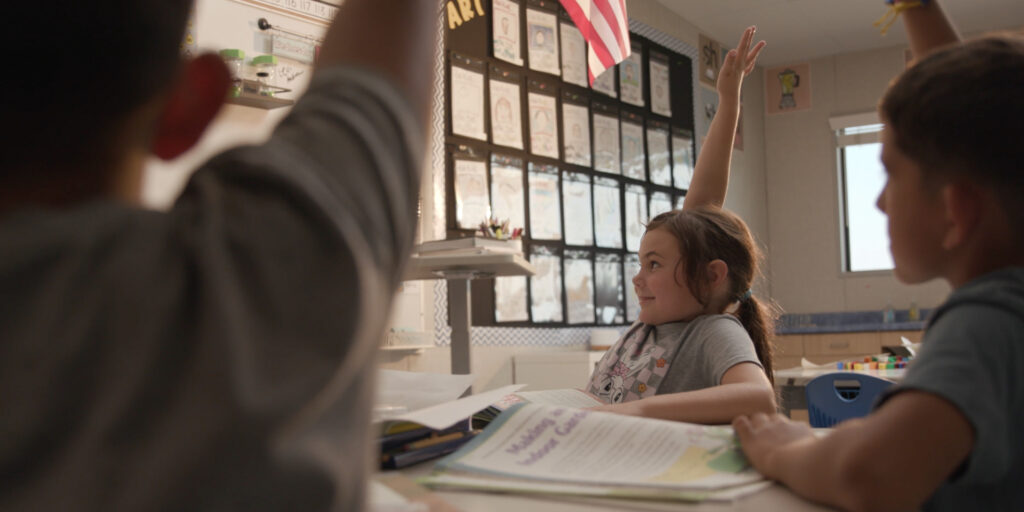
Second grade students in Maple Elementary.
Courtesy of Maple Elementary
Over the past two decades, educational technology has fundamentally reshaped teaching and learning. Digital tools have transformed instructional delivery, assessment, intervention and access to resources for students with diverse needs. As an educator who has taught at the elementary, middle and high school levels, I recognize the powerful benefits technology can offer classrooms.
However, there is an emerging imbalance in today’s classrooms that deserves closer attention.
In my current roles as superintendent of a small rural district and a board member of a large district serving nearly 20,000 students, I regularly visit classrooms and speak with educators and students. One reality is unmistakable: Students are spending a significant portion of their school day on screens.
Since the pandemic, classroom technology use has accelerated dramatically. I vividly recall in 2020 helping my 5-year-old son learn to navigate a Chromebook when kindergarten went virtual, an experience that felt developmentally premature. Today, it is extremely common to see transitional kindergarten and kindergarten students wearing headphones and working independently on devices, or high school students logging into learning management systems to complete digital modules with minimal face-to-face interaction. Whether viewed positively or negatively, this is the current reality of education. With continued growth in educational technology and the integration of artificial intelligence, technology is clearly here to stay.
The question, then, is not whether technology belongs in classrooms, but how much is too much. Effective instruction requires a balance between traditional methods and digital engagement. In both districts where I serve, we are focused on finding a balance. In fact, the Maple School District has launched efforts this year to reduce classroom screen time by 20%. We are doing this by prioritizing paper-based reading, eliminating unstructured device use, and expanding hands-on learning and student interaction. Teachers have been supported through mini-grants to purchase materials for unstructured time, and the Expanded Learning Opportunities Program (ELOP) limits screen use to homework needs only. Together, these efforts are driving measurable improvements in academic performance and overall student climate.
Evidence for this needed balance lies in the data of student health outcomes and students’ “outside school” screen time consumption. Outside of school, students already experience significant screen exposure, with 40% of children having a tablet by age 2 and 1 in 4 having a personal smartphone by age 8. Screen time consumption for our students is already a losing battle outside the classroom. A similar report in 2022 found that students ages 8 to 18 average between 5.5 to 8.3 hours of daily screen time.
The physical and mental health implications are increasingly concerning. Peer-reviewed studies consistently link excessive screen time to higher rates of nearsightedness in children, a trend confirmed by rising diagnoses in countries that conduct early vision screenings. Medical experts also point to increases in posture-related and back pain issues associated with prolonged sedentary device use. Additionally, digital fatigue, manifesting as irritability, decreased focus and reduced engagement, undermines learning and classroom climate.
These unintended consequences call for thoughtful, statewide action. California education and legislative leaders have the opportunity to lead by addressing classroom screen time in ways that protect student mental and physical health while preserving the instructional benefits of technology. Three policy areas are particularly critical in addressing the need for screen time balance.
First, California credentialing standards should be updated to emphasize balanced instructional practices. Teacher preparation programs must explicitly address how to integrate technology while protecting students’ physical and mental well-being. Clarifying “student well-being” within the California Standards for the Teaching Profession to include balanced technology use would better prepare educators for modern classrooms.
Second, schools must partner with families to promote healthy digital habits. Despite the prevalence of technology in students’ lives, there are currently no requirements for the distribution of resources on healthy digital use. While the California Department of Education recommends a limited number of resources, more consistent, relevant, research-based materials shared through parent engagement platforms would strengthen home and school partnerships and support healthier student outcomes.
Finally, California education policy should include age-appropriate classroom screen time recommendations. The American Academy of Pediatrics has called for updated guidelines to support safe and productive media use. With a growing body of scientific research offering clear, age-based recommendations, these guidelines should be reflected in district board policies and administrative regulations governing the use of technology.
California has taken positive steps toward greater accountability for personally owned devices in classrooms. The next step is to make sure that devices provided by our educational institutions are used intentionally and in the service of student well-being.
•••
Bryan Easter is the superintendent of the Maple School District and a school board trustee representing the Panama Buena Vista Union School District, both located in Kern County.
The opinions expressed in this commentary represent those of the author. EdSource welcomes commentaries representing diverse points of view. If you would like to submit a commentary, please review our guidelines and contact us.