
The vast majority of the customers enrolled in San Diego Community Power will pay less for energy generation in 2026 compared to San Diego Gas & Electric, but they will still feel the pinch of overall higher utility bills this year.
All seven board members of Community Power voted last week to approve a new rate structure for the more than 955,000 customers the agency serves in San Diego, Chula Vista, La Mesa, Encinitas, National City, Imperial Beach and the unincorporated areas of San Diego County.
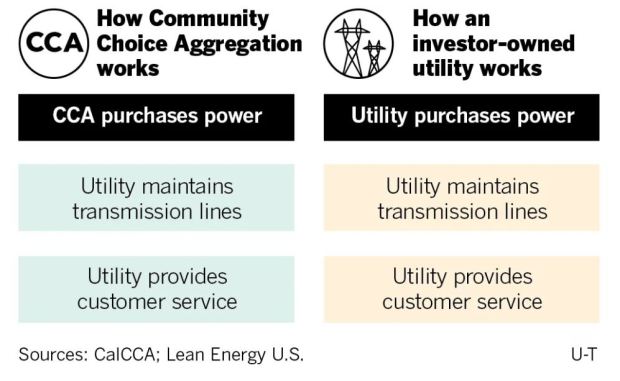
San Diego Community Power is one of 25 community choice aggregation, or CCA, energy programs that have sprung up across California in recent years. CCAs are designed to compete with traditional utilities like SDG&E and offer less carbon-intensive power sources in their respective municipalities.
The incumbent utilities still take on all the responsibilities outside of purchasing power — such as delivering electricity via transmission and distribution lines; maintaining poles and wires; and handling customer services, including billing.
 The San Diego Union-Tribune
Under the new rate structure, total generation costs for Community Power residential customers enrolled in its PowerOn program will be 3.48% lower compared to SDG&E’s 2026 generation costs.
PowerOn is the default program offered by Community Power and 844,557 of its residential customers are enrolled it.
PowerOn pledges to have a renewable energy portfolio of 53%, plus 2% from carbon-free sources such as hydroelectricity. By comparison, SDG&E’s renewable portfolio stands at 41%.
Community Power also offers a program called PowerBase that has lower renewable energy content of 45%. Under the rate structure approved Thursday, the PowerBase generation cost for residential customers this year will be 9.25% less expensive than SDG&E’s.
Some 4,535 residential customers are on the PowerBase plan.
Community Power officials say the respective 3.48% and 9.25% figures represent the biggest generation discounts compared to SDG&E in the agency’s five-year history.
“One of our goals as a not-for-profit is to make electricity as affordable as we can even despite the challenges of a volatile energy market,” Community Power CEO Karin Burns, said in a statement.
Community Power offers another option for customers who want to enroll in generation that pencils out to 100% renewable and carbon-free sources of energy. But it’s more expensive than PowerOn and PowerBase.
Under the new 2026 rates, residential customers in the Power100 program will pay 2.2% more for generation compared to SDG&E. About 26,000 Community Power customers are enrolled in Power100.
The agency’s staff said the rate adjustment “creates an opportunity to balance the need for affordability for our customers while also stabilizing” its reserves. Community Power officials aim to have 225 to 270 days of cash on hand, establish a rate stabilization reserve to insulate customers from energy price swings and bolster financial metrics so it can negotiate better terms on power purchase agreements.
But even with the generation discounts, overall monthly bills — that include all items such as transmission, distribution and other assorted costs — keep rising.
According to Community Power’s figures, last year at this time the average SDG&E residential customer using 334 kilowatt-hours of electricity paid a total monthly bill of $133.52. This year, that figure is $164.69 for a customer using 341 kilowatt-hours — some $31 more.
Community Power residential customers on the PowerOn program paid an estimated $132 at this time last year, but the 2026 overall monthly bill is projected to come to $162.59 — in increase of just over $30.
By Community Power’s reckoning, PowerBase residential customers will pay $159.13 a month, which is $28 more than last year. Those on Power100 will pay $166, which is almost $31 higher.
“Costs for just about everything continue to climb, so Community Power designed these rates to blunt the impact for as many customers as possible,” Burns said.
Community Power customers who want to switch to the lowest-cost PowerBase plan can do so by going to the agency’s website, sdcommunitypower.org/powerbase/ or calling its Contact Center at 888-382-0169 on weekdays between 8 a.m. and 5 p.m.
There is one other CCA in the San Diego region — the Clean Energy Alliance, which handles more than 255,000 customer accounts in Carlsbad, Del Mar, Escondido, Oceanside, San Marcos, Solana Beach and Vista.
The Clean Energy Alliance’s first board meeting of the year, in which 2026 rates are expected to be discussed, will be Jan. 29.